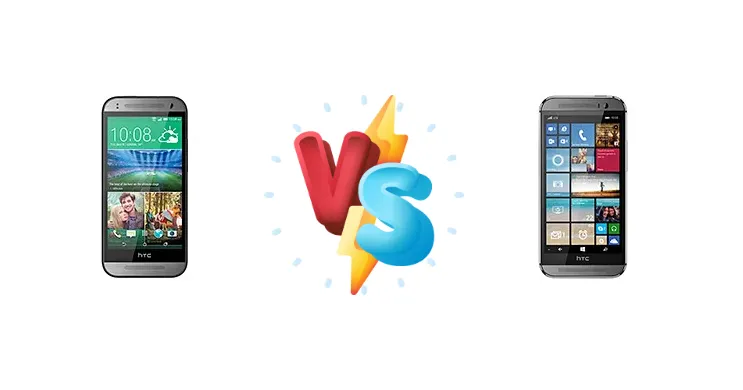
The HTC One series was a landmark in smartphone design, but the Mini 2 and the M8 for Windows catered to different needs. This comparison dives deep into their specifications and performance to help you decide which device best suits your requirements, especially considering their age.
🏆 Quick Verdict
The HTC One (M8) for Windows offers significantly better performance thanks to its Snapdragon 801 chipset. While the Mini 2 boasts impressive battery life, the M8's superior processing power and features make it the overall winner for users prioritizing speed and capabilities, despite the Windows OS limitation.
| Network |
|---|
| 2G bands | GSM 850 / 900 / 1800 / 1900 | GSM 850 / 900 / 1800 / 1900 |
| 3G bands | HSDPA 900 / 1900 / 2100 - EMEA version | - |
| 4G bands | 3, 7, 8, 20 - EMEA version | - |
| EDGE | - | Yes |
| GPRS | - | Yes |
| Speed | HSPA 42.2/5.76 Mbps, LTE Cat4 150/50 Mbps | HSPA, LTE Cat4 150/50 Mbps, EV-DO Rev.A 3.1 Mbps |
| Technology | GSM / HSPA / LTE | GSM / CDMA / HSPA / EVDO |
| | - | 3, 4, 7, 13 - Verizon |
| Launch |
|---|
| Announced | 2014, May. Released 2014, May | 2014, August. Released 2014, September |
| Status | Discontinued | Discontinued |
| Body |
|---|
| Dimensions | 137.4 x 65 x 10.6 mm (5.41 x 2.56 x 0.42 in) | 146.4 x 70.6 x 9.4 mm (5.76 x 2.78 x 0.37 in) |
| SIM | Nano-SIM | Nano-SIM |
| Weight | 137 g (4.83 oz) | 160 g (5.64 oz) |
| Display |
|---|
| Protection | Corning Gorilla Glass 3 | To be confirmed |
| Resolution | 720 x 1280 pixels, 16:9 ratio (~326 ppi density) | 1080 x 1920 pixels, 16:9 ratio (~441 ppi density) |
| Size | 4.5 inches, 55.8 cm2 (~62.5% screen-to-body ratio) | 5.0 inches, 68.9 cm2 (~66.7% screen-to-body ratio) |
| Type | Super LCD2 | Super LCD3 |
| Platform |
|---|
| CPU | Quad-core 1.2 GHz Cortex-A7 | Quad-core 2.3 GHz Krait 400 |
| Chipset | Qualcomm Snapdragon 400 (28 nm) | Qualcomm MSM8974AB Snapdragon 801 (28 nm) |
| GPU | Adreno 305 | Adreno 330 |
| OS | Android 4.4.2 (KitKat), Sense UI | Microsoft Windows Phone 8.1.1 |
| Memory |
|---|
| Card slot | microSDXC (dedicated slot) | microSDXC (dedicated slot) |
| Internal | 16GB 1GB RAM | 32GB 2GB RAM |
| | - | eMMC 5.0 |
| Main Camera |
|---|
| Features | LED flash, HDR, panorama | Dual-LED dual-tone flash, panorama, HDR |
| Single | 13 MP, 1/3.1", 1.12µm, AF | 4 MP, f/2.0, 27mm (wide), 1/3.0", 2µm, AF
Auxiliary lens |
| Video | 1080p@30fps, 720p@60fps | 1080p@60fps, 720p@60fps, HDR, stereo sound rec. |
| Selfie camera |
|---|
| Features | - | HDR |
| Single | 5 MP | 5 MP |
| Video | 1080p@30fps | 1080p@30fps |
| Sound |
|---|
| 3.5mm jack | Yes | Yes |
| 35mm jack | Yes | Yes |
| Loudspeaker | Yes, with stereo speakers | Yes, with stereo speakers |
| Comms |
|---|
| Bluetooth | 4.0, A2DP, aptX | 4.0, A2DP, aptX |
| Infrared port | - | Yes |
| NFC | Yes | Yes |
| Positioning | GPS, GLONASS | GPS, GLONASS |
| Radio | FM radio, RDS | Stereo FM radio, RDS |
| USB | microUSB 2.0, OTG | microUSB 2.0 |
| WLAN | Wi-Fi 802.11 a/b/g/n, dual-band, DLNA, hotspot | Wi-Fi 802.11 a/b/g/n/ac, dual-band, Wi-Fi Direct, DLNA, hotspot |
| Features |
|---|
| Sensors | Accelerometer, proximity, compass | Accelerometer, gyro, proximity, compass, barometer |
| Battery |
|---|
| Stand-by | Up to 556 h (3G) | Up to 387 h |
| Talk time | Up to 16 h 10 min (3G) | Up to 24 h |
| Type | Li-Po 2110 mAh, non-removable | Li-Ion 2600 mAh, non-removable |
| Misc |
|---|
| Colors | Gunmetal Gray, Glacial Silver Amber Gold | Gunmetal Gray |
| Models | One mini 2 | - |
| Price | About 250 EUR | About 300 EUR |
| Tests |
|---|
| Audio quality |
Noise -94.8dB / Crosstalk -93.5dB | - |
| Battery life |
Endurance rating 50h
| - |
| Camera |
Photo / Video | - |
| Display |
Contrast ratio: 1196 (nominal), 1.940 (sunlight) | - |
| Loudspeaker |
Voice 69dB / Noise 66dB / Ring 75dB
| - |
| Performance |
Basemark X: 1650 | - |
HTC One mini 2
- Excellent battery life
- Compact and lightweight design
- Good sunlight display visibility
- Affordable
- Lower performance compared to flagship devices
- Limited software updates
- Basic camera features
HTC One (M8) for Windows (CDMA)
- Powerful Snapdragon 801 processor
- Premium design and build quality
- Duo Camera with depth-sensing features
- Higher resolution display
- Windows Phone operating system (limited app availability and support)
- Potentially shorter battery life
- CDMA-only (limited carrier compatibility)
Display Comparison
Both phones feature respectable displays for their time. The HTC One Mini 2's contrast ratio of 1196 (nominal) and 1.940 (sunlight) suggests good visibility even in bright conditions. The HTC One (M8) had a 5.0-inch Super LCD3 display with Full HD resolution (1080 x 1920 pixels), offering a sharper image. While specific contrast ratio data for the M8 is unavailable, its higher resolution and Super LCD3 technology likely provided a more vibrant and detailed visual experience.
Camera Comparison
Camera specifications are not fully detailed for both devices. However, the HTC One (M8) was known for its Duo Camera setup, offering depth-sensing capabilities and creative photo effects. The Mini 2's camera, while functional, likely lacks the advanced features and image quality of the M8. Both phones offered Photo/Video capabilities.
Performance
The HTC One (M8) for Windows clearly takes the lead in performance. Its Qualcomm Snapdragon 801 (2.3 GHz Krait 400) chipset is significantly faster than the HTC One Mini 2's Snapdragon 400 (1.2 GHz Cortex-A7). This translates to smoother multitasking, faster app loading times, and better gaming performance on the M8. The Mini 2 is adequate for basic tasks but will struggle with demanding applications.
Battery Life
The HTC One Mini 2 shines in battery life, boasting an endurance rating of 50 hours. This is a significant advantage over the HTC One (M8), which likely had a shorter battery life due to its more powerful processor and larger display. While specific battery capacity figures are missing, the Mini 2's endurance rating indicates exceptional power efficiency.
Buying Guide
The HTC One Mini 2 is ideal for budget-conscious users who prioritize long battery life and a compact form factor. It's a good choice for basic tasks and media consumption. The HTC One (M8) for Windows is suited for users who appreciate a premium design and powerful performance, and who are comfortable with the Windows Phone operating system (though software support is likely limited now).
Frequently Asked Questions
❓ Is the HTC One (M8) for Windows still worth buying?
It depends. If you're a Windows Phone enthusiast and can find one at a very low price, it might be interesting for its hardware. However, be aware of the limited software support and app availability.
❓ Which phone has better performance?
The HTC One (M8) for Windows has significantly better performance due to its more powerful Snapdragon 801 processor.