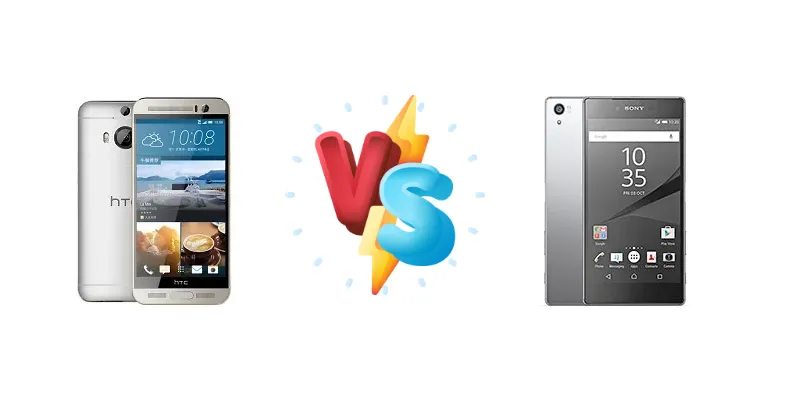
Released in 2015, the HTC One M9+ Supreme Camera and Sony Xperia Z5 Premium represented the pinnacle of Android flagship design. While both aimed for premium experiences, they took different approaches to achieving it. The M9+ focused on camera enhancements with a Mediatek chipset, while the Z5 Premium boasted a cutting-edge Snapdragon processor and a high-resolution display. This comparison dissects their strengths and weaknesses to determine which device holds up better today.
🏆 Quick Verdict
For the average user seeking a balance of features and performance, the Sony Xperia Z5 Premium emerges as the stronger choice. Its Snapdragon 810 chipset, coupled with Quick Charge 2.0 support, provides a more robust and efficient experience than the Mediatek Helio X10-powered HTC One M9+. While both offer similar battery endurance ratings, the Z5 Premium’s faster charging is a significant advantage.
| Network |
|---|
| 2G bands | GSM 850 / 900 / 1800 / 1900 | GSM 850 / 900 / 1800 / 1900 |
| 3G bands | HSDPA 850 / 900 / 1900 / 2100 | HSDPA 850 / 900 / 1900 / 2100 - E6853 |
| 4G bands | 1, 3, 5, 7, 8, 28, 38, 39, 40, 41 | 1, 2, 3, 4, 5, 7, 8, 12, 17, 20, 28, 38, 40 - E6853 |
| Speed | HSPA 42.2/21.1 Mbps, LTE (2CA) Cat6 300/50 Mbps | HSPA 42.2/5.76 Mbps, LTE Cat6 300/50 Mbps |
| Technology | GSM / HSPA / LTE | GSM / HSPA / LTE |
| Launch |
|---|
| Announced | 2015, September. Released 2015, October | 2015, September 02. Released 2015, November 05 |
| Status | Discontinued | Discontinued |
| Body |
|---|
| Build | - | Glass front, glass back, aluminum frame |
| Dimensions | 151 x 72 x 9.6 mm (5.94 x 2.83 x 0.38 in) | 154.4 x 75.8 x 7.8 mm (6.08 x 2.98 x 0.31 in) |
| SIM | Nano-SIM | Nano-SIM |
| Weight | 168 g (5.93 oz) | 180 g (6.35 oz) |
| | - | IP68 dust/water resistant (up to 1.5m for 30 min) |
| Display |
|---|
| Protection | - | Scratch-resistant glass, oleophobic coating |
| Resolution | 1440 x 2560 pixels, 16:9 ratio (~565 ppi density) | 2160 x 3840 pixels, 16:9 ratio (~806 ppi density) |
| Size | 5.2 inches, 74.5 cm2 (~68.6% screen-to-body ratio) | 5.5 inches, 82.4 cm2 (~70.4% screen-to-body ratio) |
| Type | Super LCD3 | IPS LCD |
| | - | Runs at 1080 x 1920 pixels except for select use cases |
| Platform |
|---|
| CPU | Octa-core 2.2 GHz Cortex-A53 | Octa-core (4x1.5 GHz Cortex-A53 & 4x2.0 GHz Cortex-A57) |
| Chipset | Mediatek MT6795T Helio X10 (28 nm) | Qualcomm MSM8994 Snapdragon 810 (20 nm) |
| GPU | PowerVR G6200 | Adreno 430 |
| OS | Android 5.2 (Lollipop), Sense UI 7 | Android 5.1.1 (Lollipop), upgradable to 7.0 (Nougat) |
| Memory |
|---|
| Card slot | microSDXC (dedicated slot) | microSDXC (dedicated slot) |
| Internal | 32GB 3GB RAM | 32GB 3GB RAM |
| | - | eMMC 5.0 |
| Main Camera |
|---|
| Dual | - | 48 MP, f/1.8, (wide), 1/2.0", 0.8µm, PDAF
2 MP, f/2.4, (depth) |
| Features | Laser AF, Dual-LED dual-tone flash, HDR, panorama | LED flash, HDR, panorama |
| Single | 21 MP, f/2.2, 27mm (wide), OIS | 23 MP, f/2.0, 24mm (wide), 1/2.3", PDAF |
| Video | 4K@30fps, 1080p@60fps, 720p@120fps, HDR, stereo sound rec. | 4K@30fps, 1080p@60fps, 720p@120fps, HDR |
| Selfie camera |
|---|
| Features | HDR | HDR |
| Single | 4 MP, f/2.0, 27mm (wide), 1/3", 2µm | 5.1 MP, f/2.4 |
| Video | 1080p@30fps | 1080p@30fps |
| Sound |
|---|
| 3.5mm jack | - | Yes |
| 35mm jack | Yes | Yes |
| Loudspeaker | Yes, with stereo speakers | Yes, with stereo speakers |
| | - | 24-bit/192kHz audio
|
| Comms |
|---|
| Bluetooth | 4.1, A2DP, aptX | 4.1, A2DP, aptX |
| Infrared port | Yes | - |
| NFC | Yes (market/operator dependent) | Yes |
| Positioning | GPS, GLONASS, BDS | GPS, GLONASS/ BDS (market dependant) |
| Radio | Stereo FM radio, RDS | FM radio, RDS |
| USB | microUSB 2.0 (MHL 2 TV-out), OTG | microUSB 2.0 (MHL 3 TV-out), OTG |
| WLAN | Wi-Fi 802.11 a/b/g/n/ac, dual-band, Wi-Fi Direct, DLNA, hotspot | Wi-Fi 802.11 a/b/g/n/ac, dual-band, Wi-Fi Direct, DLNA, hotspot |
| Features |
|---|
| Sensors | Fingerprint (front-mounted), accelerometer, gyro, proximity, compass | Fingerprint (side-mounted), accelerometer, gyro, proximity, compass, barometer |
| | - | ANT+ |
| Battery |
|---|
| Charging | - | 18W wired, QC2 |
| Stand-by | Up to 598 h (2G) / Up to 626 h (3G) | - |
| Talk time | Up to 23 h (2G) / Up to 13 h (3G) | - |
| Type | Li-Po 2840 mAh, non-removable | Li-Ion 3430 mAh, non-removable |
| Misc |
|---|
| Colors | Gunmetal Gray, Silver Gold, Amber Gold | Chrome, Black, Gold, Pink |
| Models | - | E6853, SO-03H |
| Price | About 480 EUR | About 190 EUR |
| SAR | - | 0.43 W/kg (head) 0.81 W/kg (body) |
| SAR EU | - | 0.47 W/kg (head) 0.47 W/kg (body) |
| Tests |
|---|
| Audio quality | - |
Noise -95.9dB / Crosstalk -95.5dB |
| Battery life | - |
Endurance rating 66h
|
| Camera | - |
Photo / Video |
| Display | - |
Contrast ratio: 966 (nominal), 2.525 (sunlight) |
| Loudspeaker | - |
Voice 66dB / Noise 65dB / Ring 66dB
|
| Performance | - |
Basemark OS II 2.0: 1687Basemark X: 24281 |
HTC One M9+ Supreme Camera
- Potentially refined camera software (depending on user preference)
- Slightly higher CPU clock speed on paper
- Premium build quality (typical of HTC)
- Less efficient Mediatek Helio X10 chipset
- No fast charging support
- Potential for thermal throttling under heavy load
Sony Xperia Z5 Premium
- More powerful Snapdragon 810 processor
- 18W Quick Charge 2.0 support for faster charging
- Sony’s TRILUMINOS display technology for vibrant colors
- Snapdragon 810 known for potential throttling
- Camera processing can be overly saturated for some users
- Larger size and weight compared to some competitors
Display Comparison
Both the HTC One M9+ and Sony Xperia Z5 Premium share a nominal contrast ratio of 966, improving to 2.525 in sunlight, suggesting similar outdoor visibility. However, the Z5 Premium’s display technology likely benefits from Sony’s TRILUMINOS display engine, offering a wider color gamut. While specific panel types aren't detailed, the Z5 Premium’s focus on visual fidelity suggests a more advanced display calibration. The M9+’s display specs are less emphasized, indicating it may not have been a primary selling point.
Camera Comparison
Both devices are marketed with a focus on camera capabilities, but details are limited. The 'Supreme Camera' branding of the M9+ suggests software optimizations and potentially a larger sensor than the standard M9. However, without specific sensor size or aperture information, it’s difficult to assess its advantage. The Z5 Premium’s camera is known for its image processing, often producing vibrant, saturated images. The lack of detail regarding OIS or specific lens characteristics makes a direct comparison challenging, but Sony’s expertise in image sensors gives the Z5 Premium an edge in overall image quality and features.
Performance
The core difference lies in the chipsets. The Sony Xperia Z5 Premium’s Qualcomm MSM8994 Snapdragon 810, built on a 20nm process, features a heterogeneous octa-core CPU with both Cortex-A53 (1.5 GHz) and Cortex-A57 (2.0 GHz) cores. This architecture allows for efficient task allocation, with the A57 cores handling demanding applications. Conversely, the HTC One M9+ utilizes the Mediatek MT6795T Helio X10 (28nm), an octa-core 2.2 GHz Cortex-A53 processor. The larger process node of the Helio X10 suggests potentially higher power consumption and thermal output compared to the Snapdragon 810. The Snapdragon 810’s architecture, while known for some throttling issues, generally offers superior sustained performance.
Battery Life
Both the HTC One M9+ and Sony Xperia Z5 Premium achieve an endurance rating of 66 hours, indicating comparable battery life under similar usage scenarios. However, the Z5 Premium’s inclusion of 18W wired charging with Quick Charge 2.0 is a significant advantage. This allows for substantially faster charging times compared to the M9+, which lacks fast charging support. While both may last a full day, the Z5 Premium’s ability to quickly replenish its battery provides greater convenience.
Buying Guide
Buy the HTC One M9+ Supreme Camera if you prioritize a potentially more refined camera experience (depending on software preferences) and are comfortable with a chipset that may exhibit more thermal throttling under sustained load. Buy the Sony Xperia Z5 Premium if you prefer a more powerful processor for demanding tasks, faster charging capabilities, and a display with excellent sunlight readability, even if the camera processing style is more saturated.
Frequently Asked Questions
❓ Is the Snapdragon 810 in the Sony Xperia Z5 Premium prone to overheating?
The Snapdragon 810 was known to experience thermal throttling under sustained heavy load, particularly during prolonged gaming sessions. However, Sony implemented thermal management solutions within the Z5 Premium to mitigate this issue. While throttling may still occur, it’s generally less severe than in some other devices using the same chipset.
❓ Does the HTC One M9+ Supreme Camera offer significant camera improvements over the standard M9?
The 'Supreme Camera' branding suggests software optimizations and potentially a larger sensor, but concrete details are scarce. User reviews indicate that the camera performance is good, but not dramatically different from the standard M9. The improvements are likely subtle refinements rather than a complete overhaul.
❓ How does the Mediatek Helio X10 compare to the Snapdragon 810 in real-world gaming performance?
The Snapdragon 810 generally outperforms the Helio X10 in demanding games due to its more powerful GPU and efficient architecture. While the Helio X10 can handle most games at medium settings, the Z5 Premium will provide a smoother and more consistent gaming experience, especially with graphically intensive titles.
❓ Is the battery life of the Sony Xperia Z5 Premium significantly impacted by its faster charging capabilities?
No, the use of Quick Charge 2.0 does not negatively impact the long-term health or capacity of the battery. Quick Charge intelligently adjusts the voltage and current to minimize heat generation and maximize charging efficiency. Both phones have similar endurance ratings, indicating comparable battery life despite the Z5 Premium’s faster charging.