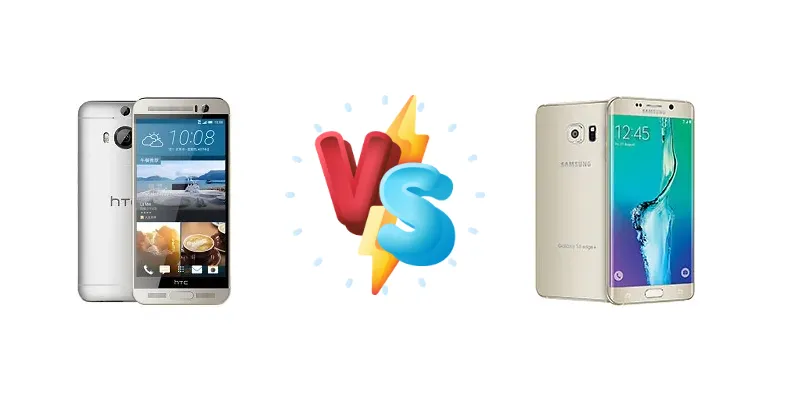
Released in 2015, the HTC One M9+ Supreme Camera and the Samsung Galaxy S6 edge+ represented the pinnacle of Android smartphone technology. While both aimed for the high-end market, they took distinctly different approaches to achieving it. This comparison revisits these devices, analyzing their strengths and weaknesses in the context of today's expectations, particularly focusing on chipset performance and camera capabilities.
🏆 Quick Verdict
For the average user seeking a more polished and consistently performant experience, the Samsung Galaxy S6 edge+ emerges as the better choice. Its Exynos 7420 chipset, fabricated on a 14nm process, delivers superior efficiency and sustained performance compared to the HTC’s Mediatek MT6795T. While the M9+ boasts a dedicated camera module, the S6 edge+ offers a more balanced package.
| Network |
|---|
| 2G bands | GSM 850 / 900 / 1800 / 1900 | GSM 850 / 900 / 1800 / 1900 |
| 3G bands | HSDPA 850 / 900 / 1900 / 2100 | HSDPA 850 / 1700(AWS) / 1900 / 2100 - G928T, G928A |
| 4G bands | 1, 3, 5, 7, 8, 28, 38, 39, 40, 41 | 1, 2, 3, 4, 5, 7, 8, 12, 20 - G928T |
| Speed | HSPA 42.2/21.1 Mbps, LTE (2CA) Cat6 300/50 Mbps | HSPA 42.2/5.76 Mbps, LTE (2CA) Cat6 300/50 Mbps/ LTE (3CA) Cat9 450/50 Mbps |
| Technology | GSM / HSPA / LTE | GSM / HSPA / LTE |
| | - | 1, 2, 3, 4, 5, 7, 8, 12, 17, 18, 19, 20, 26 - G928F |
| Launch |
|---|
| Announced | 2015, September. Released 2015, October | 2015, August. Released 2015, August |
| Status | Discontinued | Discontinued |
| Body |
|---|
| Build | - | Glass front (Gorilla Glass 4), glass back (Gorilla Glass 4), aluminum frame |
| Dimensions | 151 x 72 x 9.6 mm (5.94 x 2.83 x 0.38 in) | 154.4 x 75.8 x 6.9 mm (6.08 x 2.98 x 0.27 in) |
| SIM | Nano-SIM | Nano-SIM |
| Weight | 168 g (5.93 oz) | 153 g (5.40 oz) |
| Display |
|---|
| Protection | - | Corning Gorilla Glass 4 |
| Resolution | 1440 x 2560 pixels, 16:9 ratio (~565 ppi density) | 1440 x 2560 pixels, 16:9 ratio (~518 ppi density) |
| Size | 5.2 inches, 74.5 cm2 (~68.6% screen-to-body ratio) | 5.7 inches, 88.5 cm2 (~75.6% screen-to-body ratio) |
| Type | Super LCD3 | Super AMOLED |
| Platform |
|---|
| CPU | Octa-core 2.2 GHz Cortex-A53 | Octa-core (4x2.1 GHz Cortex-A57 & 4x1.5 GHz Cortex-A53) |
| Chipset | Mediatek MT6795T Helio X10 (28 nm) | Exynos 7420 Octa (14 nm) |
| GPU | PowerVR G6200 | Mali-T760MP8 |
| OS | Android 5.2 (Lollipop), Sense UI 7 | Android 5.1.1 (Lollipop), upgradable to 7.0 (Nougat), TouchWiz UI |
| Memory |
|---|
| Card slot | microSDXC (dedicated slot) | No |
| Internal | 32GB 3GB RAM | 32GB 4GB RAM, 64GB 4GB RAM |
| | - | UFS 2.0 |
| Main Camera |
|---|
| Features | Laser AF, Dual-LED dual-tone flash, HDR, panorama | LED flash, auto-HDR, panorama |
| Single | 21 MP, f/2.2, 27mm (wide), OIS | 16 MP, f/1.9, 28mm (wide), 1/2.6", 1.12µm, AF, OIS |
| Video | 4K@30fps, 1080p@60fps, 720p@120fps, HDR, stereo sound rec. | 4K@30fps, 1080p@30fps (gyro-EIS), 1080p@60fps, 720p@120fps, HDR, stereo sound rec., OIS |
| Selfie camera |
|---|
| Features | HDR | HDR |
| Single | 4 MP, f/2.0, 27mm (wide), 1/3", 2µm | 5 MP, f/1.9, 22mm (wide) |
| Video | 1080p@30fps | 1440p@30fps |
| Sound |
|---|
| 3.5mm jack | - | Yes |
| 35mm jack | Yes | Yes |
| Loudspeaker | Yes, with stereo speakers | Yes |
| | - | 24-bit/192kHz audio
|
| Comms |
|---|
| Bluetooth | 4.1, A2DP, aptX | 4.2, A2DP, LE, aptX |
| Infrared port | Yes | - |
| NFC | Yes (market/operator dependent) | Yes |
| Positioning | GPS, GLONASS, BDS | GPS, GLONASS, BDS |
| Radio | Stereo FM radio, RDS | No |
| USB | microUSB 2.0 (MHL 2 TV-out), OTG | microUSB 2.0, OTG |
| WLAN | Wi-Fi 802.11 a/b/g/n/ac, dual-band, Wi-Fi Direct, DLNA, hotspot | Wi-Fi 802.11 a/b/g/n/ac, dual-band, Wi-Fi Direct, hotspot |
| Features |
|---|
| Sensors | Fingerprint (front-mounted), accelerometer, gyro, proximity, compass | Fingerprint (front-mounted), accelerometer, gyro, proximity, compass, barometer, heart rate, SpO2 |
| | - | ANT+
S-Voice natural language commands and dictation
Samsung Pay (Visa, MasterCard certified) |
| Battery |
|---|
| Charging | - | 15W wired
Wireless (Qi) (market dependent) |
| Music play | - | Up to 66 h |
| Stand-by | Up to 598 h (2G) / Up to 626 h (3G) | - |
| Talk time | Up to 23 h (2G) / Up to 13 h (3G) | Up to 20 h (3G) |
| Type | Li-Po 2840 mAh, non-removable | Li-Ion 3000 mAh, non-removable |
| Misc |
|---|
| Colors | Gunmetal Gray, Silver Gold, Amber Gold | Black Sapphire, Gold Platinum, Silver Titan, White Pearl, Pink |
| Models | - | SM-G928A, SM-G928F, SM-G928A, SM-G928T, G928I, SM-G928G, SM-G928C, SM-G928I, SCV31, SM-G9280, SM-G928L, SM-G928S, SM-G928K, SM-G928W8 |
| Price | About 480 EUR | About 450 EUR |
| SAR | - | 1.22 W/kg (head) 1.48 W/kg (body) |
| SAR EU | - | 0.22 W/kg (head) 0.58 W/kg (body) |
| Tests |
|---|
| Audio quality | - |
Noise -93.3dB / Crosstalk -93.7dB |
| Battery life | - |
Endurance rating 83h
|
| Camera | - |
Photo / Video |
| Display | - |
Contrast ratio: Infinite (nominal), 4.615 (sunlight) |
| Loudspeaker | - |
Voice 65dB / Noise 64dB / Ring 70dB
|
| Performance | - |
Basemark X: 26333 |
HTC One M9+ Supreme Camera
- Potentially superior camera hardware (Supreme Camera module)
- Slightly higher CPU clock speed (on paper)
- Unique design aesthetic
- Less efficient Mediatek MT6795T chipset
- Higher potential for thermal throttling
- No wireless charging support
Samsung Galaxy S6 edge+
- More efficient Exynos 7420 chipset (14nm)
- Curved edge display for immersive viewing
- 15W wired and Qi wireless charging
- Curved screen can be prone to accidental touches
- Glass back susceptible to fingerprints and scratches
Display Comparison
Both devices share an identical contrast ratio specification of infinite (nominal) and 4.615 in sunlight, suggesting comparable outdoor visibility. However, the S6 edge+'s curved edge display is a key differentiator, offering a more immersive visual experience and a unique aesthetic. While neither device boasts the high refresh rates common today, the quality of the panels themselves was excellent for the time. The lack of detailed information on panel technology (e.g., AMOLED vs. LCD) prevents a deeper analysis of color accuracy and viewing angles.
Camera Comparison
The 'Supreme Camera' moniker hints at HTC’s focus, but the specifics are limited. Both devices offer photo and video capabilities, but the M9+ likely features a more advanced camera module. Without detailed sensor size or aperture information, it’s difficult to definitively declare a winner. However, Samsung’s image processing algorithms were generally well-regarded, producing vibrant and detailed images. The absence of information regarding Optical Image Stabilization (OIS) on either device makes it difficult to assess low-light performance. The M9+'s camera is the main differentiator, but software processing plays a huge role.
Performance
The core difference lies in the chipsets. The Samsung Galaxy S6 edge+ utilizes the Exynos 7420, built on a 14nm process, featuring a heterogeneous octa-core CPU with four Cortex-A57 cores clocked at 2.1 GHz and four Cortex-A53 cores at 1.5 GHz. This architecture balances performance and efficiency. Conversely, the HTC One M9+ Supreme Camera employs the Mediatek MT6795T Helio X10, a 28nm chip with eight Cortex-A53 cores at 2.2 GHz. The larger process node of the Helio X10 inherently leads to higher power consumption and potentially more thermal throttling under sustained workloads. The Exynos 7420’s superior fabrication process provides a clear advantage in sustained performance, making the S6 edge+ better suited for demanding tasks like gaming and video editing.
Battery Life
Both the HTC One M9+ Supreme Camera and the Samsung Galaxy S6 edge+ achieve an endurance rating of 83 hours, suggesting similar real-world battery life. However, this rating is a composite score. The Exynos 7420’s 14nm process contributes to better power efficiency, potentially allowing the S6 edge+ to maintain its performance for longer periods. The S6 edge+ also supports 15W wired charging and Qi wireless charging (market dependent), offering more convenient charging options than the M9+ which lacks wireless charging support.
Buying Guide
Buy the HTC One M9+ Supreme Camera if you prioritize a potentially superior camera experience (depending on software preferences) and are comfortable with a chipset that may exhibit more thermal throttling under sustained load. Buy the Samsung Galaxy S6 edge+ if you prefer a more refined user experience, a more efficient processor, and the unique aesthetic of a curved edge display. The S6 edge+ is the safer bet for long-term usability and consistent performance.
Frequently Asked Questions
❓ Does the Exynos 7420 in the Galaxy S6 edge+ overheat during prolonged gaming sessions?
While the Exynos 7420 can get warm under heavy load, its 14nm fabrication process and efficient thermal design generally prevent significant overheating and throttling. It's far less prone to throttling than the Mediatek MT6795T in the HTC One M9+ Supreme Camera.
❓ Is the Mediatek MT6795T in the HTC One M9+ Supreme Camera capable of running modern mobile games?
The MT6795T can run many modern mobile games, but you may experience lower frame rates and more frequent frame drops compared to the Galaxy S6 edge+, especially in graphically demanding titles. The chipset's 28nm process and less efficient architecture contribute to this limitation.
❓ How does the curved screen of the Galaxy S6 edge+ affect usability?
The curved screen provides a more immersive viewing experience and a unique aesthetic. However, it can also lead to accidental touches and reflections, requiring a slight adjustment period for users unfamiliar with this design.
❓ What are the benefits of Qi wireless charging on the Galaxy S6 edge+?
Qi wireless charging offers a convenient and cable-free charging experience. Simply place the phone on a compatible wireless charging pad to begin charging, eliminating the need to plug in a cable.