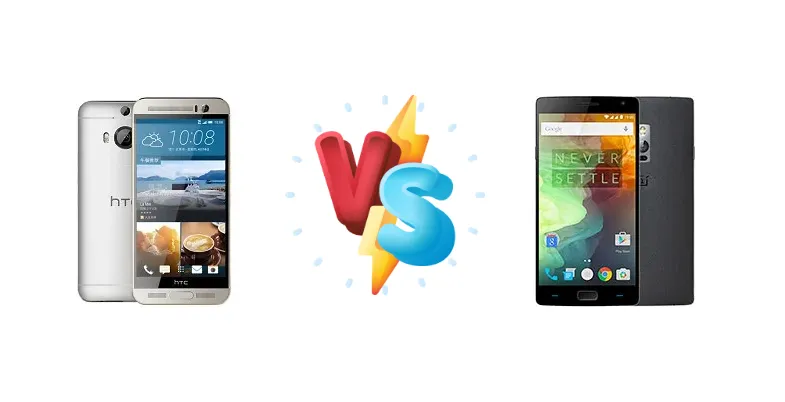
The OnePlus 2 and HTC One M9+ Supreme Camera represent distinct approaches to the 2015 flagship market. The OnePlus 2 aimed to disrupt with high-end specs at a lower price, while the M9+ focused on camera enhancements over the standard M9. This comparison dissects their core components to determine which device holds up better today, considering their original positioning and current relevance.
🏆 Quick Verdict
For the average user seeking a functional and relatively modern experience, the OnePlus 2 emerges as the slightly better choice. Its Snapdragon 810, despite potential throttling, offers a more robust processing foundation than the Mediatek Helio X10 in the M9+, and both phones offer identical battery endurance.
| Network |
|---|
| 2G bands | GSM 850 / 900 / 1800 / 1900 | GSM 850 / 900 / 1800 / 1900 - SIM 1 & SIM 2 |
| 3G bands | HSDPA 850 / 900 / 1900 / 2100 | HSDPA 850 / 900 / 1900 / 2100 |
| 4G bands | 1, 3, 5, 7, 8, 28, 38, 39, 40, 41 | 1, 3, 5, 7, 8, 20, 38, 40, 41 |
| Speed | HSPA 42.2/21.1 Mbps, LTE (2CA) Cat6 300/50 Mbps | HSPA 42.2/5.76 Mbps, LTE Cat4 150/50 Mbps |
| Technology | GSM / HSPA / LTE | GSM / HSPA / LTE |
| Launch |
|---|
| Announced | 2015, September. Released 2015, October | 2015, July. Released 2015, August |
| Status | Discontinued | Discontinued |
| Body |
|---|
| Build | - | Glass front (Gorilla Glass 3), plastic back, aluminum frame |
| Dimensions | 151 x 72 x 9.6 mm (5.94 x 2.83 x 0.38 in) | 151.8 x 74.9 x 9.9 mm (5.98 x 2.95 x 0.39 in) |
| SIM | Nano-SIM | Nano-SIM + Nano-SIM |
| Weight | 168 g (5.93 oz) | 175 g (6.17 oz) |
| Display |
|---|
| Protection | - | Corning Gorilla Glass 3 |
| Resolution | 1440 x 2560 pixels, 16:9 ratio (~565 ppi density) | 1080 x 1920 pixels, 16:9 ratio (~401 ppi density) |
| Size | 5.2 inches, 74.5 cm2 (~68.6% screen-to-body ratio) | 5.5 inches, 83.4 cm2 (~73.3% screen-to-body ratio) |
| Type | Super LCD3 | IPS LCD |
| Platform |
|---|
| CPU | Octa-core 2.2 GHz Cortex-A53 | Octa-core (4x1.56 GHz Cortex-A53 & 4x1.82 GHz Cortex-A57) |
| Chipset | Mediatek MT6795T Helio X10 (28 nm) | Qualcomm MSM8994 Snapdragon 810 (20 nm) |
| GPU | PowerVR G6200 | Adreno 430 |
| OS | Android 5.2 (Lollipop), Sense UI 7 | Android 5.1 (Lollipop), upgradable to 6.0.1 (Marshmallow), Oxygen 3.5.6 UI |
| Memory |
|---|
| Card slot | microSDXC (dedicated slot) | No |
| Internal | 32GB 3GB RAM | 16GB 3GB RAM, 64GB 4GB RAM |
| | - | eMMC 5.0 |
| Main Camera |
|---|
| Features | Laser AF, Dual-LED dual-tone flash, HDR, panorama | Laser AF, Dual-LED flash, panorama, HDR |
| Single | 21 MP, f/2.2, 27mm (wide), OIS | 13 MP, f/2.0, 1/2.6", 1.3µm, OIS |
| Video | 4K@30fps, 1080p@60fps, 720p@120fps, HDR, stereo sound rec. | 4K@30fps, 4K(DCI)@24fps, 1080p@60fps, 720p@120fps, HDR, stereo sound rec. |
| Selfie camera |
|---|
| Features | HDR | - |
| Single | 4 MP, f/2.0, 27mm (wide), 1/3", 2µm | 5 MP, f/2.4 |
| Video | 1080p@30fps | 720p@30fps |
| Sound |
|---|
| 3.5mm jack | - | Yes |
| 35mm jack | Yes | Yes |
| Loudspeaker | Yes, with stereo speakers | Yes |
| Comms |
|---|
| Bluetooth | 4.1, A2DP, aptX | 4.1, A2DP |
| Infrared port | Yes | - |
| NFC | Yes (market/operator dependent) | No |
| Positioning | GPS, GLONASS, BDS | GPS, GLONASS |
| Radio | Stereo FM radio, RDS | No |
| USB | microUSB 2.0 (MHL 2 TV-out), OTG | USB Type-C 2.0 |
| WLAN | Wi-Fi 802.11 a/b/g/n/ac, dual-band, Wi-Fi Direct, DLNA, hotspot | Wi-Fi 802.11 a/b/g/n/ac, Wi-Fi Direct, DLNA, hotspot |
| Features |
|---|
| Sensors | Fingerprint (front-mounted), accelerometer, gyro, proximity, compass | Fingerprint (front-mounted), accelerometer, gyro, proximity, compass |
| Battery |
|---|
| Stand-by | Up to 598 h (2G) / Up to 626 h (3G) | - |
| Talk time | Up to 23 h (2G) / Up to 13 h (3G) | - |
| Type | Li-Po 2840 mAh, non-removable | Li-Po 3300 mAh, non-removable |
| Misc |
|---|
| Colors | Gunmetal Gray, Silver Gold, Amber Gold | Sandstone Black |
| Models | - | ONE A2003, ONE A2005, ONE A2001 |
| Price | About 480 EUR | About 300 EUR |
| SAR EU | - | 0.43 W/kg (head) 0.20 W/kg (body) |
| Tests |
|---|
| Audio quality | - |
Noise -94.2dB / Crosstalk -94.3dB |
| Battery life | - | Endurance rating 61h |
| Camera | - |
Photo / Video |
| Display | - |
Contrast ratio: 1187 (nominal), 2.165 (sunlight) |
| Loudspeaker | - |
Voice 75dB / Noise 73dB / Ring 80dB |
| Performance | - |
Basemark OS II 2.0: 1622Basemark X: 21937 |
HTC One M9+ Supreme Camera
- Potentially superior camera system (due to 'Supreme Camera' branding)
- Similar battery endurance to the OnePlus 2
- May appeal to users prioritizing camera features
- Less powerful chipset (Helio X10 vs Snapdragon 810)
- Larger process node (28nm) potentially leading to higher heat output
- Limited information on camera specifications
OnePlus 2
- More powerful chipset (Snapdragon 810) for better overall performance
- More efficient 20nm process node
- Balanced performance and battery life
- Snapdragon 810 prone to throttling under sustained load
- Camera performance not a primary strength
- Similar battery endurance to the M9+
Display Comparison
Both devices share a similar display profile, boasting a contrast ratio of 1187 (nominal) and 2.165 (sunlight). This suggests comparable visibility in bright outdoor conditions. However, the lack of detailed display specifications like peak brightness or color gamut coverage prevents a definitive judgment on image quality. The shared contrast ratio indicates a similar panel technology, likely IPS LCD, but without further data, it's difficult to assess color accuracy or viewing angles.
Camera Comparison
The 'Supreme Camera' moniker of the HTC One M9+ suggests a focus on imaging, but the provided data is insufficient to determine the extent of its advantage. Both phones are listed as having 'Photo / Video' capabilities, lacking specifics on sensor size, aperture, or image stabilization. Given the marketing emphasis, the M9+ likely features a more advanced camera module, potentially with a larger sensor or improved image processing algorithms. However, without concrete details, it's impossible to quantify the difference in image quality. The OnePlus 2's camera performance was generally considered adequate for its price point, but not a standout feature.
Performance
The core difference lies in the chipsets. The OnePlus 2’s Qualcomm MSM8994 Snapdragon 810 (20 nm) utilizes a big.LITTLE architecture with Cortex-A53 and A57 cores, offering a theoretical performance advantage over the HTC One M9+’s Mediatek MT6795T Helio X10 (28 nm) which relies solely on Cortex-A53 cores. The 20nm process node of the Snapdragon 810 also provides better thermal efficiency, though the 810 was known for throttling under sustained load. The OnePlus 2’s architecture allows for more efficient task allocation, with the A57 cores handling demanding tasks and the A53 cores managing background processes. This translates to a smoother multitasking experience, even if peak performance is limited by thermal constraints.
Battery Life
Interestingly, both the HTC One M9+ Supreme Camera and the OnePlus 2 share an endurance rating of 61 hours. This suggests similar battery life despite the differing chipsets and potentially different battery capacities (which are not specified). The Snapdragon 810’s more efficient 20nm process may partially offset the Helio X10’s lower power consumption, resulting in comparable real-world usage. The lack of charging wattage information prevents a comparison of charging speeds; however, the OnePlus 2 was known for its relatively fast charging capabilities at the time.
Buying Guide
Buy the HTC One M9+ Supreme Camera if you prioritize a dedicated camera-focused experience and are willing to accept potential performance limitations. Its 'Supreme Camera' branding suggests a focus on photography, though the actual benefits are limited by the chipset. Buy the OnePlus 2 if you prefer a more balanced device with a stronger processor for general use and gaming, and value a more streamlined software experience.
Frequently Asked Questions
❓ Is the Snapdragon 810 in the OnePlus 2 known to overheat during gaming?
Yes, the Snapdragon 810 was notorious for thermal throttling, particularly during extended gaming sessions. While the OnePlus 2 implemented some cooling measures, users often reported performance drops after prolonged use. This is a key consideration for gamers.
❓ Does the HTC One M9+ Supreme Camera offer significantly better low-light performance compared to the standard M9?
While the 'Supreme Camera' branding suggests improvements, specific details regarding the sensor and image processing are scarce. It's likely the M9+ offers some enhancement in low-light scenarios, but the extent of the improvement is difficult to quantify without detailed camera tests.
❓ Which phone would be better for running older Android apps from 2015-2016?
Both phones will struggle with modern apps, but the OnePlus 2's Snapdragon 810 likely provides a slightly smoother experience with older software due to its more powerful CPU architecture. However, software updates are a major concern for both devices at this point.
❓ Are there any known issues with the Mediatek Helio X10 chipset in the HTC One M9+ Supreme Camera regarding software updates or long-term reliability?
Mediatek chipsets historically received less consistent software support compared to Qualcomm. The HTC One M9+ Supreme Camera is unlikely to receive further updates, and finding reliable long-term support for this device may be challenging.