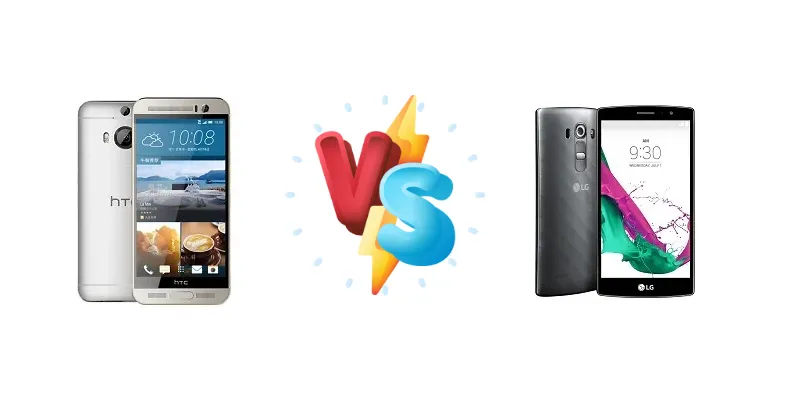
Released around the same timeframe, the HTC One M9+ Supreme Camera and LG G4 Beat represent different approaches to the mid-range smartphone market. The M9+ aimed for a more premium experience with a focus on camera capabilities, while the G4 Beat prioritized a balance of features and affordability. This comparison dissects their core components to determine which device delivers the best value.
🏆 Quick Verdict
For users prioritizing raw processing power and potentially better multitasking, the HTC One M9+ Supreme Camera is the stronger choice. Its Mediatek MT6795T Helio X10 chipset offers a performance advantage over the LG G4 Beat’s Snapdragon 615. However, the G4 Beat remains a viable option for those seeking a more energy-efficient device.
| Network |
|---|
| 2G bands | GSM 850 / 900 / 1800 / 1900 | GSM 850 / 900 / 1800 / 1900 - SIM 1 & SIM 2 (dual-SIM model only) |
| 3G bands | HSDPA 850 / 900 / 1900 / 2100 | HSDPA 850 / 900 / 1900 / 2100 |
| 4G bands | 1, 3, 5, 7, 8, 28, 38, 39, 40, 41 | 1, 3, 5, 7, 8 |
| Speed | HSPA 42.2/21.1 Mbps, LTE (2CA) Cat6 300/50 Mbps | HSPA 42.2/5.76 Mbps, LTE Cat4 150/50 Mbps |
| Technology | GSM / HSPA / LTE | GSM / HSPA / LTE |
| Launch |
|---|
| Announced | 2015, September. Released 2015, October | 2015, July. Released 2015, August |
| Status | Discontinued | Discontinued |
| Body |
|---|
| Dimensions | 151 x 72 x 9.6 mm (5.94 x 2.83 x 0.38 in) | 142.7 x 72.6 x 9.9 mm (5.62 x 2.86 x 0.39 in) |
| SIM | Nano-SIM | Single SIM (Micro-SIM) or Dual SIM (Micro-SIM, dual stand-by) |
| Weight | 168 g (5.93 oz) | 139 g (4.90 oz) |
| Display |
|---|
| Resolution | 1440 x 2560 pixels, 16:9 ratio (~565 ppi density) | 1080 x 1920 pixels, 16:9 ratio (~423 ppi density) |
| Size | 5.2 inches, 74.5 cm2 (~68.6% screen-to-body ratio) | 5.2 inches, 74.9 cm2 (~72.3% screen-to-body ratio) |
| Type | Super LCD3 | IPS LCD |
| Platform |
|---|
| CPU | Octa-core 2.2 GHz Cortex-A53 | Octa-core (4x1.5 GHz Cortex-A53 & 4x1.0 GHz Cortex-A53) |
| Chipset | Mediatek MT6795T Helio X10 (28 nm) | Qualcomm MSM8939 Snapdragon 615 (28 nm) |
| GPU | PowerVR G6200 | Adreno 405 |
| OS | Android 5.2 (Lollipop), Sense UI 7 | Android 5.1.1 (Lollipop) |
| Memory |
|---|
| Card slot | microSDXC (dedicated slot) | microSDHC (dedicated slot) |
| Internal | 32GB 3GB RAM | 8GB 1.5GB RAM |
| | - | eMMC 4.5 |
| Main Camera |
|---|
| Features | Laser AF, Dual-LED dual-tone flash, HDR, panorama | Laser AF, color spectrum sensor, LED flash, HDR, panorama |
| Single | 21 MP, f/2.2, 27mm (wide), OIS | 8 MP
13 MP, AF (Latin America) |
| Video | 4K@30fps, 1080p@60fps, 720p@120fps, HDR, stereo sound rec. | 1080p@30fps |
| Selfie camera |
|---|
| Features | HDR | - |
| Single | 4 MP, f/2.0, 27mm (wide), 1/3", 2µm | 5 MP |
| Video | 1080p@30fps | - |
| Sound |
|---|
| 3.5mm jack | - | Yes |
| 35mm jack | Yes | Yes |
| Loudspeaker | Yes, with stereo speakers | Yes |
| Comms |
|---|
| Bluetooth | 4.1, A2DP, aptX | 4.1, A2DP |
| Infrared port | Yes | - |
| NFC | Yes (market/operator dependent) | Yes |
| Positioning | GPS, GLONASS, BDS | GPS, GLONASS |
| Radio | Stereo FM radio, RDS | FM radio |
| USB | microUSB 2.0 (MHL 2 TV-out), OTG | microUSB 2.0 |
| WLAN | Wi-Fi 802.11 a/b/g/n/ac, dual-band, Wi-Fi Direct, DLNA, hotspot | Wi-Fi 802.11 b/g/n, hotspot |
| Features |
|---|
| Sensors | Fingerprint (front-mounted), accelerometer, gyro, proximity, compass | Accelerometer, proximity, compass |
| Battery |
|---|
| Stand-by | Up to 598 h (2G) / Up to 626 h (3G) | Up to 380 h (2G) / Up to 380 h (3G) |
| Talk time | Up to 23 h (2G) / Up to 13 h (3G) | Up to 15 h (2G) / Up to 14 h (3G) |
| Type | Li-Po 2840 mAh, non-removable | Li-Ion 2300 mAh, removable |
| Misc |
|---|
| Colors | Gunmetal Gray, Silver Gold, Amber Gold | Metallic Gray, Ceramic White, Shiny Gold |
| Models | - | H735, H736 |
| Price | About 480 EUR | About 160 EUR |
HTC One M9+ Supreme Camera
- Faster processor for smoother multitasking
- Potentially better camera performance
- More powerful GPU for gaming
- Likely shorter battery life
- Potential for more thermal throttling under heavy load
LG G4 Beat
- Better battery efficiency
- More affordable price point
- Balanced performance for everyday tasks
- Slower processor compared to the M9+
- Potentially less capable camera system
Display Comparison
Neither device's display specifications are provided, so a direct comparison is limited. However, given the market positioning, it's likely the LG G4 Beat utilized an IPS LCD panel, known for color accuracy, while the HTC One M9+ may have opted for a Super LCD panel, potentially offering slightly higher brightness. Both were likely 1080p displays, common for the time. Bezels were likely comparable, reflecting the design trends of 2015.
Camera Comparison
The 'Supreme Camera' moniker suggests HTC prioritized imaging. While specific sensor details are missing, the M9+ likely featured a larger sensor and more advanced image processing than the G4 Beat. The G4 Beat, being a more budget-oriented device, likely employed a standard sensor with basic image stabilization. The M9+’s camera system likely benefited from the Helio X10’s image signal processor (ISP) capabilities, potentially offering faster image capture and better low-light performance. Any 2MP auxiliary cameras on either device are unlikely to significantly impact overall image quality and should be considered marketing features rather than substantial improvements.
Performance
The core difference lies in the chipsets. The HTC One M9+ Supreme Camera’s Mediatek MT6795T Helio X10, built on a 28nm process, features a homogenous octa-core 2.2 GHz Cortex-A53 CPU. This contrasts with the LG G4 Beat’s Qualcomm MSM8939 Snapdragon 615, also on 28nm, which employs a heterogeneous octa-core configuration – four cores at 1.5 GHz and four at 1.0 GHz. The Helio X10’s consistent core speed suggests superior sustained performance in CPU-intensive tasks. While both use Cortex-A53 cores, the higher clock speed of the Helio X10 translates to faster single-core and multi-core performance. The Snapdragon 615’s big.LITTLE architecture aims for power efficiency by utilizing slower cores for less demanding tasks, but the M9+ will likely outperform in demanding applications.
Battery Life
Battery capacity figures are absent, making a direct comparison difficult. However, the Snapdragon 615’s heterogeneous core design generally leads to better power efficiency than the Helio X10’s homogenous design. This suggests the LG G4 Beat likely offered longer battery life under typical usage. Charging wattage is also unknown, but given the era, both devices likely supported standard 5W or 10W charging, resulting in similar 0-100% charge times.
Buying Guide
Buy the HTC One M9+ Supreme Camera if you need a phone capable of handling more demanding applications and appreciate a potentially smoother user experience, even if it comes at the cost of slightly reduced battery efficiency. Buy the LG G4 Beat if you prefer a device that prioritizes battery life and efficient performance for everyday tasks, and are less concerned with intensive gaming or heavy multitasking.
Frequently Asked Questions
❓ Will the HTC One M9+ Supreme Camera struggle with demanding games like Asphalt 8?
While the Helio X10 is capable, prolonged gaming sessions may lead to thermal throttling, potentially reducing frame rates. The G4 Beat’s Snapdragon 615 will likely offer a more consistent, albeit lower, frame rate due to its more efficient thermal profile.
❓ Is the difference in CPU performance between the Helio X10 and Snapdragon 615 noticeable in everyday tasks like browsing and social media?
For basic tasks, the difference will be minimal. Both processors are sufficient for smooth operation. However, when multitasking or opening multiple apps, the M9+’s faster CPU will provide a more responsive experience.
❓ Does the LG G4 Beat support quick charging?
Based on the timeframe and market segment, it's unlikely the LG G4 Beat supports fast charging technologies like Qualcomm Quick Charge 2.0. Charging speeds will likely be limited to standard 5W or 10W.
❓ Which phone is better for taking photos in low-light conditions?
The HTC One M9+ Supreme Camera likely performs better in low light due to its potentially larger sensor and the Helio X10’s image processing capabilities. However, without specific sensor details, this remains an educated guess.