
HTC One M9+ Supreme Camera vs. iPhone 6s Plus: A Detailed Comparison
| Phones Images | |||||
|---|---|---|---|---|---|
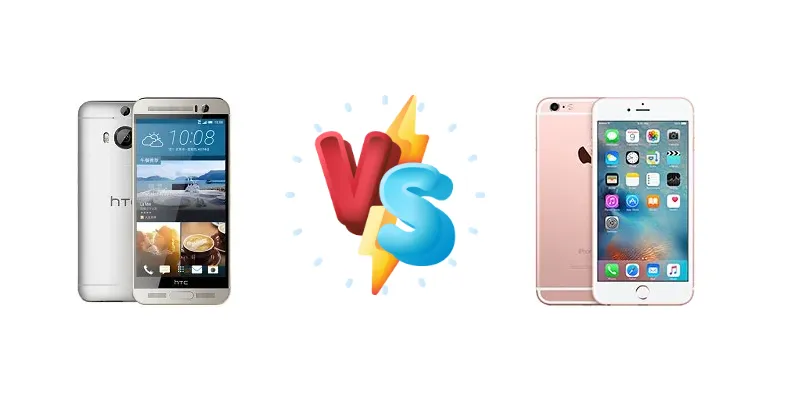
|
🏆 Quick Verdict
For the average user in 2024, the Apple iPhone 6s Plus emerges as the better choice. While the HTC One M9+ boasts a newer chipset on paper, Apple’s A9 chip, coupled with its optimized software, delivers a smoother and more consistent user experience, alongside comparable battery life and a more refined camera system.
| PHONES | ||
|---|---|---|
| Phone Names | HTC One M9+ Supreme Camera | Apple iPhone 6s Plus |
| Network | ||
|---|---|---|
| 2G bands | GSM 850 / 900 / 1800 / 1900 | GSM 850 / 900 / 1800 / 1900 |
| 3G bands | HSDPA 850 / 900 / 1900 / 2100 | HSDPA 850 / 900 / 1700 / 1900 / 2100 |
| 4G bands | 1, 3, 5, 7, 8, 28, 38, 39, 40, 41 | 1, 2, 3, 4, 5, 7, 8, 12, 13, 17, 18, 19, 20, 25, 26, 28, 29, 30 - A1633 |
| Speed | HSPA 42.2/21.1 Mbps, LTE (2CA) Cat6 300/50 Mbps | HSPA 42.2/5.76 Mbps, LTE (2CA) Cat6 300/50 Mbps, EV-DO Rev.A 3.1 Mbps |
| Technology | GSM / HSPA / LTE | GSM / CDMA / HSPA / EVDO / LTE |
| - | 1, 2, 3, 4, 5, 7, 8, 12, 13, 17, 18, 19, 20, 25, 26, 28, 29, 30, 38, 39, 40, 41 - A1634 | |
| Launch | ||
|---|---|---|
| Announced | 2015, September. Released 2015, October | 2015, September 09. Released 2015, September 25 |
| Status | Discontinued | Discontinued |
| Body | ||
|---|---|---|
| Build | - | Glass front (Corning-made glass), aluminum back, aluminum frame |
| Dimensions | 151 x 72 x 9.6 mm (5.94 x 2.83 x 0.38 in) | 158.2 x 77.9 x 7.3 mm (6.23 x 3.07 x 0.29 in) |
| SIM | Nano-SIM | Nano-SIM |
| Weight | 168 g (5.93 oz) | 192 g (6.77 oz) |
| - | Apple Pay (Visa, MasterCard, AMEX certified) | |
| Display | ||
|---|---|---|
| Protection | - | Ion-strengthened glass, oleophobic coating |
| Resolution | 1440 x 2560 pixels, 16:9 ratio (~565 ppi density) | 1080 x 1920 pixels, 16:9 ratio (~401 ppi density) |
| Size | 5.2 inches, 74.5 cm2 (~68.6% screen-to-body ratio) | 5.5 inches, 83.4 cm2 (~67.7% screen-to-body ratio) |
| Type | Super LCD3 | IPS LCD |
| - | 3D Touch display | |
| Platform | ||
|---|---|---|
| CPU | Octa-core 2.2 GHz Cortex-A53 | Dual-core 1.84 GHz Twister |
| Chipset | Mediatek MT6795T Helio X10 (28 nm) | Apple A9 (14/16 nm - maker dependant) |
| GPU | PowerVR G6200 | PowerVR GT7600 (six-core graphics) |
| OS | Android 5.2 (Lollipop), Sense UI 7 | iOS 9, upgradable to iOS 15.8.5 |
| Memory | ||
|---|---|---|
| Card slot | microSDXC (dedicated slot) | No |
| Internal | 32GB 3GB RAM | 16GB 2GB RAM, 32GB 2GB RAM, 64GB 2GB RAM, 128GB 2GB RAM |
| - | NVMe | |
| Main Camera | ||
|---|---|---|
| Features | Laser AF, Dual-LED dual-tone flash, HDR, panorama | Dual-LED dual-tone flash, HDR |
| Single | 21 MP, f/2.2, 27mm (wide), OIS | 12 MP, f/2.2, 29mm (standard), 1/3.0", 1.22µm, PDAF, OIS |
| Video | 4K@30fps, 1080p@60fps, 720p@120fps, HDR, stereo sound rec. | 4K@30fps, 1080p@60fps, 1080p@120fps, 720p@240fps |
| Selfie camera | ||
|---|---|---|
| Features | HDR | Face detection, HDR, panorama |
| Single | 4 MP, f/2.0, 27mm (wide), 1/3", 2µm | 5 MP, f/2.2, 31mm (standard) |
| Video | 1080p@30fps | 720p@30fps |
| Sound | ||
|---|---|---|
| 3.5mm jack | - | Yes |
| 35mm jack | Yes | Yes |
| Loudspeaker | Yes, with stereo speakers | Yes |
| - | 16-bit/44.1kHz audio | |
| Comms | ||
|---|---|---|
| Bluetooth | 4.1, A2DP, aptX | 4.2, A2DP, LE |
| Infrared port | Yes | - |
| NFC | Yes (market/operator dependent) | Yes (Apple Pay only) |
| Positioning | GPS, GLONASS, BDS | GPS, GLONASS, GALILEO, QZSS |
| Radio | Stereo FM radio, RDS | No |
| USB | microUSB 2.0 (MHL 2 TV-out), OTG | Lightning, USB 2.0 |
| WLAN | Wi-Fi 802.11 a/b/g/n/ac, dual-band, Wi-Fi Direct, DLNA, hotspot | Wi-Fi 802.11 a/b/g/n/ac, dual-band, hotspot |
| Features | ||
|---|---|---|
| Sensors | Fingerprint (front-mounted), accelerometer, gyro, proximity, compass | Fingerprint (front-mounted), accelerometer, gyro, proximity, compass, barometer |
| Battery | ||
|---|---|---|
| Stand-by | Up to 598 h (2G) / Up to 626 h (3G) | Up to 384 h (3G) |
| Talk time | Up to 23 h (2G) / Up to 13 h (3G) | Up to 24 h (3G) |
| Type | Li-Po 2840 mAh, non-removable | Li-Ion 2750 mAh, non-removable (10.45 Wh) |
| Misc | ||
|---|---|---|
| Colors | Gunmetal Gray, Silver Gold, Amber Gold | Space Gray, Silver, Gold, Rose Gold |
| Models | - | A1634, A1687, A1690, A1699, iPhone8,2 |
| Price | About 480 EUR | About 240 EUR |
| SAR | - | 1.12 W/kg (head) 1.14 W/kg (body) |
| SAR EU | - | 0.93 W/kg (head) 0.98 W/kg (body) |
| Tests | ||
|---|---|---|
| Audio quality | - | Noise -93.4dB / Crosstalk -71.1dB |
| Battery life | - | Endurance rating 85h |
| Camera | - | Photo / Video |
| Display | - | Contrast ratio: 1382:1 (nominal), 3.530 (sunlight) |
| Loudspeaker | - | Voice 65dB / Noise 65dB / Ring 64dB |
| Performance | - | Basemark OS II 2.0: 2261 |
HTC One M9+ Supreme Camera
- Potentially faster multi-core performance (on paper)
- Lower price point in the current market
- May offer expandable storage (depending on variant)
- Less efficient chipset leading to potential thermal throttling
- Less refined software experience
- Uncertain camera performance without detailed specs
Apple iPhone 6s Plus
- Superior single-core performance and efficiency
- Optimized iOS ecosystem for a smooth user experience
- Reliable and consistent camera performance
- Slower charging speeds
- Older design with larger bezels
- Officially discontinued software support
Display Comparison
Both the HTC One M9+ Supreme Camera and the iPhone 6s Plus share a similar display contrast ratio of 1382:1 (nominal) and 3.530 (sunlight), suggesting comparable visibility in bright conditions. However, details regarding the panel technology (LCD vs. IPS) and resolution of the M9+ are missing. Apple’s Retina Display on the 6s Plus is known for its color accuracy and viewing angles, a key advantage given the lack of detailed display specs for the HTC device. Bezels are likely larger on the M9+ due to its 2015 design, impacting the screen-to-body ratio.
Camera Comparison
Both devices offer photo and video capabilities, but the specifics are crucial. Without detailed sensor information for the M9+, it’s difficult to make a direct comparison. However, Apple’s image processing pipeline on the 6s Plus is renowned for its natural color reproduction and dynamic range. The iPhone’s camera consistently delivers reliable results in various lighting conditions. The M9+’s camera likely relies heavily on software processing to compensate for any hardware limitations. The absence of information regarding OIS (Optical Image Stabilization) on the M9+ suggests it may lack this feature, impacting low-light performance and video stabilization compared to the iPhone 6s Plus.
Performance
The core difference lies in the chipset architecture. The HTC One M9+ utilizes the Mediatek MT6795T Helio X10, an octa-core processor based on the Cortex-A53 architecture at 2.2 GHz. In contrast, the iPhone 6s Plus features Apple’s A9, a dual-core Twister processor clocked at 1.84 GHz. Despite the core count disparity, the A9, fabricated on a 14/16nm process (depending on region), demonstrates superior single-core performance and efficiency. This translates to snappier app launches and smoother multitasking on the iPhone. The A9’s architecture is optimized for iOS, providing a significant advantage over the Helio X10 running Android. The 28nm process of the Helio X10 is less efficient, potentially leading to more heat generation under sustained load.
Battery Life
Both the HTC One M9+ Supreme Camera and the iPhone 6s Plus achieve an endurance rating of 85 hours, indicating similar battery life in typical usage scenarios. However, this rating doesn’t reveal the battery capacity of the M9+. The A9’s superior power efficiency, stemming from its smaller fabrication node, likely contributes to this comparable endurance despite the lower clock speed. Charging speeds are also unknown for the M9+, while the iPhone 6s Plus supports standard 5W charging, which is relatively slow by today’s standards.
Buying Guide
Buy the HTC One M9+ Supreme Camera if you prioritize a potentially faster processor for basic multitasking and are comfortable with a less polished software experience. Buy the Apple iPhone 6s Plus if you value a seamless user experience, a more reliable camera, and long-term software support (though officially ended, the community is active).