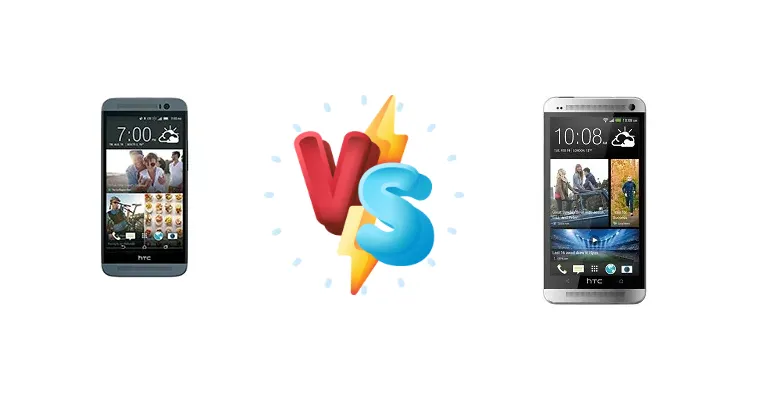
The HTC One series was a landmark in Android design, offering premium build quality and innovative features. But which variant – the E8 CDMA or the Dual Sim model – holds up best today? This in-depth comparison will help you decide which vintage HTC One is right for you.
🏆 Quick Verdict
The HTC One (E8) CDMA edges out the Dual Sim thanks to its significantly more powerful Snapdragon 801 chipset. While both offer a classic HTC experience, the E8's performance advantage makes it the slightly better choice for those seeking a responsive Android device.
| Network |
|---|
| 2G bands | GSM 850 / 900 / 1800 / 1900 | GSM 850 / 900 / 1800 / 1900 - SIM 1 & SIM 2 |
| 3G bands | HSDPA 850 / 1900 / 2100 | HSDPA 850 / 1900 / 2100 - SIM 1 |
| 4G bands | 25, 26, 41 | - |
| Speed | HSPA 14.4/5.76 Mbps, LTE Cat4 150/50 Mbps, EV-DO Rev.A 3.1 Mbps | HSPA 21.1/5.76 Mbps |
| Technology | GSM / CDMA / HSPA / EVDO / LTE | GSM / HSPA |
| | CDMA2000 1xEV-DO | HSDPA 900 / 2100 - SIM 1 |
| Launch |
|---|
| Announced | 2014, August. Released 2014, August | 2013, June. Released 2013, August |
| Status | Discontinued | Discontinued |
| Body |
|---|
| Dimensions | 146.4 x 70.7 x 9.9 mm (5.76 x 2.78 x 0.39 in) | 137.8 x 69.3 x 10.4 mm (5.43 x 2.73 x 0.41 in) |
| SIM | Nano-SIM | Dual SIM (Micro-SIM, dual stand-by) |
| Weight | 164 g (5.78 oz) | 156 g (5.50 oz) |
| Display |
|---|
| Protection | Corning Gorilla Glass 3 | Corning Gorilla Glass 2 |
| Resolution | 1080 x 1920 pixels, 16:9 ratio (~441 ppi density) | 1080 x 1920 pixels, 16:9 ratio (~471 ppi density) |
| Size | 5.0 inches, 68.9 cm2 (~66.6% screen-to-body ratio) | 4.68 inches, 60.4 cm2 (~63.2% screen-to-body ratio) |
| Type | Super LCD3 | Super LCD3 |
| Platform |
|---|
| CPU | Quad-core 2.3 GHz Krait 400 | Quad-core 1.7 GHz Krait 300 |
| Chipset | Qualcomm MSM8975AC Snapdragon 801 (28 nm) | Qualcomm APQ8064T Snapdragon 600 |
| GPU | Adreno 330 | Adreno 320 |
| OS | Android 4.4.2 (KitKat), Sense UI 6 | Android 4.1.2 (Jelly Bean), upgradable to 5 (Lollipop), Sense UI 5 |
| Memory |
|---|
| Card slot | microSDXC (dedicated slot) | microSDXC (dedicated slot) |
| Internal | 16GB 2GB RAM | 32GB 2GB RAM |
| | eMMC 5.0 | - |
| Main Camera |
|---|
| Features | LED flash, panorama, HDR | LED flash |
| Single | 13 MP, AF | 4 MP, 1/3.0", 2µm, AF, OIS |
| Video | 1080p@30fps | 1080p@30fps, 720p@60fps, HDR, stereo sound rec. |
| Selfie camera |
|---|
| Features | - | HDR |
| Single | 5 MP | 2.1 MP |
| Video | 1080p@30fps | 1080p@30fps |
| Sound |
|---|
| 3.5mm jack | Yes | Yes |
| 35mm jack | Yes | Yes |
| Loudspeaker | Yes, with stereo speakers | Yes, with stereo speakers |
| Comms |
|---|
| Bluetooth | 4.0, A2DP, aptX | 4.0, A2DP, aptX |
| Infrared port | - | Yes |
| NFC | Yes | Yes (Market dependent) |
| Positioning | GPS, GLONASS | GPS, GLONASS |
| Radio | No | Stereo FM radio, RDS |
| USB | microUSB 2.0 | microUSB 2.0 (MHL TV-out) |
| WLAN | Wi-Fi 802.11 a/b/g/n, dual-band, Wi-Fi Direct, DLNA, hotspot | Wi-Fi 802.11 a/b/g/n/ac, Wi-Fi Direct, DLNA, hotspot |
| Features |
|---|
| Sensors | Accelerometer, gyro, proximity, compass, barometer | Accelerometer, gyro, proximity, compass |
| Battery |
|---|
| Stand-by | - | Up to 500 h (2G) / Up to 480 h (3G) |
| Talk time | - | Up to 27 h (2G) / Up to 18 h (3G) |
| Type | Li-Ion 2600 mAh, non-removable | Li-Po 2300 mAh, non-removable |
| Misc |
|---|
| Colors | Polar White, Misty Gray | Silver, Black |
| Models | One | One dual sim, One 802w |
| Price | About 350 EUR | About 300 EUR |
| SAR | - | 1.27 W/kg (head) |
HTC One (E8) CDMA
- Superior Performance (Snapdragon 801)
- Slightly Brighter Display
- Duo Camera for Depth Effects
- Premium Build Quality
- CDMA Network Lock-in
- Potentially Older Software Support
- Plastic Body (compared to metal on some other One models)
HTC One Dual Sim
- Dual SIM Functionality
- Slightly Larger Battery (potentially)
- Good Value (if found at a low price)
- Compact Size
- Weaker Performance (Snapdragon 600)
- Less Efficient Chipset
- Potentially Older Software Support
Display Comparison
Both devices feature a 5-inch Super LCD 3 display with a 1080 x 1920 resolution. While the panels are similar in quality, the E8's slightly brighter display might offer a marginally better viewing experience, especially outdoors. Color accuracy is generally good on both.
Camera Comparison
The HTC One E8 boasts a 13MP rear camera with Duo Camera technology (depth sensing), while the Dual Sim also has a 13MP rear camera. Image quality is comparable, but the E8's depth sensing can provide slightly more natural bokeh effects in portrait mode. Both offer decent front-facing cameras for selfies.
Performance
This is where the E8 truly shines. Its Snapdragon 801 (28nm) with a 2.3 GHz Krait 400 CPU significantly outperforms the Dual Sim's Snapdragon 600 (45nm) with a 1.7 GHz Krait 300 CPU. Expect noticeably faster app loading, smoother multitasking, and better gaming performance on the E8.
Battery Life
The HTC One Dual Sim typically has a slightly larger battery capacity (2440 mAh) compared to the E8 CDMA (2320 mAh). However, the E8's more efficient Snapdragon 801 chipset often results in comparable or even slightly better battery life in real-world usage due to lower power consumption.
Buying Guide
The HTC One (E8) CDMA is ideal for users prioritizing performance and a smoother experience, particularly those in CDMA networks. The HTC One Dual Sim is a better fit for those needing dual SIM functionality and are less concerned with top-tier performance, or those in GSM networks.
Frequently Asked Questions
❓ Is the HTC One E8 CDMA worth buying in 2024?
If you prioritize performance and can find one in good condition, the E8 CDMA is a decent option. However, consider the age of the device and potential software limitations.
❓ What network does the HTC One E8 CDMA work on?
The E8 CDMA is designed for CDMA networks like Sprint and Verizon. It will not work on GSM networks like AT&T or T-Mobile without unlocking and compatibility checks.