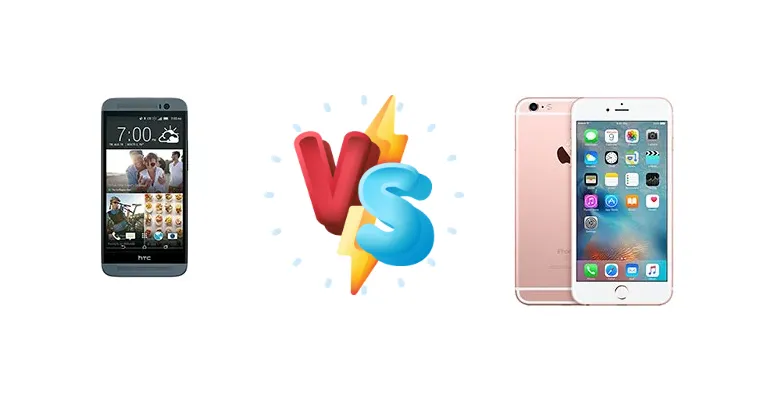
The HTC One (E8) CDMA and Apple iPhone 6s Plus represent different eras of smartphone design and operating systems. The One (E8) offered a premium Android experience, while the 6s Plus brought Apple's refined iOS to a larger format. Let's dive into a comprehensive comparison to see which device holds up best today.
🏆 Quick Verdict
The iPhone 6s Plus ultimately wins due to its superior software support, camera quality, and overall ecosystem integration. While the HTC One (E8) boasts a powerful Snapdragon 801, the iPhone's longevity and iOS advantages make it the more compelling choice for most users.
| Network |
|---|
| 2G bands | GSM 850 / 900 / 1800 / 1900 | GSM 850 / 900 / 1800 / 1900 |
| 3G bands | HSDPA 850 / 1900 / 2100 | HSDPA 850 / 900 / 1700 / 1900 / 2100 |
| 4G bands | 25, 26, 41 | 1, 2, 3, 4, 5, 7, 8, 12, 13, 17, 18, 19, 20, 25, 26, 28, 29, 30 - A1633 |
| Speed | HSPA 14.4/5.76 Mbps, LTE Cat4 150/50 Mbps, EV-DO Rev.A 3.1 Mbps | HSPA 42.2/5.76 Mbps, LTE (2CA) Cat6 300/50 Mbps, EV-DO Rev.A 3.1 Mbps |
| Technology | GSM / CDMA / HSPA / EVDO / LTE | GSM / CDMA / HSPA / EVDO / LTE |
| | CDMA2000 1xEV-DO | 1, 2, 3, 4, 5, 7, 8, 12, 13, 17, 18, 19, 20, 25, 26, 28, 29, 30, 38, 39, 40, 41 - A1634 |
| Launch |
|---|
| Announced | 2014, August. Released 2014, August | 2015, September 09. Released 2015, September 25 |
| Status | Discontinued | Discontinued |
| Body |
|---|
| Build | - | Glass front (Corning-made glass), aluminum back, aluminum frame |
| Dimensions | 146.4 x 70.7 x 9.9 mm (5.76 x 2.78 x 0.39 in) | 158.2 x 77.9 x 7.3 mm (6.23 x 3.07 x 0.29 in) |
| SIM | Nano-SIM | Nano-SIM |
| Weight | 164 g (5.78 oz) | 192 g (6.77 oz) |
| | - | Apple Pay (Visa, MasterCard, AMEX certified) |
| Display |
|---|
| Protection | Corning Gorilla Glass 3 | Ion-strengthened glass, oleophobic coating |
| Resolution | 1080 x 1920 pixels, 16:9 ratio (~441 ppi density) | 1080 x 1920 pixels, 16:9 ratio (~401 ppi density) |
| Size | 5.0 inches, 68.9 cm2 (~66.6% screen-to-body ratio) | 5.5 inches, 83.4 cm2 (~67.7% screen-to-body ratio) |
| Type | Super LCD3 | IPS LCD |
| | - | 3D Touch display |
| Platform |
|---|
| CPU | Quad-core 2.3 GHz Krait 400 | Dual-core 1.84 GHz Twister |
| Chipset | Qualcomm MSM8975AC Snapdragon 801 (28 nm) | Apple A9 (14/16 nm - maker dependant) |
| GPU | Adreno 330 | PowerVR GT7600 (six-core graphics) |
| OS | Android 4.4.2 (KitKat), Sense UI 6 | iOS 9, upgradable to iOS 15.8.5 |
| Memory |
|---|
| Card slot | microSDXC (dedicated slot) | No |
| Internal | 16GB 2GB RAM | 16GB 2GB RAM, 32GB 2GB RAM, 64GB 2GB RAM, 128GB 2GB RAM |
| | eMMC 5.0 | NVMe |
| Main Camera |
|---|
| Features | LED flash, panorama, HDR | Dual-LED dual-tone flash, HDR |
| Single | 13 MP, AF | 12 MP, f/2.2, 29mm (standard), 1/3.0", 1.22µm, PDAF, OIS |
| Video | 1080p@30fps | 4K@30fps, 1080p@60fps, 1080p@120fps, 720p@240fps |
| Selfie camera |
|---|
| Features | - | Face detection, HDR, panorama |
| Single | 5 MP | 5 MP, f/2.2, 31mm (standard) |
| Video | 1080p@30fps | 720p@30fps |
| Sound |
|---|
| 3.5mm jack | Yes | Yes |
| 35mm jack | Yes | Yes |
| Loudspeaker | Yes, with stereo speakers | Yes |
| | - | 16-bit/44.1kHz audio
|
| Comms |
|---|
| Bluetooth | 4.0, A2DP, aptX | 4.2, A2DP, LE |
| NFC | Yes | Yes (Apple Pay only) |
| Positioning | GPS, GLONASS | GPS, GLONASS, GALILEO, QZSS |
| Radio | No | No |
| USB | microUSB 2.0 | Lightning, USB 2.0 |
| WLAN | Wi-Fi 802.11 a/b/g/n, dual-band, Wi-Fi Direct, DLNA, hotspot | Wi-Fi 802.11 a/b/g/n/ac, dual-band, hotspot |
| Features |
|---|
| Sensors | Accelerometer, gyro, proximity, compass, barometer | Fingerprint (front-mounted), accelerometer, gyro, proximity, compass, barometer |
| Battery |
|---|
| Stand-by | - | Up to 384 h (3G) |
| Talk time | - | Up to 24 h (3G) |
| Type | Li-Ion 2600 mAh, non-removable | Li-Ion 2750 mAh, non-removable (10.45 Wh) |
| Misc |
|---|
| Colors | Polar White, Misty Gray | Space Gray, Silver, Gold, Rose Gold |
| Models | One | A1634, A1687, A1690, A1699, iPhone8,2 |
| Price | About 350 EUR | About 240 EUR |
| SAR | - | 1.12 W/kg (head) 1.14 W/kg (body) |
| SAR EU | - | 0.93 W/kg (head) 0.98 W/kg (body) |
| Tests |
|---|
| Audio quality | - |
Noise -93.4dB / Crosstalk -71.1dB |
| Battery life | - |
Endurance rating 85h
|
| Camera | - |
Photo / Video |
| Display | - |
Contrast ratio: 1382:1 (nominal), 3.530 (sunlight) |
| Loudspeaker | - |
Voice 65dB / Noise 65dB / Ring 64dB
|
| Performance | - |
Basemark OS II 2.0: 2261 |
HTC One (E8) CDMA
- Powerful Snapdragon 801 processor
- Premium build quality (aluminum unibody)
- BoomSound stereo speakers (excellent audio)
- Compact size (compared to the 6s Plus)
- Outdated software support
- Camera quality lags behind the iPhone
- Plastic construction on the back (E8 variant)
- Limited availability of spare parts
Apple iPhone 6s Plus
- Excellent camera quality
- Long-term software support (iOS updates)
- Smooth and optimized performance (A9 chip)
- Strong ecosystem integration
- Larger display
- Older design
- Battery life could be better with heavy usage
- Repair costs can be high
- Lightning connector (less universal than USB-C)
Display Comparison
Both phones feature a respectable contrast ratio of 1382:1 (nominal) and 3.530 in sunlight. The iPhone 6s Plus has a 5.5-inch display, significantly larger than the One (E8)'s 5-inch screen. Color accuracy and viewing angles are generally better on the iPhone, thanks to Apple's display technology. The One (E8) had a slightly warmer color profile.
Camera Comparison
The iPhone 6s Plus consistently outperforms the HTC One (E8) in camera quality. Apple's image processing is superior, delivering more detailed photos with better dynamic range and low-light performance. The iPhone also offers features like improved video stabilization and a more intuitive camera app.
Performance
The HTC One (E8) packs a Snapdragon 801, a powerful chipset for its time. However, the iPhone 6s Plus's A9 chip, while dual-core, is more efficient and optimized for iOS, often resulting in smoother performance in everyday tasks and demanding apps. iOS's efficient memory management also contributes to a more fluid experience.
Battery Life
Both devices are reported to have an endurance rating of 85h. However, real-world usage often differs. The iPhone 6s Plus's power efficiency and iOS optimization often lead to slightly better battery life in practical scenarios, especially with heavy usage.
Buying Guide
The HTC One (E8) CDMA is a good option for budget-conscious users who prefer Android and don't need the latest features. The Apple iPhone 6s Plus is ideal for those invested in the Apple ecosystem, prioritizing camera quality, and seeking a device with longer software support.
Frequently Asked Questions
❓ Is the HTC One (E8) CDMA still worth buying?
Only if you're on a very tight budget and prefer Android. Be aware of the limited software support and potential hardware issues due to its age.
❓ Which phone has better resale value?
The Apple iPhone 6s Plus generally retains better resale value due to the Apple ecosystem and longer software support.