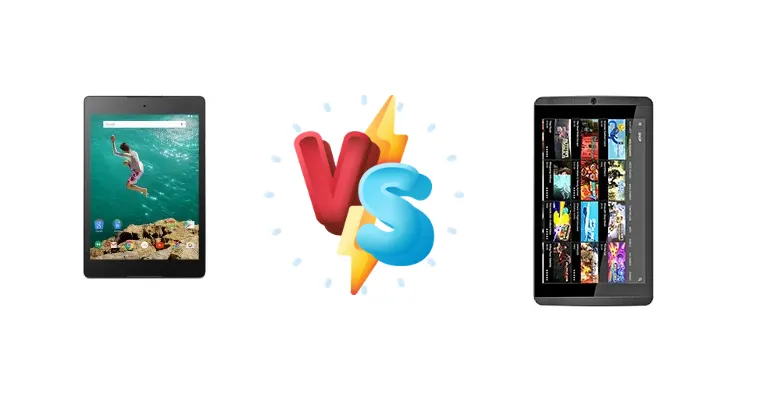
The HTC Nexus 9 and Nvidia Shield K1 were both contenders in the Android tablet space, offering distinct strengths. The Nexus 9 aimed for a balance of features and affordability, while the Shield K1 prioritized gaming performance. Let's dive into a detailed comparison to see which tablet still holds up today.
🏆 Quick Verdict
The Nvidia Shield K1 takes the crown for gaming enthusiasts thanks to its superior CPU and GPU. While the Nexus 9 boasts a slightly better display and more refined design, the Shield K1's raw power makes it the better choice for demanding applications and games. It's a clear win for performance.
| Network |
|---|
| 2G bands | GSM 850 / 900 / 1800 / 1900 | N/A |
| 3G bands | HSDPA 850 / 900 / 1700 / 1900 / 2100 | - |
| 4G bands | 1, 2, 3, 4, 5, 7, 8, 20 | - |
| EDGE | No | No |
| GPRS | Class 12 | No |
| Speed | HSPA 42.2/5.76 Mbps, LTE Cat4 150/50 Mbps - cellular model only | - |
| Technology | GSM / HSPA / LTE | No cellular connectivity |
| | 2, 3, 5, 6, 13 - T-Mobile | - |
| Launch |
|---|
| Announced | 2014, October. Released 2014, November | 2015, November. Released 2015, November |
| Status | Discontinued | Discontinued |
| Body |
|---|
| Build | Glass front, plastic back, plastic frame | - |
| Dimensions | 228.2 x 153.7 x 8 mm (8.98 x 6.05 x 0.31 in) | 221 x 126 x 9.2 mm (8.70 x 4.96 x 0.36 in) |
| SIM | Nano-SIM (cellular model only) | No |
| Weight | 425 g (Wi-Fi) / 436 g (3G/LTE) (14.99 oz) | 356 g (12.56 oz) |
| | - | Stylus |
| Display |
|---|
| Protection | Corning Gorilla Glass 3 | - |
| Resolution | 1536 x 2048 pixels, 4:3 ratio (~281 ppi density) | 1920 x 1200 pixels, 16:10 ratio (~283 ppi density) |
| Size | 8.9 inches, 257.7 cm2 (~73.5% screen-to-body ratio) | 8.0 inches, 185.6 cm2 (~66.6% screen-to-body ratio) |
| Type | IPS LCD | IPS LCD |
| Platform |
|---|
| CPU | Dual-core 2.3 GHz Denver | Quad-core 2.2 GHz Cortex-A15 |
| Chipset | Nvidia Tegra K1 | Nvidia Tegra K1 |
| GPU | Kepler DX1 | ULP GeForce Kepler (192 cores) |
| OS | Android 5.0 (Lollipop), upgradable to 7.1.1 (Nougat) | Android 5.0 (Lollipop), upgradable to 7.0 (Nougat) |
| Memory |
|---|
| Call records | Yes | - |
| Card slot | No | microSDXC (dedicated slot) |
| Internal | 16GB (Wi-Fi)/ 32GB (LTE), 2GB RAM | 16GB 2GB RAM |
| Phonebook | 500 entries | - |
| Main Camera |
|---|
| Features | LED flash | HDR |
| Quad | 48 MP, f/1.7, (wide), 1/2.0", 0.8µm, PDAF
8 MP, f/2.2, 118˚ (ultrawide), 1/4.0", 1.12µm
5 MP, f/2.2, (macro)
2 MP, f/2.2, (depth) | - |
| Single | 8 MP, AF | 5 MP, AF |
| Video | 1080p@30fps, stereo sound rec. | Yes |
| Selfie camera |
|---|
| Features | - | HDR |
| Single | 1.6 MP | 5 MP |
| Video | 720p | - |
| Sound |
|---|
| 3.5mm jack | Yes | Yes |
| 35mm jack | Yes | Yes |
| Loudspeaker | Yes, with stereo speakers | Yes, with stereo speakers |
| | - | Dual bass reflex port |
| Comms |
|---|
| Bluetooth | 4.1, A2DP, aptX | 4.0, A2DP, LE |
| NFC | Yes | No |
| Positioning | GPS, GLONASS - cellular model only | GPS, GLONASS |
| Radio | No | No |
| USB | microUSB 2.0 | microUSB 2.0 |
| WLAN | Wi-Fi 802.11 a/b/g/n/ac, dual-band, Wi-Fi Direct, DLNA, hotspot | Wi-Fi 802.11 a/b/g/n, dual-band |
| Features |
|---|
| Browser | WAP 2.0/xHTML | - |
| Games | Downloadable | - |
| Java | No | - |
| Messaging | SMS, MMS | - |
| Sensors | Accelerometer, gyro, compass | Accelerometer, gyro, compass |
| | - | HDMI port |
| Battery |
|---|
| Charging | 10W wired | - |
| Stand-by | Up to 720 h (3G) | - |
| Talk time | Up to 9 h 30 min (multimedia) (3G) | - |
| Type | Li-Po 6700 mAh, non-removable | Li-Ion 5200 mAh, non-removable (19.75 Wh) |
| Misc |
|---|
| Colors | Indigo Black, Lunar White, Sand | Black |
| Models | XT2073-2 | - |
| Price | About 300 EUR | About 200 EUR |
| Tests |
|---|
| Camera |
Photo / Video | - |
| Performance |
Basemark OS II 2.0: 1540Basemark X: 28244 | - |
HTC Nexus 9
- Better display resolution
- More refined design
- Slightly better battery life (potentially)
- Weaker performance
- Outdated chipset
- Modest camera quality
Nvidia Shield K1
- Superior performance for gaming and demanding apps
- Powerful GPU
- Good value for money
- Lower display resolution
- Less premium design
- Battery life can drain quickly during intense gaming
Display Comparison
The Nexus 9 features a 9.7-inch IPS LCD display with a resolution of 2048 x 1440 (276 ppi). It offers vibrant colors and good viewing angles. The Shield K1 has an 8-inch IPS LCD display with a resolution of 1280 x 800 (189 ppi). While adequate, it's noticeably less sharp than the Nexus 9's display. The Nexus 9 wins here.
Camera Comparison
Both tablets have modest cameras. The Nexus 9 has a 2MP front and 2MP rear camera. The Shield K1 also features a 5MP front and 5MP rear camera. Image quality is generally unremarkable on both devices, suitable for basic video calls but not for serious photography. It's a draw.
Performance
This is where the Shield K1 shines. Its quad-core Cortex-A15 CPU and Nvidia Tegra K1 GPU provide significantly more processing power than the Nexus 9's dual-core Denver CPU. The Shield K1 handles games and demanding applications with ease, while the Nexus 9 can sometimes feel sluggish. The Shield K1 is the clear performance leader.
Battery Life
The Nexus 9 has a 6700 mAh battery, while the Shield K1 has a 25Wh battery (approximately 3450 mAh). Battery life is generally comparable, offering around 8-10 hours of mixed usage. The Nexus 9 *might* edge out the Shield K1 slightly due to its larger capacity, but real-world usage is similar. It's a draw.
Buying Guide
The HTC Nexus 9 is ideal for users seeking a well-rounded tablet for everyday tasks like browsing, media consumption, and light productivity. The Nvidia Shield K1 is perfect for gamers and those who need a tablet capable of handling demanding applications like video editing or emulating older consoles.
Frequently Asked Questions
❓ Is the Nvidia Shield K1 good for gaming?
Yes, the Shield K1 is excellent for gaming. Its Tegra K1 GPU provides strong performance for Android games and even allows for emulation of older consoles.
❓ Which tablet is better for everyday use?
The HTC Nexus 9 is generally better for everyday tasks like browsing, email, and media consumption due to its sharper display and more refined design.