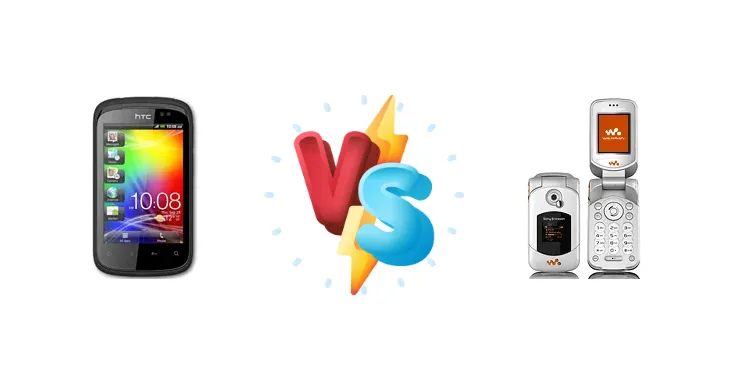
Remember the dawn of the smartphone era? These two devices, the HTC Explorer and the Sony Ericsson W300, represent a time of innovation and experimentation. Let's dive into a comparison of these relics, examining their strengths and weaknesses to see which one holds up best today.
🏆 Quick Verdict
The HTC Explorer edges out the Sony Ericsson W300 due to its slightly more powerful processor and known display specs. While the W300's features are charming, the Explorer offers a marginally better overall experience for those seeking a functional retro device. Both are limited by today's standards.
| Network |
|---|
| 2G bands | GSM 850 / 900 / 1800 / 1900 | GSM 850 / 900 / 1800 / 1900 |
| 3G bands | HSDPA 900 / 2100 | - |
| EDGE | No | Class 10 |
| GPRS | Class 10 | Class 10 |
| Speed | HSPA 14.4/5.76 Mbps | - |
| Technology | GSM / HSPA | GSM |
| Launch |
|---|
| Announced | 2011, September. Released 2011, October | 2006, February |
| Status | Discontinued | Discontinued |
| Body |
|---|
| Dimensions | 102.8 x 57.2 x 12.9 mm (4.05 x 2.25 x 0.51 in) | 90 x 47 x 24 mm (3.54 x 1.85 x 0.94 in) |
| SIM | Mini-SIM | Mini-SIM |
| Weight | 108 g (3.81 oz) | 94 g (3.32 oz) |
| Display |
|---|
| Resolution | 320 x 480 pixels, 3:2 ratio (~180 ppi density) | 128 x 160 pixels (~123 ppi density) |
| Size | 3.2 inches, 30.5 cm2 (~51.9% screen-to-body ratio) | 1.66 inches, 8.7 cm2 (~20.5% screen-to-body ratio) |
| Type | TFT, 256K colors | TFT, 256K colors |
| | - | Second external mono display (101 x 80 pixels)
Wallpapers, screensavers |
| Platform |
|---|
| CPU | 600 MHz Cortex A5 | - |
| Chipset | Qualcomm MSM7225A Snapdragon S1 | - |
| GPU | Adreno 200 | - |
| OS | Android 2.3 (Gingerbread), Sense UI 3.5 | - |
| Memory |
|---|
| Call records | Yes | 30 received, dialed and missed calls |
| Card slot | microSDHC (dedicated slot) | Memory Stick Micro (M2), up to 2 GB, 256 MB included |
| Internal | 512MB 512MB RAM | 20MB |
| Phonebook | 500 entries | 1000 x 20 fields, Photo call |
| Main Camera |
|---|
| Single | 3.15 MP | VGA |
| Video | 480p | QCIF |
| Sound |
|---|
| 3.5mm jack | Yes | No |
| 35mm jack | Yes | No |
| Alert types | - | Vibration; Downloadable polyphonic, MP3, MP4, WAVE, AMR, MIDI, iMelody ringtones, composer |
| Loudspeaker | Yes | Yes |
| | SRS surround | - |
| Comms |
|---|
| Bluetooth | 3.0, A2DP, EDR | Yes |
| Infrared port | - | Yes |
| Positioning | GPS, A-GPS | No |
| Radio | Stereo FM radio, RDS | Stereo FM radio, RDS |
| USB | microUSB 2.0 | 2.0 |
| WLAN | Wi-Fi 802.11 b/g/n, hotspot | No |
| Features |
|---|
| Browser | - | WAP 2.0/xHTML, HTML (NetFront) |
| Games | Downloadable | Yes + downloadable |
| Java | No | Yes, MIDP 2.0 |
| Messaging | SMS, MMS | SMS, EMS, MMS, Email, Instant Messaging |
| Sensors | Accelerometer, proximity | - |
| | MP3/eAAC+/WAV/WMA player
XviD/MP4/H.264/WMV player
Organizer
Voice memo
Predictive text input | Media player
Predictive text input
Photo editor
Organizer
RSS reader
Voice memo
Exchangeable Style-Up covers |
| Battery |
|---|
| Stand-by | Up to 485 h (2G) / Up to 445 h (3G) | Up to 400 h |
| Talk time | Up to 7 h 40 min (2G) / Up to 7 h 33 min (3G) | Up to 9 h |
| Type | Removable Li-Ion 1230 mAh battery | Removable Li-Po 900 mAh battery |
| Misc |
|---|
| Colors | Active Black, Active Navy, Metallic Black, Metallic Navy | Shadow Black, Shimmering White, Lime Green |
| Price | About 70 EUR | About 100 EUR |
| SAR | 1.56 W/kg (head) 0.75 W/kg (body) | 1.42 W/kg (head) 0.48 W/kg (body) |
| SAR EU | 1.24 W/kg (head) 0.72 W/kg (body) | 1.20 W/kg (head) |
| Tests |
|---|
| Audio quality |
Noise -82.4dB / Crosstalk -81.1dB | - |
| Camera |
Photo | - |
| Display |
Contrast ratio: 755:1 (nominal) | - |
| Loudspeaker |
Voice 66dB / Noise 66dB / Ring 79dB
| - |
HTC Explorer
- Android OS (early version)
- Slightly better performance
- Known display specs
- More versatile than a feature phone
- Outdated hardware
- Low resolution display
- Limited app support
- Poor camera quality
Sony Ericsson W300
- Compact and lightweight
- Classic Sony Ericsson design
- Potentially better battery life (feature phone)
- Dedicated music playback features
- No specific specs available
- Limited functionality
- Outdated technology
- Likely lower performance
Display Comparison
The HTC Explorer boasts a contrast ratio of 755:1, a respectable figure for its time. The Sony Ericsson W300's display is likely a standard QVGA screen common in feature phones of that era, offering lower resolution and contrast. The Explorer's display is likely the winner here, providing a slightly better viewing experience.
Camera Comparison
Both devices feature a photo camera, but details are scarce for the W300. The HTC Explorer's camera was basic by today's standards, likely offering a low-resolution image sensor. Image quality on both will be poor compared to modern smartphones, but the Explorer might have slightly better processing.
Performance
The HTC Explorer is powered by a Qualcomm MSM7225A Snapdragon S1 chipset with a 600 MHz Cortex A5 CPU. The Sony Ericsson W300 likely used a less powerful ARM processor, typical for feature phones. The Explorer's processor provides a noticeable performance advantage, allowing for smoother navigation and app usage (within the limitations of early Android).
Battery Life
Battery life for both devices would have been decent for their time, but modern usage patterns will drain them quickly. The Sony Ericsson W300, being a feature phone, likely had better battery efficiency due to its simpler functionality. However, the Explorer's larger size might allow for a slightly larger battery.
Buying Guide
The HTC Explorer is for those fascinated by early Android devices and seeking a basic, functional smartphone experience. The Sony Ericsson W300 appeals to nostalgia lovers and fans of Sony Ericsson's classic feature phones, prioritizing music playback and a compact form factor over advanced smartphone capabilities.
Frequently Asked Questions
❓ Are these phones usable in 2024?
While technically possible, using these phones in 2024 is challenging. App compatibility is extremely limited, and network support may be unavailable. They are primarily for collectors or those seeking a nostalgic experience.
❓ Can I find replacement parts for these phones?
Finding replacement parts is difficult. Both models are quite old, and parts availability is limited to online marketplaces and repair shops specializing in vintage electronics.