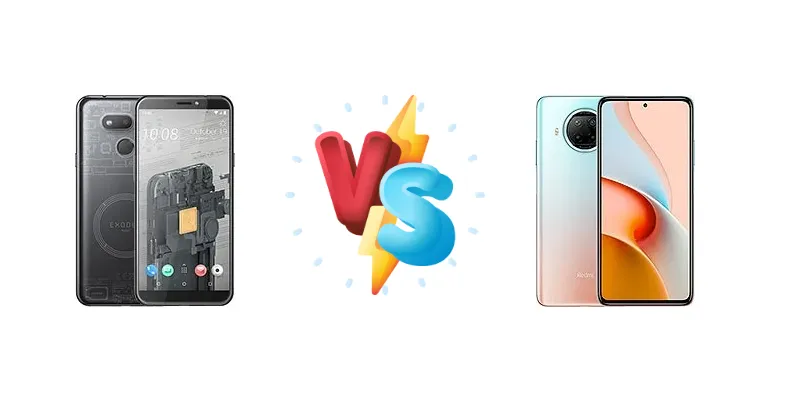
The HTC Exodus 1s, released with a focus on blockchain technology, represents an older generation of budget smartphones. The Xiaomi Redmi Note 9 Pro 5G, however, brings modern features like 5G connectivity and a more powerful processor to the table. This comparison dissects the core differences between these two devices, focusing on performance, battery, and overall value for the user.
🏆 Quick Verdict
For the vast majority of users, the Xiaomi Redmi Note 9 Pro 5G is the clear winner. Its Snapdragon 750G chipset delivers significantly faster performance, 5G connectivity, and 33W fast charging, all features the Exodus 1s lacks. While the Exodus 1s may appeal to niche blockchain enthusiasts, the Redmi Note 9 Pro 5G offers a far more compelling overall package.
| Network |
|---|
| 2G bands | GSM 850 / 900 / 1800 / 1900 | GSM 850 / 900 / 1800 / 1900 |
| 3G bands | HSDPA 850 / 900 / 1900 / 2100 | HSDPA 850 / 900 / 1900 / 2100 |
| 4G bands | 1, 3, 5, 7, 8, 20, 28, 38, 40, 41 | 1, 3, 5, 7, 8, 34, 38, 39, 40, 41 |
| 5G bands | - | 1, 3, 41, 78, 79 SA/NSA/Sub6 |
| Speed | HSPA 42.2/5.76 Mbps, LTE (2CA) Cat6 300/50 Mbps | HSPA, LTE, 5G |
| Technology | GSM / HSPA / LTE | GSM / CDMA / HSPA / EVDO / LTE / 5G |
| | - | CDMA2000 1xEV-DO |
| Launch |
|---|
| Announced | 2019, October 19. Released 2019, December | 2020, November 26 |
| Status | Discontinued | Available. Released 2020, December 01 |
| Body |
|---|
| Build | Glass front, plastic back, plastic frame | Glass front (Gorilla Glass 5), glass back (Gorilla Glass 5) |
| Dimensions | 154.2 x 72.7 x 8.3 mm (6.07 x 2.86 x 0.33 in) | 165.4 x 76.8 x 9 mm (6.51 x 3.02 x 0.35 in) |
| SIM | Nano-SIM + Nano-SIM | Nano-SIM + Nano-SIM |
| Weight | 150 g (5.29 oz) | 215 g (7.58 oz) |
| | - | IP53, dust and splash resistant |
| Display |
|---|
| Protection | - | Corning Gorilla Glass 5 |
| Resolution | 720 x 1440 pixels, 18:9 ratio (~282 ppi density) | 1080 x 2400 pixels, 20:9 ratio (~395 ppi density) |
| Size | 5.7 inches, 83.8 cm2 (~74.8% screen-to-body ratio) | 6.67 inches, 107.4 cm2 (~84.6% screen-to-body ratio) |
| Type | IPS LCD | IPS LCD, HDR10, 120Hz, 450 nits (typ) |
| Platform |
|---|
| CPU | Octa-core 1.4 GHz Cortex-A53 | Octa-core (2x2.2 GHz Kryo 570 & 6x1.8 GHz Kryo 570) |
| Chipset | Qualcomm SDM435 Snapdragon 435 (28 nm) | Qualcomm SM7225 Snapdragon 750G 5G (8 nm) |
| GPU | Adreno 505 | Adreno 619 |
| OS | Android 8.1 (Oreo) | Android 10, MIUI 12 |
| Memory |
|---|
| Card slot | No | microSDXC (uses shared SIM slot) |
| Internal | 64GB 4GB RAM | 128GB 6GB RAM, 128GB 8GB RAM, 256GB 8GB RAM |
| | eMMC 5.1 | UFS 2.2 |
| Main Camera |
|---|
| Features | LED flash, HDR, panorama | Dual-LED dual-tone flash, HDR, panorama |
| Quad | - | 108 MP, f/1.8, 26mm (wide), 1/1.52", 0.7µm, PDAF
8 MP, f/2.2, 118˚ (ultrawide), 1/4.0", 1.12µm
2 MP (macro)
Auxiliary lens |
| Single | 13 MP, PDAF | - |
| Video | 4K@30fps, 1080p@30fps | 4K@30fps, 1080p@30/60fps, gyro-EIS |
| Selfie camera |
|---|
| Features | LED flash, HDR | HDR, panorama |
| Single | 13 MP | 16 MP, f/2.5, (wide), 1/3.06", 1.0µm |
| Video | 1080p@30fps | 1080p@30fps, gyro-EIS |
| Sound |
|---|
| 3.5mm jack | Yes | Yes |
| 35mm jack | Yes | Yes |
| Loudspeaker | Yes | Yes, with stereo speakers |
| | - | 24-bit/192kHz audio |
| Comms |
|---|
| Bluetooth | 5.0, A2DP | 5.1, A2DP, LE |
| Infrared port | - | Yes |
| NFC | No | Yes |
| Positioning | GPS, GLONASS, GALILEO, BDS | GPS (L1+L5), GLONASS (G1), BDS (B1I+B2a), GALILEO (E1+E5a), QZSS (L1+L5) |
| Radio | No | Unspecified |
| USB | microUSB 2.0 | USB Type-C 2.0 |
| WLAN | Wi-Fi 802.11 a/b/g/n/ac, dual-band, Wi-Fi Direct | Wi-Fi 802.11 a/b/g/n/ac, dual-band, Wi-Fi Direct |
| Features |
|---|
| Sensors | Fingerprint (rear-mounted), accelerometer, proximity, compass | Fingerprint (side-mounted), accelerometer, gyro, compass |
| | Zion crypto wallet
Secure Enclave
Social Key Recovery (key sharding)
dApps (decentralized apps)
Bitcoin Full Node support | Virtual proximity sensing |
| Battery |
|---|
| Charging | - | 33W wired, 100% in 58 min |
| Type | Li-Ion 3075 mAh, non-removable | Li-Po 4820 mAh |
| Misc |
|---|
| Colors | Black | Gray, Blue, Red/Mint |
| Models | - | M2007J17C |
| Price | About 220 EUR | About 370 EUR |
HTC Exodus 1s
- Potential focus on privacy and blockchain features.
- May be available at a very low price point due to its age.
- Simple and straightforward user experience.
- Significantly slower performance compared to modern smartphones.
- Lacks 5G connectivity.
- Outdated chipset and limited software support.
Xiaomi Redmi Note 9 Pro 5G
- Faster Snapdragon 750G processor for smooth performance.
- 5G connectivity for faster data speeds.
- 33W fast charging for quick power-ups.
- May have more bloatware than the Exodus 1s.
- Xiaomi's MIUI software can be polarizing.
- Build quality may not be as premium as some flagship devices.
Display Comparison
Neither device's display specifications are provided, but given the Exodus 1s' age, it likely features a lower resolution and less color accurate panel than the Redmi Note 9 Pro 5G. Xiaomi typically equips its Redmi Note series with IPS LCDs offering good brightness and color reproduction for the price. The Redmi Note 9 Pro 5G likely benefits from a higher refresh rate, contributing to smoother scrolling and animations, a feature absent in the older Exodus 1s.
Camera Comparison
Without detailed camera specs, a direct comparison is difficult. However, Xiaomi’s Redmi Note series is known for including high-resolution main sensors. The Redmi Note 9 Pro 5G likely features a more capable primary camera than the Exodus 1s, offering better image quality in various lighting conditions. The Exodus 1s, being an older device, likely has a simpler camera system with less advanced image processing capabilities. The Redmi Note 9 Pro 5G’s image signal processor (ISP), integrated within the Snapdragon 750G, will also contribute to superior image processing.
Performance
The core difference lies in the chipsets. The HTC Exodus 1s utilizes the Qualcomm Snapdragon 435, a 28nm processor with Cortex-A53 cores clocked at 1.4 GHz. This is a decidedly entry-level chip. Conversely, the Xiaomi Redmi Note 9 Pro 5G boasts the Snapdragon 750G, built on an 8nm process. The 750G’s Kryo 570 cores (2x2.2 GHz and 6x1.8 GHz) offer a substantial performance uplift, particularly in multi-threaded tasks and gaming. The 8nm process also translates to improved power efficiency and reduced thermal throttling compared to the 28nm Snapdragon 435. Users will experience significantly faster app loading times, smoother multitasking, and a more responsive user experience on the Redmi Note 9 Pro 5G.
Battery Life
Battery capacity isn't specified for either device. However, the Redmi Note 9 Pro 5G’s 33W wired charging capability is a significant advantage. Achieving a 100% charge in just 58 minutes is considerably faster than what the Exodus 1s can likely achieve. While a larger battery capacity on the Exodus 1s could partially offset the charging speed difference, the Redmi Note 9 Pro 5G’s faster charging is a practical benefit for users who need to quickly top up their device.
Buying Guide
Buy the HTC Exodus 1s if your primary concern is a device with built-in blockchain features and you prioritize privacy above all else, accepting significant performance limitations. Buy the Xiaomi Redmi Note 9 Pro 5G if you want a modern, capable smartphone with 5G connectivity, faster processing speeds for gaming and everyday tasks, and quicker charging – all at a competitive price point.
Frequently Asked Questions
❓ Is the Snapdragon 435 in the HTC Exodus 1s sufficient for modern mobile games?
No, the Snapdragon 435 is a very basic processor and will struggle with most modern mobile games. Expect low frame rates, significant lag, and limited graphical settings even on less demanding titles. The Redmi Note 9 Pro 5G’s Snapdragon 750G is far better suited for gaming.
❓ Does the Xiaomi Redmi Note 9 Pro 5G support VoLTE and VoWiFi?
Generally, Xiaomi Redmi Note series phones support VoLTE (Voice over LTE) and VoWiFi (Voice over Wi-Fi) depending on the carrier and region. It's crucial to check compatibility with your specific mobile carrier before purchasing to ensure these features are available.
❓ What are the blockchain-specific features of the HTC Exodus 1s, and are they still relevant today?
The Exodus 1s featured a dedicated hardware enclave for storing private keys and a built-in crypto wallet. While these features were innovative at the time, their relevance has diminished as software-based crypto wallets have become more secure and user-friendly. The performance trade-offs for these features are substantial.