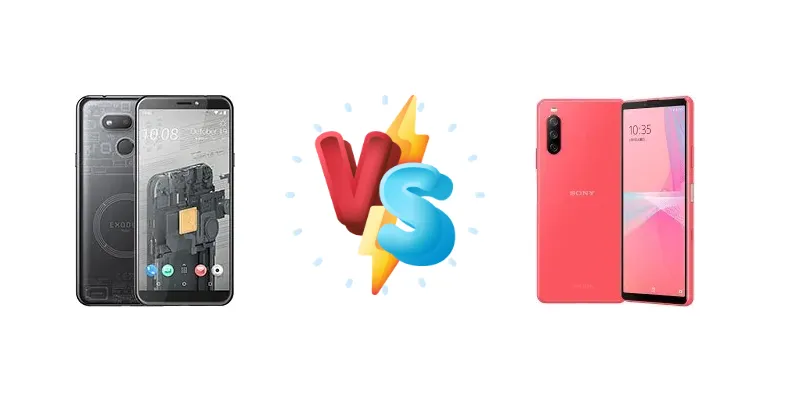
The HTC Exodus 1s, released in 2018, represented an early foray into blockchain-focused smartphones. The Sony Xperia 10 III Lite, arriving several years later, targets the mainstream budget 5G market. This comparison dissects the core hardware differences, revealing a substantial performance gap and highlighting which device offers the better value in 2024.
🏆 Quick Verdict
For the vast majority of users, the Sony Xperia 10 III Lite is the superior choice. Its Snapdragon 690 chipset, built on an 8nm process, provides a dramatically faster and more efficient experience than the HTC Exodus 1s’ Snapdragon 435. The addition of 5G connectivity and 30W fast charging further solidify its advantage.
| Network |
|---|
| 2G bands | GSM 850 / 900 / 1800 / 1900 | GSM 850 / 900 / 1800 / 1900 |
| 3G bands | HSDPA 850 / 900 / 1900 / 2100 | HSDPA 850 / 1900 |
| 4G bands | 1, 3, 5, 7, 8, 20, 28, 38, 40, 41 | 1, 3, 4, 12, 18, 19, 38, 41 |
| 5G bands | - | 77, 78 SA/NSA |
| Speed | HSPA 42.2/5.76 Mbps, LTE (2CA) Cat6 300/50 Mbps | HSPA, LTE, 5G |
| Technology | GSM / HSPA / LTE | GSM / HSPA / LTE / 5G |
| Launch |
|---|
| Announced | 2019, October 19. Released 2019, December | 2021, August 20 |
| Status | Discontinued | Available. Released 2021, August 27 |
| Body |
|---|
| Build | Glass front, plastic back, plastic frame | Glass front (Gorilla Glass 6), glass back (Gorilla Glass 6), plastic frame |
| Dimensions | 154.2 x 72.7 x 8.3 mm (6.07 x 2.86 x 0.33 in) | 154 x 68 x 8.3 mm (6.06 x 2.68 x 0.33 in) |
| SIM | Nano-SIM + Nano-SIM | Nano-SIM + eSIM |
| Weight | 150 g (5.29 oz) | 169 g (5.96 oz) |
| Display |
|---|
| Protection | - | Corning Gorilla Glass 6 |
| Resolution | 720 x 1440 pixels, 18:9 ratio (~282 ppi density) | 1080 x 2520 pixels, 21:9 ratio (~457 ppi density) |
| Size | 5.7 inches, 83.8 cm2 (~74.8% screen-to-body ratio) | 6.0 inches, 84.1 cm2 (~80.3% screen-to-body ratio) |
| Type | IPS LCD | OLED, 1B colors, HDR |
| Platform |
|---|
| CPU | Octa-core 1.4 GHz Cortex-A53 | Octa-core (2x2.0 GHz Kryo 560 Gold & 6x1.7 GHz Kryo 560 Silver) |
| Chipset | Qualcomm SDM435 Snapdragon 435 (28 nm) | Qualcomm SM6350 Snapdragon 690 5G (8 nm) |
| GPU | Adreno 505 | Adreno 619 |
| OS | Android 8.1 (Oreo) | Android 11 |
| Memory |
|---|
| Card slot | No | microSDXC (uses shared SIM slot) |
| Internal | 64GB 4GB RAM | 64GB 6GB RAM |
| | eMMC 5.1 | - |
| Main Camera |
|---|
| Features | LED flash, HDR, panorama | LED flash, HDR, panorama |
| Single | 13 MP, PDAF | - |
| Triple | - | 12 MP, f/1.8, 27mm (wide), 1/2.8", PDAF
8 MP, f/2.4, 54mm (telephoto), 1/4.0", PDAF, 2x optical zoom
8 MP, f/2.2, 16mm, 120˚ (ultrawide), 1/4.0" |
| Video | 4K@30fps, 1080p@30fps | 4K@30fps, 1080p@30fps |
| Selfie camera |
|---|
| Features | LED flash, HDR | HDR |
| Single | 13 MP | 8 MP, f/2.0, 24mm (wide), 1/4.0" |
| Video | 1080p@30fps | 1080p@30fps |
| Sound |
|---|
| 3.5mm jack | Yes | Yes |
| 35mm jack | Yes | Yes |
| Loudspeaker | Yes | Yes |
| Comms |
|---|
| Bluetooth | 5.0, A2DP | 5.1, A2DP, LE, aptX HD |
| NFC | No | Yes |
| Positioning | GPS, GLONASS, GALILEO, BDS | GPS, GLONASS, GALILEO, BDS, QZSS |
| Radio | No | No |
| USB | microUSB 2.0 | USB Type-C 3.1, OTG, video output |
| WLAN | Wi-Fi 802.11 a/b/g/n/ac, dual-band, Wi-Fi Direct | Wi-Fi 802.11 a/b/g/n/ac, dual-band, Wi-Fi Direct |
| Features |
|---|
| Sensors | Fingerprint (rear-mounted), accelerometer, proximity, compass | Fingerprint (side-mounted), accelerometer, proximity, compass |
| | Zion crypto wallet
Secure Enclave
Social Key Recovery (key sharding)
dApps (decentralized apps)
Bitcoin Full Node support | - |
| Battery |
|---|
| Charging | - | 30W wired, PD, QC |
| Type | Li-Ion 3075 mAh, non-removable | Li-Po 4500 mAh |
| Misc |
|---|
| Colors | Black | Black, White, Blue, Pink |
| Models | - | XQ-BT44 |
| Price | About 220 EUR | About 370 EUR |
HTC Exodus 1s
- Potentially lower price (due to age)
- Focus on privacy features (blockchain integration)
- Simple, straightforward Android experience
- Outdated Snapdragon 435 chipset
- Slow performance
- No 5G connectivity
- Slow charging
Sony Xperia 10 III Lite
- Significantly faster Snapdragon 690 chipset
- 5G connectivity
- 30W fast charging (PD, QC)
- More efficient 8nm process
- May be slightly more expensive
- Sony’s software can include bloatware
- Camera performance may not rival flagship devices
Display Comparison
Neither device is known for a standout display. Given the Exodus 1s' age, it likely utilizes an older LCD panel with lower brightness and color accuracy compared to the Xperia 10 III Lite. While specific nit ratings are unavailable for both, the Xperia 10 III Lite benefits from Sony’s image processing expertise, potentially offering a more vibrant and refined visual experience. Bezels are also likely larger on the Exodus 1s due to its older design.
Camera Comparison
Without detailed camera specs, a direct comparison is difficult. However, the Xperia 10 III Lite likely benefits from more advanced image signal processing (ISP) within the Snapdragon 690. The Exodus 1s, with its older chipset, will have a less sophisticated ISP, resulting in lower dynamic range and less detail in photos. While both may include multiple cameras, the Xperia 10 III Lite’s processing capabilities will likely yield superior image quality, especially in challenging lighting conditions. We can assume the Xperia 10 III Lite has a more capable main sensor.
Performance
The core difference lies in the chipsets. The Sony Xperia 10 III Lite’s Snapdragon 690 (8nm) is a significant upgrade over the HTC Exodus 1s’ Snapdragon 435 (28nm). The 690 features Kryo 560 cores – a mix of performance (Gold) and efficiency (Silver) – offering a substantial CPU performance boost. The 8nm process node also translates to improved thermal efficiency, reducing throttling during sustained tasks. The Exodus 1s’ Cortex-A53 cores, while adequate for basic tasks, will struggle with modern applications and multitasking. The 690 also includes a more capable Adreno 619 GPU, enabling smoother gaming experiences.
Battery Life
Battery capacity is not specified for either device. However, the Xperia 10 III Lite’s 30W wired charging with Power Delivery (PD) and Quick Charge (QC) support is a major advantage. The Exodus 1s likely utilizes slower charging technology. The Snapdragon 690’s 8nm process also contributes to better power efficiency, potentially offsetting any capacity difference. The faster charging of the Xperia 10 III Lite means less downtime and more usable time throughout the day.
Buying Guide
Buy the HTC Exodus 1s if your primary need is a very basic smartphone with a focus on privacy features and you are operating on an extremely limited budget. Buy the Sony Xperia 10 III Lite if you prioritize performance, 5G connectivity, faster charging, and a more modern user experience. The Xperia 10 III Lite is the clear choice for anyone who uses their phone for more than just basic calls and texts.
Frequently Asked Questions
❓ Is the Snapdragon 690 in the Xperia 10 III Lite capable of handling demanding games like PUBG Mobile?
Yes, the Snapdragon 690, paired with the Adreno 619 GPU, can comfortably run PUBG Mobile at medium to high settings with stable frame rates. While it won't match the performance of flagship chipsets, it provides a significantly better gaming experience than the Snapdragon 435 in the Exodus 1s.
❓ Does the HTC Exodus 1s' blockchain focus offer any real-world benefits for the average user?
The Exodus 1s' blockchain features, such as a secure enclave for cryptocurrency storage, are niche and unlikely to be utilized by most users. The added complexity doesn't outweigh the significant performance and feature limitations compared to the Xperia 10 III Lite.
❓ How much faster is the Snapdragon 690 compared to the Snapdragon 435 in real-world usage?
The Snapdragon 690 is approximately 60-80% faster than the Snapdragon 435 in CPU performance and offers a substantial improvement in GPU performance. This translates to snappier app launches, smoother multitasking, and a more responsive overall user experience.
❓ Will the Xperia 10 III Lite receive software updates for an extended period?
Sony typically provides two major Android updates and three years of security patches for its Xperia devices. While not as long as some competitors, it offers a more reliable update schedule than the HTC Exodus 1s, which is unlikely to receive further software support.