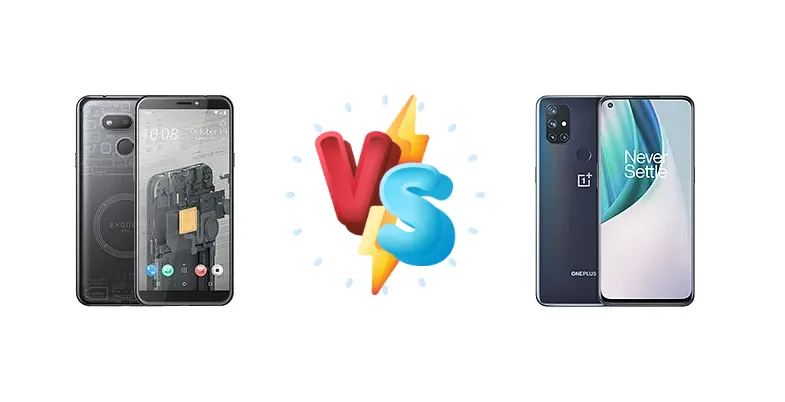
The HTC Exodus 1s, representing an older generation of budget smartphones, faces off against the OnePlus Nord N10 5G, a device aiming to deliver 5G connectivity and a modern experience at an accessible price point. This comparison dissects the core differences between these two phones, focusing on where the newer chipset and features of the N10 5G truly shine.
🏆 Quick Verdict
For the vast majority of users, the OnePlus Nord N10 5G is the clear winner. Its Snapdragon 690 chipset provides a substantial performance uplift over the Exodus 1s’ Snapdragon 435, coupled with faster charging and a brighter display. While both offer similar battery endurance ratings, the N10 5G’s overall experience is far more responsive and future-proof.
| Network |
|---|
| 2G bands | GSM 850 / 900 / 1800 / 1900 | GSM 850 / 900 / 1800 / 1900 |
| 3G bands | HSDPA 850 / 900 / 1900 / 2100 | HSDPA 850 / 900 / 1700(AWS) / 1900 / 2100 |
| 4G bands | 1, 3, 5, 7, 8, 20, 28, 38, 40, 41 | 1, 2, 3, 4, 5, 7, 8, 12, 17, 20, 28, 38, 39, 40, 41, 66 - International |
| 5G bands | - | 1, 3, 7, 28, 41, 66, 78 SA/NSA - International |
| Speed | HSPA 42.2/5.76 Mbps, LTE (2CA) Cat6 300/50 Mbps | HSPA 42.2/5.76 Mbps, LTE Cat18 1024/150 Mbps, 5G |
| Technology | GSM / HSPA / LTE | GSM / CDMA / HSPA / LTE / 5G |
| | - | 2, 5, 25, 41, 66, 71 SA/NSA - USA |
| Launch |
|---|
| Announced | 2019, October 19. Released 2019, December | 2020, October 26 |
| Status | Discontinued | Available. Released 2020, November 21 |
| Body |
|---|
| Build | Glass front, plastic back, plastic frame | Glass front (Gorilla Glass 3), plastic back, plastic frame |
| Dimensions | 154.2 x 72.7 x 8.3 mm (6.07 x 2.86 x 0.33 in) | 163 x 74.7 x 9 mm (6.42 x 2.94 x 0.35 in) |
| SIM | Nano-SIM + Nano-SIM | Nano-SIM + Nano-SIM |
| Weight | 150 g (5.29 oz) | 190 g (6.70 oz) |
| Display |
|---|
| Protection | - | Corning Gorilla Glass 3 |
| Resolution | 720 x 1440 pixels, 18:9 ratio (~282 ppi density) | 1080 x 2400 pixels, 20:9 ratio (~406 ppi density) |
| Size | 5.7 inches, 83.8 cm2 (~74.8% screen-to-body ratio) | 6.49 inches, 101.7 cm2 (~83.5% screen-to-body ratio) |
| Type | IPS LCD | IPS LCD, 90Hz |
| Platform |
|---|
| CPU | Octa-core 1.4 GHz Cortex-A53 | Octa-core (2x2.0 GHz Kryo 560 Gold & 6x1.7 GHz Kryo 560 Silver) |
| Chipset | Qualcomm SDM435 Snapdragon 435 (28 nm) | Qualcomm SM6350 Snapdragon 690 5G (8 nm) |
| GPU | Adreno 505 | Adreno 619L |
| OS | Android 8.1 (Oreo) | Android 10, OxygenOS 10.5 |
| Memory |
|---|
| Card slot | No | microSDXC |
| Internal | 64GB 4GB RAM | 128GB 6GB RAM |
| | eMMC 5.1 | UFS 2.1 |
| Main Camera |
|---|
| Features | LED flash, HDR, panorama | LED flash, HDR, panorama |
| Quad | - | 64 MP, f/1.8, (wide), 1/1.72", 0.8µm, PDAF
8 MP, f/2.3, 119˚ (ultrawide)
2 MP (macro)
Auxiliary lens |
| Single | 13 MP, PDAF | - |
| Video | 4K@30fps, 1080p@30fps | 4K@30fps, 1080p@30/60/120fps; gyro-EIS |
| Selfie camera |
|---|
| Features | LED flash, HDR | HDR |
| Single | 13 MP | 16 MP, f/2.1 |
| Video | 1080p@30fps | 1080p@30/60fps, gyro-EIS |
| Sound |
|---|
| 3.5mm jack | Yes | Yes |
| 35mm jack | Yes | Yes |
| Loudspeaker | Yes | Yes, with dual speakers |
| Comms |
|---|
| Bluetooth | 5.0, A2DP | 5.1, A2DP, LE |
| NFC | No | Yes |
| Positioning | GPS, GLONASS, GALILEO, BDS | GPS (L1+L5), GLONASS, GALILEO, BDS |
| Radio | No | No |
| USB | microUSB 2.0 | USB Type-C 2.0, OTG |
| WLAN | Wi-Fi 802.11 a/b/g/n/ac, dual-band, Wi-Fi Direct | Wi-Fi 802.11 a/b/g/n/ac, dual-band, Wi-Fi Direct |
| Features |
|---|
| Sensors | Fingerprint (rear-mounted), accelerometer, proximity, compass | Fingerprint (rear-mounted), accelerometer, gyro, proximity, compass |
| | Zion crypto wallet
Secure Enclave
Social Key Recovery (key sharding)
dApps (decentralized apps)
Bitcoin Full Node support | - |
| Battery |
|---|
| Charging | - | 30W wired |
| Type | Li-Ion 3075 mAh, non-removable | Li-Po 4300 mAh |
| Misc |
|---|
| Colors | Black | Midnight Ice |
| Models | - | BE2029, BE2025, BE2026, BE2028 |
| Price | About 220 EUR | About 250 EUR |
| Tests |
|---|
| Battery life | - |
Endurance rating 99h
|
| Camera | - |
Photo / Video |
| Loudspeaker | - |
-25.8 LUFS (Very good)
|
| Performance | - |
AnTuTu: 279579 (v8)
GeekBench: 1848 (v5.1)
GFXBench: 13fps (ES 3.1 onscreen) |
HTC Exodus 1s
- Potentially simpler software experience (depending on ROM)
- May be available at a significantly lower price point (due to age)
- Basic functionality for essential tasks
- Outdated Snapdragon 435 chipset
- Likely poor performance with modern apps
- Lower display brightness and contrast
- Slow charging speeds
OnePlus Nord N10 5G
- Significantly faster Snapdragon 690 5G chipset
- 30W fast charging
- Brighter and higher contrast display
- 5G connectivity
- Software experience may not appeal to all users
- Build quality may feel less premium than some competitors
- Camera performance is good, but not exceptional
Display Comparison
The OnePlus Nord N10 5G boasts a significantly more usable display experience. While both lack high-end panel technologies like LTPO, the N10 5G’s measured 440 nits of peak brightness is considerably higher than what the Exodus 1s likely achieves (data unavailable, but typical for the segment). The 1447:1 contrast ratio on the N10 5G also contributes to a more vibrant image. The Exodus 1s, being an older model, likely suffers from lower brightness and contrast, making it less visible outdoors.
Camera Comparison
Both phones are listed as having 'Photo / Video' capabilities, but the underlying hardware is likely vastly different. Without specific sensor details for the Exodus 1s, it’s safe to assume it utilizes a lower-resolution sensor and lacks features like Optical Image Stabilization (OIS) found in more modern budget phones. The N10 5G, while not a camera champion, benefits from a more advanced image signal processor (ISP) within the Snapdragon 690, leading to better image quality and video stabilization. The inclusion of a dedicated Night Mode on the N10 5G is also a significant advantage.
Performance
The performance gap between these two devices is substantial. The OnePlus Nord N10 5G’s Snapdragon 690, built on an 8nm process, is a generational leap over the HTC Exodus 1s’ Snapdragon 435 (28nm). The 690 features Kryo 560 cores – a mix of performance (Gold) and efficiency (Silver) – allowing for better multitasking and responsiveness. The 435’s Cortex-A53 cores, while adequate for basic tasks, struggle with demanding applications. The 8nm node of the 690 also translates to improved thermal efficiency, reducing the likelihood of throttling during sustained use. This means the N10 5G will maintain performance for longer periods.
Battery Life
Interestingly, both devices share an endurance rating of 99 hours. However, this doesn't tell the whole story. The Snapdragon 690’s improved efficiency partially offsets any potential battery capacity differences (data unavailable for Exodus 1s). More importantly, the N10 5G’s 30W wired charging is a game-changer. This allows for a significantly faster 0-100% charge time compared to the Exodus 1s, which likely supports a much slower charging speed. This rapid charging capability provides a more convenient user experience.
Buying Guide
Buy the HTC Exodus 1s if your primary need is a very basic smartphone for essential tasks like calls and messaging, and you prioritize a minimal software footprint. Buy the OnePlus Nord N10 5G if you want a phone capable of handling modern apps, streaming video, and occasional gaming, with the added benefit of 5G connectivity and significantly faster performance.
Frequently Asked Questions
❓ Is the Snapdragon 435 in the HTC Exodus 1s sufficient for running popular social media apps like TikTok and Instagram?
While the Snapdragon 435 can technically run these apps, expect a sluggish experience with frequent lag and slow loading times. The processor struggles with the demands of modern app development and the associated animations and features. The OnePlus Nord N10 5G’s Snapdragon 690 provides a much smoother and more responsive experience.
❓ How much faster is the charging on the OnePlus Nord N10 5G compared to the HTC Exodus 1s?
The OnePlus Nord N10 5G supports 30W fast charging, which can typically charge the phone from 0-100% in around an hour. The HTC Exodus 1s likely supports standard 5W or 10W charging, meaning a full charge could take upwards of 4-6 hours. This difference is substantial and significantly impacts daily usability.
❓ Will the OnePlus Nord N10 5G be able to handle graphically demanding games like PUBG Mobile?
The Snapdragon 690 in the N10 5G can run PUBG Mobile, but you'll likely need to lower the graphics settings to achieve a smooth frame rate. It won't deliver a flagship-level gaming experience, but it's far more capable than the Exodus 1s, which would struggle to run the game at playable settings.