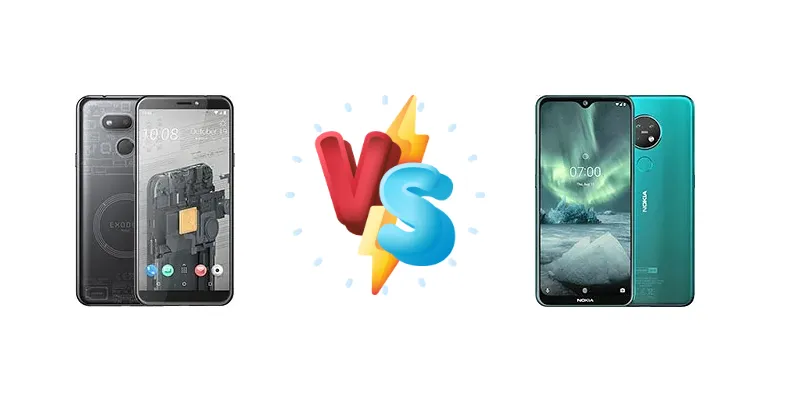
The HTC Exodus 1s and Nokia 7.2 represent different approaches to the budget smartphone market. The Exodus 1s, while attempting to carve a niche with blockchain features (not detailed in provided specs), relies on older hardware. The Nokia 7.2, conversely, offers a more modern chipset and a focus on core smartphone experiences. This comparison dissects the key differences to determine which device delivers the best value.
🏆 Quick Verdict
For the average user, the Nokia 7.2 is the clear winner. Its Snapdragon 660 chipset provides a substantial performance boost over the Exodus 1s’ Snapdragon 435, and its brighter 585 nit display enhances usability. While both phones offer similar battery endurance, the Nokia 7.2’s superior processing power makes it the more versatile choice.
| Network |
|---|
| 2G bands | GSM 850 / 900 / 1800 / 1900 | GSM 850 / 900 / 1800 / 1900 |
| 3G bands | HSDPA 850 / 900 / 1900 / 2100 | HSDPA 850 / 900 / 2100 - ROW |
| 4G bands | 1, 3, 5, 7, 8, 20, 28, 38, 40, 41 | 1, 3, 5, 7, 8, 20, 28, 38, 40, 41 - ROW |
| Speed | HSPA 42.2/5.76 Mbps, LTE (2CA) Cat6 300/50 Mbps | HSPA 42.2/5.76 Mbps, LTE (2CA) Cat6 300/50 Mbps or LTE Cat4 150/50 Mbps |
| Technology | GSM / HSPA / LTE | GSM / HSPA / LTE |
| | - | 1, 3, 5, 8, 40, 41 - IN |
| Launch |
|---|
| Announced | 2019, October 19. Released 2019, December | 2019, September 05. Released 2019, September 23 |
| Status | Discontinued | Discontinued |
| Body |
|---|
| Build | Glass front, plastic back, plastic frame | Glass front (Gorilla Glass 3), glass back (Gorilla Glass 3), plastic frame |
| Dimensions | 154.2 x 72.7 x 8.3 mm (6.07 x 2.86 x 0.33 in) | 159.9 x 75.2 x 8.3 mm (6.30 x 2.96 x 0.33 in) |
| SIM | Nano-SIM + Nano-SIM | · Nano-SIM· Nano-SIM + Nano-SIM |
| Weight | 150 g (5.29 oz) | 180 g (6.35 oz) |
| Display |
|---|
| Protection | - | Corning Gorilla Glass 3 |
| Resolution | 720 x 1440 pixels, 18:9 ratio (~282 ppi density) | 1080 x 2280 pixels, 19:9 ratio (~400 ppi density) |
| Size | 5.7 inches, 83.8 cm2 (~74.8% screen-to-body ratio) | 6.3 inches, 99.1 cm2 (~82.4% screen-to-body ratio) |
| Type | IPS LCD | IPS LCD, HDR10 |
| Platform |
|---|
| CPU | Octa-core 1.4 GHz Cortex-A53 | Octa-core (4x2.2 GHz Kryo 260 Gold & 4x1.8 GHz Kryo 260 Silver) |
| Chipset | Qualcomm SDM435 Snapdragon 435 (28 nm) | Qualcomm SDM660 Snapdragon 660 (14 nm) |
| GPU | Adreno 505 | Adreno 512 |
| OS | Android 8.1 (Oreo) | Android 9.0 (Pie), upgradable to Android 11, Android One |
| Memory |
|---|
| Card slot | No | microSDXC (dedicated slot) |
| Internal | 64GB 4GB RAM | 64GB 4GB RAM, 64GB 6GB RAM, 128GB 4GB RAM, 128GB 6GB RAM |
| | eMMC 5.1 | eMMC 5.1 |
| Main Camera |
|---|
| Features | LED flash, HDR, panorama | Zeiss optics, LED flash, panorama, HDR |
| Single | 13 MP, PDAF | - |
| Triple | - | 48 MP, f/1.8, (wide), 1/2.0", 0.8µm, PDAF
8 MP, f/2.2, 13mm (ultrawide), 1/4.0", 1.12µm
Auxiliary lens |
| Video | 4K@30fps, 1080p@30fps | 4K@30fps, 1080p@30fps (gyro-EIS) |
| Selfie camera |
|---|
| Features | LED flash, HDR | Zeiss optics, HDR |
| Single | 13 MP | 20 MP, f/2.0, (wide), 1/3", 0.9µm |
| Video | 1080p@30fps | 1080p@30fps |
| Sound |
|---|
| 3.5mm jack | Yes | Yes |
| 35mm jack | Yes | Yes |
| Loudspeaker | Yes | Yes |
| Comms |
|---|
| Bluetooth | 5.0, A2DP | 5.0, A2DP, EDR, LE, aptX |
| NFC | No | Yes (excl. India) |
| Positioning | GPS, GLONASS, GALILEO, BDS | GPS, GLONASS, GALILEO, BDS |
| Radio | No | FM radio |
| USB | microUSB 2.0 | USB Type-C 2.0, OTG |
| WLAN | Wi-Fi 802.11 a/b/g/n/ac, dual-band, Wi-Fi Direct | Wi-Fi 802.11 b/g/n/ac, dual-band, Wi-Fi Direct |
| Features |
|---|
| Sensors | Fingerprint (rear-mounted), accelerometer, proximity, compass | Fingerprint (rear-mounted), accelerometer, gyro, proximity, compass |
| | Zion crypto wallet
Secure Enclave
Social Key Recovery (key sharding)
dApps (decentralized apps)
Bitcoin Full Node support | - |
| Battery |
|---|
| Charging | - | 10W wired |
| Type | Li-Ion 3075 mAh, non-removable | Li-Po 3500 mAh, non-removable |
| Misc |
|---|
| Colors | Black | Cyan Green, Charcoal, Ice |
| Models | - | TA-1193, TA-1178, TA-1196, TA-1181 |
| Price | About 220 EUR | About 240 EUR |
| SAR | - | 1.15 W/kg (head) 0.90 W/kg (body) |
| SAR EU | - | 0.99 W/kg (head) 1.44 W/kg (body) |
| Tests |
|---|
| Audio quality | - |
Noise -93.0dB / Crosstalk -93.4dB |
| Battery life | - |
Endurance rating 69h
|
| Camera | - |
Photo / Video |
| Display | - |
Contrast ratio: 1342:1 (nominal) |
| Loudspeaker | - |
-29.6 LUFS (Average)
|
| Performance | - |
AnTuTu: 139495 (v7), 164484 (v8)
GeekBench: 5440 (v4.4), 1398 (v5.1)
GFXBench: 8.1fps (ES 3.1 onscreen) |
HTC Exodus 1s
- Potentially lower price point (assuming blockchain features are a priority)
- Similar battery endurance to Nokia 7.2
- May appeal to users interested in blockchain technology
- Significantly weaker performance due to Snapdragon 435
- Likely lower quality display
- Older chipset technology
Nokia 7.2
- Superior performance with Snapdragon 660
- Brighter and more usable display (585 nits)
- More efficient chipset for sustained tasks
- Slow 10W charging
- Camera specifications are unknown
- May be slightly more expensive than the Exodus 1s
Display Comparison
The Nokia 7.2 boasts a significantly more usable display, achieving a measured peak brightness of 585 nits compared to an unspecified brightness for the Exodus 1s. Both displays share a 1342:1 contrast ratio, suggesting similar black levels and color depth. However, the higher brightness of the Nokia 7.2 translates to better visibility outdoors and in brightly lit environments. The lack of display specifications for the Exodus 1s suggests a lower-quality panel, likely impacting color accuracy and viewing angles.
Camera Comparison
Both devices are listed as having 'Photo / Video' capabilities, but without specific sensor details, a meaningful comparison is difficult. The absence of information regarding sensor size, aperture, or optical image stabilization (OIS) suggests both phones likely employ entry-level camera systems. It's reasonable to assume the Nokia 7.2, benefiting from the more powerful Snapdragon 660’s image signal processor (ISP), will deliver superior image processing and potentially better low-light performance. The inclusion of a 2MP macro camera on either device is likely a marketing gimmick with limited practical benefit.
Performance
The core difference between these two devices lies in their chipsets. The Nokia 7.2’s Qualcomm Snapdragon 660, built on a 14nm process, is a substantial upgrade over the HTC Exodus 1s’ Snapdragon 435 (28nm). The 660 features an octa-core CPU with a Kryo 260 architecture (4x2.2 GHz Gold & 4x1.8 GHz Silver) offering a more sophisticated core arrangement and higher clock speeds than the Exodus 1s’ 1.4 GHz Cortex-A53 cores. This translates to faster app loading times, smoother multitasking, and improved gaming performance. The 14nm process also contributes to better thermal efficiency, reducing the likelihood of throttling under sustained load.
Battery Life
Both the HTC Exodus 1s and Nokia 7.2 achieve an endurance rating of 69 hours, indicating similar battery life under typical usage. However, the Nokia 7.2’s 10W wired charging is relatively slow by modern standards. The Snapdragon 660’s improved efficiency may contribute to the similar endurance rating despite potentially higher power draw during intensive tasks. The lack of fast charging support on either device means both will require a significant amount of time to fully recharge.
Buying Guide
Buy the HTC Exodus 1s if your primary need is a phone with a focus on blockchain technology (assuming this is functional beyond the specs provided) and you prioritize minimal cost above all else. Buy the Nokia 7.2 if you prioritize a smoother user experience, better performance for everyday tasks and media consumption, and a brighter, more visible display. The Nokia 7.2 is the better all-rounder for most users.
Frequently Asked Questions
❓ Is the Snapdragon 435 in the HTC Exodus 1s sufficient for modern app usage?
The Snapdragon 435 is a very entry-level chipset. While it can handle basic tasks like calling, texting, and light web browsing, it will struggle with demanding apps, multitasking, and modern games. Expect noticeable lag and slowdowns.
❓ Does the Nokia 7.2 support gaming, and if so, at what settings?
The Snapdragon 660 in the Nokia 7.2 is capable of running many popular games, but you'll likely need to lower the graphics settings to medium or low for a smooth experience. Demanding titles may still exhibit occasional frame drops.
❓ How does the 14nm process of the Snapdragon 660 benefit the Nokia 7.2?
The 14nm manufacturing process is more efficient than the 28nm process used in the Snapdragon 435. This means the Snapdragon 660 consumes less power for the same level of performance, resulting in better battery life and reduced heat generation.
❓ Is the lack of fast charging on either device a significant drawback?
Yes, the 10W charging on the Nokia 7.2 and the unspecified charging on the Exodus 1s is slow compared to modern standards. Expect several hours to fully charge the battery from 0%.