
HTC Exodus 1s vs. Google Pixel 4a 5G: A Generational Gap in Performance
| Phones Images | |||||
|---|---|---|---|---|---|
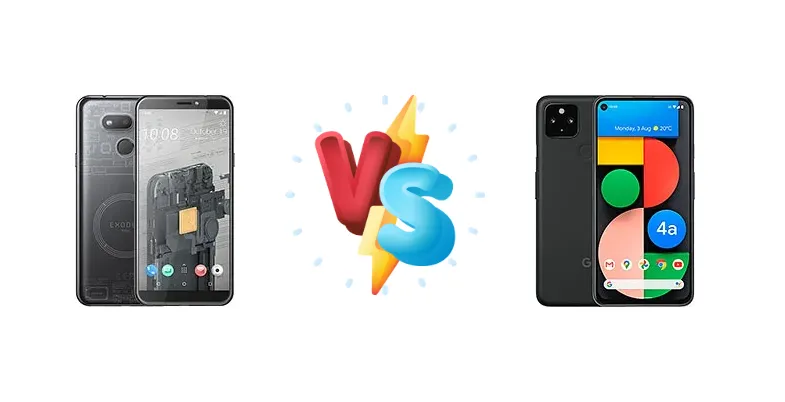
|
🏆 Quick Verdict
For the vast majority of users, the Google Pixel 4a 5G is the clear winner. Its Snapdragon 765G chipset, built on a 7nm process, delivers substantially better performance, 5G capabilities, and future-proofing compared to the aging Snapdragon 435 in the HTC Exodus 1s. While the Exodus 1s may appeal to a very specific user, the Pixel 4a 5G offers a far more compelling overall experience.
| PHONES | ||
|---|---|---|
| Phone Names | HTC Exodus 1s | Google Pixel 4a 5G |
| Network | ||
|---|---|---|
| 2G bands | GSM 850 / 900 / 1800 / 1900 | GSM 850 / 900 / 1800 / 1900 |
| 3G bands | HSDPA 850 / 900 / 1900 / 2100 | HSDPA 850 / 900 / 1700(AWS) / 1900 / 2100 |
| 4G bands | 1, 3, 5, 7, 8, 20, 28, 38, 40, 41 | 1, 2, 3, 4, 5, 7, 8, 12, 13, 14, 17, 18, 19, 20, 25, 26, 28, 29, 30, 32, 38, 39, 40, 41, 42, 46, 48, 66, 71 |
| 5G bands | - | 1, 2, 3, 5, 7, 8, 12, 28, 41, 66, 71, 77, 78 Sub6, mmWave (market dependant) |
| Speed | HSPA 42.2/5.76 Mbps, LTE (2CA) Cat6 300/50 Mbps | HSPA, LTE, 5G |
| Technology | GSM / HSPA / LTE | GSM / HSPA / LTE / 5G |
| Launch | ||
|---|---|---|
| Announced | 2019, October 19. Released 2019, December | 2020, September 30 |
| Status | Discontinued | Available. Released 2020, November 05 |
| Body | ||
|---|---|---|
| Build | Glass front, plastic back, plastic frame | Glass front (Gorilla Glass 3), plastic back, plastic frame |
| Dimensions | 154.2 x 72.7 x 8.3 mm (6.07 x 2.86 x 0.33 in) | 153.9 x 74 x 8.2 mm (Sub-6) or 8.5 mm (Sub-6 and mmWave) |
| SIM | Nano-SIM + Nano-SIM | Nano-SIM + eSIM |
| Weight | 150 g (5.29 oz) | 168 g (5G Sub-6); 171 g ( 5G Sub-6 and mmWave) (5.93 oz) |
| Display | ||
|---|---|---|
| Protection | - | Corning Gorilla Glass 3 |
| Resolution | 720 x 1440 pixels, 18:9 ratio (~282 ppi density) | 1080 x 2340 pixels, 19.5:9 ratio (~413 ppi density) |
| Size | 5.7 inches, 83.8 cm2 (~74.8% screen-to-body ratio) | 6.2 inches, 95.7 cm2 (~84.1% screen-to-body ratio) |
| Type | IPS LCD | OLED, HDR |
| - | Always-on display | |
| Platform | ||
|---|---|---|
| CPU | Octa-core 1.4 GHz Cortex-A53 | Octa-core (1x2.4 GHz Kryo 475 Prime & 1x2.2 GHz Kryo 475 Gold & 6x1.8 GHz Kryo 475 Silver) |
| Chipset | Qualcomm SDM435 Snapdragon 435 (28 nm) | Qualcomm SM7250 Snapdragon 765G 5G (7 nm) |
| GPU | Adreno 505 | Adreno 620 |
| OS | Android 8.1 (Oreo) | Android 11, upgradable to Android 14 |
| Memory | ||
|---|---|---|
| Card slot | No | No |
| Internal | 64GB 4GB RAM | 128GB 6GB RAM |
| eMMC 5.1 | UFS 2.1 | |
| Main Camera | ||
|---|---|---|
| Dual | - | 12.2 MP, f/1.7, 27mm (wide), 1/2.55", 1.4µm, dual pixel PDAF, OIS 16 MP, f/2.2, 107˚ (ultrawide), 1.0µm |
| Features | LED flash, HDR, panorama | LED flash, Pixel Shift, Auto-HDR, panorama |
| Single | 13 MP, PDAF | - |
| Video | 4K@30fps, 1080p@30fps | 4K@30/60fps, 1080p@30/60/120/240fps; gyro-EIS |
| Selfie camera | ||
|---|---|---|
| Features | LED flash, HDR | HDR |
| Single | 13 MP | 8 MP, f/2.0, 24mm (wide), 1/4.0", 1.12µm |
| Video | 1080p@30fps | 1080p@30fps |
| Sound | ||
|---|---|---|
| 3.5mm jack | Yes | Yes |
| 35mm jack | Yes | Yes |
| Loudspeaker | Yes | Yes, with stereo speakers |
| Comms | ||
|---|---|---|
| Bluetooth | 5.0, A2DP | 5.0, A2DP, LE, aptX HD |
| NFC | No | Yes |
| Positioning | GPS, GLONASS, GALILEO, BDS | GPS, GLONASS, GALILEO, QZSS, BDS |
| Radio | No | No |
| USB | microUSB 2.0 | USB Type-C 3.1 |
| WLAN | Wi-Fi 802.11 a/b/g/n/ac, dual-band, Wi-Fi Direct | Wi-Fi 802.11 a/b/g/n/ac, dual-band, Wi-Fi Direct |
| Features | ||
|---|---|---|
| Sensors | Fingerprint (rear-mounted), accelerometer, proximity, compass | Fingerprint (rear-mounted), accelerometer, gyro, proximity, compass, barometer |
| Zion crypto wallet Secure Enclave Social Key Recovery (key sharding) dApps (decentralized apps) Bitcoin Full Node support | - | |
| Battery | ||
|---|---|---|
| Charging | - | 18W wired, PD2.0 |
| Type | Li-Ion 3075 mAh, non-removable | Li-Po 3885 mAh |
| Misc | ||
|---|---|---|
| Colors | Black | Just Black, Clearly White |
| Models | - | GD1YQ, G025I, G025E, G025H, G6QU3 |
| Price | About 220 EUR | About 140 EUR |
HTC Exodus 1s
- Focus on blockchain and privacy features
- Potentially lower price point (depending on availability)
- May appeal to niche users interested in decentralized technology
- Significantly outdated Snapdragon 435 chipset
- Poor performance for modern applications and games
- Limited software support and updates
- Inferior camera capabilities
Google Pixel 4a 5G
- Powerful Snapdragon 765G chipset for smooth performance
- 5G connectivity for faster data speeds
- Excellent camera quality with Google’s computational photography
- Clean Android experience with timely updates
- Fast 18W charging with PD2.0
- May be slightly more expensive than the Exodus 1s
- Plastic build quality
Display Comparison
Detailed display specifications are unavailable for the Exodus 1s, but given its market positioning, it likely features a 720p or 1080p LCD panel. The Pixel 4a 5G, in contrast, boasts a 6.6-inch FHD+ (2400 x 1080) OLED display. The OLED panel on the Pixel 4a 5G provides superior contrast, color accuracy, and viewing angles. The 7nm Snapdragon 765G's ISP also supports better image processing for the display. While both likely have standard 60Hz refresh rates, the Pixel's superior panel technology is a significant advantage.
Camera Comparison
Camera details for the Exodus 1s are limited, but it likely features a basic camera setup. The Pixel 4a 5G, benefiting from Google’s computational photography expertise and the Snapdragon 765G’s image signal processor, offers a significantly more capable camera system. While specific sensor sizes aren't provided for the Exodus 1s, the Pixel 4a 5G’s main sensor, combined with Google’s software algorithms, delivers excellent image quality in various lighting conditions. The 765G's ISP enables features like Night Sight and HDR+ that are absent on the Exodus 1s.
Performance
The performance disparity is the most significant difference. The HTC Exodus 1s utilizes the Qualcomm Snapdragon 435, a 28nm chipset with an octa-core Cortex-A53 CPU clocked at 1.4 GHz. This is a budget-oriented processor designed for basic tasks. The Google Pixel 4a 5G, however, is powered by the Snapdragon 765G, a 7nm chipset featuring a Kryo 475 CPU with a prime core clocked at 2.4 GHz, a gold core at 2.2 GHz, and six silver cores at 1.8 GHz. The 7nm process node allows for significantly higher transistor density and improved power efficiency, resulting in substantially faster performance and reduced thermal throttling. The 765G's Adreno 620 GPU also provides a massive leap in graphics performance, making the Pixel 4a 5G suitable for moderate gaming, while the Exodus 1s will struggle with even less demanding titles.
Battery Life
Battery capacity for the Exodus 1s is unknown, but its less powerful chipset and likely lower-resolution display suggest it could offer comparable battery life to the Pixel 4a 5G’s 3885 mAh battery. However, the Pixel 4a 5G supports 18W wired charging with PD2.0, allowing for faster charging speeds. The Snapdragon 765G’s power efficiency also contributes to better overall battery endurance, especially during demanding tasks. The Exodus 1s, with its older chipset, will likely drain faster under load.
Buying Guide
Buy the HTC Exodus 1s if your primary need is a phone with a focus on blockchain technology and you prioritize privacy features above all else, and are willing to accept significant performance limitations. Buy the Google Pixel 4a 5G if you prioritize a smooth, responsive user experience, 5G connectivity, a capable camera, and timely software updates – essentially, a modern smartphone experience.