
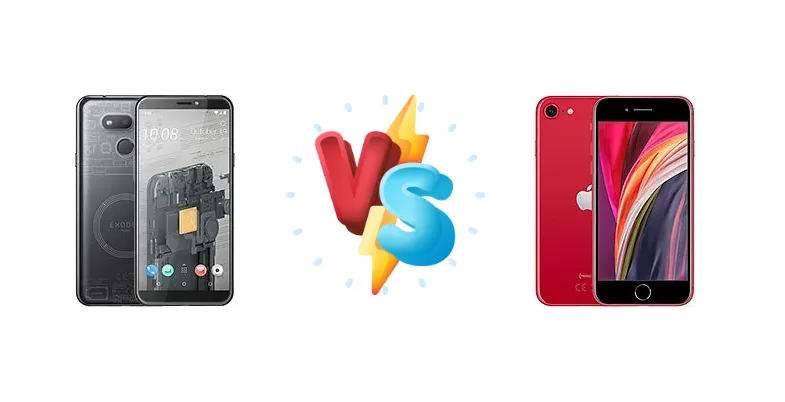
HTC Exodus 1s vs. Apple iPhone SE (2020): A Performance and Value Showdown
| Phones Images | |||||
|---|---|---|---|---|---|
|
🏆 Quick Verdict
For the vast majority of users, the Apple iPhone SE (2020) is the clear winner. Its A13 Bionic chip provides a level of performance the Snapdragon 435 simply cannot match, offering a smoother, more responsive experience for demanding tasks and future-proofing. While the Exodus 1s has a unique focus, the SE’s overall package is far more compelling.
| PHONES | ||
|---|---|---|
| Phone Names | HTC Exodus 1s | Apple iPhone SE (2020) |
| Network | ||
|---|---|---|
| 2G bands | GSM 850 / 900 / 1800 / 1900 | GSM 850 / 900 / 1800 / 1900 |
| 3G bands | HSDPA 850 / 900 / 1900 / 2100 | HSDPA 850 / 900 / 1700(AWS) / 1900 / 2100 |
| 4G bands | 1, 3, 5, 7, 8, 20, 28, 38, 40, 41 | 1, 2, 3, 4, 5, 7, 8, 11, 12, 13, 17, 18, 19, 20, 21, 25, 26, 28, 29, 30, 32, 34, 38, 39, 40, 41, 42, 46, 48, 66 - A2296 |
| Speed | HSPA 42.2/5.76 Mbps, LTE (2CA) Cat6 300/50 Mbps | HSPA 42.2/5.76 Mbps, LTE (5CA) Cat16 1024/150 Mbps, EV-DO Rev.A 3.1 Mbps |
| Technology | GSM / HSPA / LTE | GSM / CDMA / HSPA / EVDO / LTE |
| - | 1, 2, 3, 4, 5, 7, 8, 12, 13, 14, 17, 18, 19, 20, 25, 26, 29, 30, 34, 38, 39, 40, 41, 42, 46, 48, 66, 71 - A2275, A2298 | |
| Launch | ||
|---|---|---|
| Announced | 2019, October 19. Released 2019, December | 2020, April 15 |
| Status | Discontinued | Available. Released 2020, April 24 |
| Body | ||
|---|---|---|
| Build | Glass front, plastic back, plastic frame | Glass front, glass back, aluminum frame |
| Dimensions | 154.2 x 72.7 x 8.3 mm (6.07 x 2.86 x 0.33 in) | 138.4 x 67.3 x 7.3 mm (5.45 x 2.65 x 0.29 in) |
| SIM | Nano-SIM + Nano-SIM | Nano-SIM + eSIM |
| Weight | 150 g (5.29 oz) | 148 g (5.22 oz) |
| - | IP67 dust/water resistant (up to 1m for 30 min) Apple Pay (Visa, MasterCard, AMEX certified) | |
| Display | ||
|---|---|---|
| Protection | - | Ion-strengthened glass |
| Resolution | 720 x 1440 pixels, 18:9 ratio (~282 ppi density) | 750 x 1334 pixels, 16:9 ratio (~326 ppi density) |
| Size | 5.7 inches, 83.8 cm2 (~74.8% screen-to-body ratio) | 4.7 inches, 60.9 cm2 (~65.4% screen-to-body ratio) |
| Type | IPS LCD | Retina IPS LCD, 625 nits (typ) |
| Platform | ||
|---|---|---|
| CPU | Octa-core 1.4 GHz Cortex-A53 | Hexa-core (2x2.65 GHz Lightning + 4x1.8 GHz Thunder) |
| Chipset | Qualcomm SDM435 Snapdragon 435 (28 nm) | Apple A13 Bionic (7 nm+) |
| GPU | Adreno 505 | Apple GPU (4-core graphics) |
| OS | Android 8.1 (Oreo) | iOS 13, upgradable to iOS 26.1 |
| Memory | ||
|---|---|---|
| Card slot | No | No |
| Internal | 64GB 4GB RAM | 64GB 3GB RAM, 128GB 3GB RAM, 256GB 3GB RAM |
| eMMC 5.1 | NVMe | |
| Main Camera | ||
|---|---|---|
| Features | LED flash, HDR, panorama | Quad-LED dual-tone flash, HDR, panorama |
| Single | 13 MP, PDAF | 12 MP, f/1.8 (wide), PDAF, OIS |
| Video | 4K@30fps, 1080p@30fps | 4K@24/30/60fps, 1080p@30/60/120/240fps, HDR, OIS, stereo sound rec. |
| Selfie camera | ||
|---|---|---|
| Features | LED flash, HDR | HDR |
| Single | 13 MP | 7 MP, f/2.2 |
| Video | 1080p@30fps | 1080p@30fps; gyro-EIS |
| Sound | ||
|---|---|---|
| 3.5mm jack | Yes | No |
| 35mm jack | Yes | No |
| Loudspeaker | Yes | Yes, with stereo speakers |
| Comms | ||
|---|---|---|
| Bluetooth | 5.0, A2DP | 5.0, A2DP, LE |
| NFC | No | Yes |
| Positioning | GPS, GLONASS, GALILEO, BDS | GPS, GLONASS |
| Radio | No | No |
| USB | microUSB 2.0 | Lightning, USB 2.0 |
| WLAN | Wi-Fi 802.11 a/b/g/n/ac, dual-band, Wi-Fi Direct | Wi-Fi 802.11 a/b/g/n/ac/6, dual-band, hotspot |
| Features | ||
|---|---|---|
| Sensors | Fingerprint (rear-mounted), accelerometer, proximity, compass | Fingerprint (front-mounted), accelerometer, proximity, gyro, compass, barometer |
| Zion crypto wallet Secure Enclave Social Key Recovery (key sharding) dApps (decentralized apps) Bitcoin Full Node support | - | |
| Battery | ||
|---|---|---|
| Charging | - | 18W wired, 50% in 30 min 7.5W wireless (Qi) |
| Type | Li-Ion 3075 mAh, non-removable | Li-Ion 1821 mAh (6.91 Wh) |
| Misc | ||
|---|---|---|
| Colors | Black | Black, White, Red |
| Models | - | A2275, A2296, A2298, iPhone12,8 |
| Price | About 220 EUR | $ 120.00 / C$ 165.75 / £ 99.95 / € 130.89 |
| SAR | - | 1.17 W/kg (head) 1.16 W/kg (body) |
| SAR EU | - | 0.98 W/kg (head) 0.99 W/kg (body) |
| Tests | ||
|---|---|---|
| Battery life | - | Endurance rating 59h |
| Camera | - | Photo / Video |
| Display | - | Contrast ratio: 1544:1 (nominal) |
| Loudspeaker | - | -24.1 LUFS (Very good) |
| Performance | - | AnTuTu: 462253 (v8) GeekBench: 3237 (v5.1) |
HTC Exodus 1s
- Blockchain-focused features for privacy-conscious users
- Potentially lower price point (depending on market)
- Dedicated hardware security features
- Significantly slower performance due to the Snapdragon 435
- Outdated 28nm manufacturing process
- Limited software support and updates
Apple iPhone SE (2020)
- Exceptional performance thanks to the A13 Bionic chip
- Bright and accurate display
- Long-term software support from Apple
- Smaller display size may not suit all users
- Limited battery capacity compared to some competitors
- Older design with larger bezels
Display Comparison
Both devices feature a contrast ratio of 1544:1, suggesting similar panel characteristics in terms of black levels. However, the iPhone SE (2020) boasts a significantly brighter display, reaching a measured 670 nits, compared to an unspecified brightness for the Exodus 1s. This higher brightness translates to better visibility in direct sunlight. While both likely utilize IPS LCD technology, the iPhone SE’s superior brightness and Apple’s color calibration provide a more vibrant and accurate viewing experience.
Camera Comparison
Both phones offer photo and video capabilities, but details are limited. Without specific sensor size or aperture information for the Exodus 1s, it’s difficult to make a direct comparison. However, Apple’s image processing pipeline is renowned for its quality and consistency. The iPhone SE (2020) likely benefits from Apple’s computational photography algorithms, delivering superior image quality in various lighting conditions. The Exodus 1s’ camera is likely a more basic implementation, suitable for casual snapshots.
Performance
The performance gap between these two devices is substantial. The Apple A13 Bionic, built on a 7nm+ process, features a hexa-core CPU (2x2.65 GHz Lightning + 4x1.8 GHz Thunder) and a powerful GPU. This architecture dwarfs the Qualcomm SDM435 Snapdragon 435 (28nm) with its octa-core 1.4 GHz Cortex-A53 CPU. The A13’s smaller node size and more efficient design result in significantly higher performance and better thermal management. The Exodus 1s will struggle with demanding applications and multitasking, while the iPhone SE (2020) handles them with ease.
Battery Life
Interestingly, both devices achieve an endurance rating of 59 hours, suggesting comparable battery life despite the significant performance difference. This is likely due to the A13 Bionic’s power efficiency offsetting its higher performance. The iPhone SE (2020) supports 18W wired charging (50% in 30 minutes) and 7.5W wireless charging (Qi), offering convenient charging options. The Exodus 1s’ charging capabilities are not specified, but are likely slower and lack wireless charging.
Buying Guide
Buy the HTC Exodus 1s if you prioritize blockchain-centric features and are comfortable with a significantly slower processor. Its niche appeal caters to a specific user base. Buy the Apple iPhone SE (2020) if you value performance, a polished user experience, and long-term software support. It’s the ideal choice for users who want a powerful, compact iPhone without the flagship price tag.