
HTC Exodus 1 vs. Google Pixel 2 XL: A Deep Dive into Performance and Value
| Phones Images | |||||
|---|---|---|---|---|---|
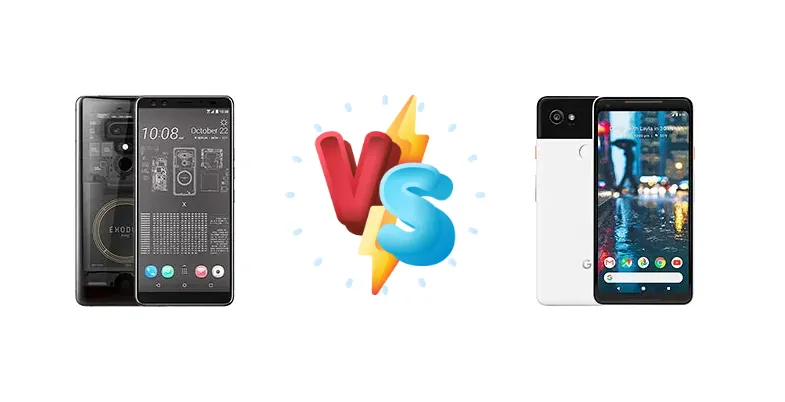
|
🏆 Quick Verdict
For the average user prioritizing performance and future-proofing, the HTC Exodus 1 emerges as the better choice due to its Snapdragon 845 chipset. However, the Google Pixel 2 XL’s exceptional camera and software support remain compelling, particularly for photography enthusiasts who value Google’s image processing.
| PHONES | ||
|---|---|---|
| Phone Names | HTC Exodus 1 | Google Pixel 2 XL |
| Network | ||
|---|---|---|
| 2G bands | GSM 850 / 900 / 1800 / 1900 | GSM 850 / 900 / 1800 / 1900 |
| 3G bands | HSDPA 850 / 900 / 1700(AWS) / 1900 / 2100 | HSDPA 850 / 900 / 1700(AWS) / 1900 / 2100 |
| 4G bands | 4, 12, 17, 28, 20, 5, 8, 3, 1, 7, 32, 2, 13, 66, 39, 40, 38, 41 | 1, 2, 3, 4, 5, 7, 8, 12, 13, 17, 20, 25, 26, 28, 29, 30, 32, 38, 40, 41, 66 |
| Speed | HSPA 42.2/5.76 Mbps, LTE (5CA) Cat18 1200/150 Mbps | HSPA 42.2/5.76 Mbps, LTE (3CA) Cat15 800/75 Mbps |
| Technology | GSM / HSPA / LTE | GSM / CDMA / HSPA / EVDO / LTE |
| Launch | ||
|---|---|---|
| Announced | 2018, October 23. Released 2018, December 06 | 2017, October 04. Released 2017, October 17 |
| Status | Discontinued | Discontinued |
| Body | ||
|---|---|---|
| Build | - | Glass front (Gorilla Glass 5), aluminum/glass back, aluminum frame |
| Dimensions | 156.6 x 73.9 x 8.7 mm (6.17 x 2.91 x 0.34 in) | 157.9 x 76.7 x 7.9 mm (6.22 x 3.02 x 0.31 in) |
| SIM | Nano-SIM + Nano-SIM | Nano-SIM + eSIM |
| Weight | 188 g (6.63 oz) | 175 g (6.17 oz) |
| IP68 dust/water resistant (up to 1.5m for 30 mins) | - | |
| Display | ||
|---|---|---|
| Protection | - | Corning Gorilla Glass 5 |
| Resolution | 1440 x 2880 pixels, 18:9 ratio (~537 ppi density) | 1440 x 2880 pixels, 18:9 ratio (~538 ppi density) |
| Size | 6.0 inches, 92.9 cm2 (~80.3% screen-to-body ratio) | 6.0 inches, 92.6 cm2 (~76.4% screen-to-body ratio) |
| Type | Super LCD6 | P-OLED |
| Platform | ||
|---|---|---|
| CPU | Octa-core (4x2.8 GHz Kryo 385 Gold & 4x1.7 GHz Kryo 385 Silver) | Octa-core (4x2.35 GHz Kryo & 4x1.9 GHz Kryo) |
| Chipset | Qualcomm SDM845 Snapdragon 845 (10 nm) | Qualcomm MSM8998 Snapdragon 835 (10 nm) |
| GPU | Adreno 630 | Adreno 540 |
| OS | Android 8.1 (Oreo) | Android 8.0 (Oreo), upgradable to Android 11 |
| Memory | ||
|---|---|---|
| Card slot | No | No |
| Internal | 128GB 6GB RAM | 64GB 4GB RAM, 128GB 4GB RAM |
| UFS 2.1 | - | |
| Main Camera | ||
|---|---|---|
| Dual | 12 MP, f/1.8, 1/2.55", 1.4µm, dual pixel PDAF, OIS 16 MP (12 MP effective), f/2.6, 1/3.1", 1.0µm, 2x optical zoom, AF | - |
| Features | Laser AF, Dual-LED dual-tone flash, HDR | Laser AF, Dual-LED flash, HDR, panorama |
| Single | - | 12.2 MP, f/1.8, 27mm (wide), 1/2.55", 1.4µm, dual pixel PDAF, OIS |
| Video | 4K@60fps, 1080p@60/240fps, 1080p@30fps (gyro-EIS), HDR, 24-bit/96kHz stereo sound rec. | 4K@30fps (gyro-EIS), 1080p@30/60/120fps (gyro-EIS), 720p@240fps (gyro-EIS) |
| Selfie camera | ||
|---|---|---|
| Dual | 8 MP, f/2.0, 1/4.0", 1.12µm 8 MP, f/2.0, 1/4.0", 1.12µm | - |
| Features | HDR, panorama | HDR |
| Single | - | 8 MP, f/2.4, 25mm (wide), 1/3.2", 1.4µm |
| Video | 1080p@30fps | 1080p@30fps |
| Sound | ||
|---|---|---|
| 3.5mm jack | No | No |
| 35mm jack | No | No |
| Loudspeaker | Yes, with stereo speakers | Yes, with stereo speakers |
| 32-bit/384kHz audio | - | |
| Comms | ||
|---|---|---|
| Bluetooth | 5.0, A2DP, aptX HD, LE | 5.0, A2DP, LE, aptX HD |
| NFC | No | Yes |
| Positioning | GPS, GLONASS, GALILEO, BDS | GPS, GLONASS, BDS, GALILEO |
| Radio | No | No |
| USB | USB Type-C 3.1 | USB Type-C 3.1 |
| WLAN | Wi-Fi 802.11 a/b/g/n/ac, dual-band, Wi-Fi Direct | Wi-Fi 802.11 a/b/g/n/ac, dual-band, Wi-Fi Direct, DLNA |
| Features | ||
|---|---|---|
| Sensors | Fingerprint (rear-mounted), accelerometer, gyro, proximity, compass | Fingerprint (rear-mounted), accelerometer, gyro, proximity, compass, barometer |
| Zion crypto wallet Secure Enclave Social Key Recovery (key sharding) dApps (decentralized apps) | - | |
| Battery | ||
|---|---|---|
| Charging | 18W wired, QC3, 50% in 35 min | 10.5W wired (capped), PD2.0 |
| Type | Li-Ion 3500 mAh, non-removable | Li-Ion 3520 mAh, non-removable |
| Misc | ||
|---|---|---|
| Colors | Black | Just Black, Black & White |
| Models | - | G011C |
| Price | About BTC 0.15/ETH 4.78(crypto curr) | About 520 EUR |
| Tests | ||
|---|---|---|
| Audio quality | - | Noise - 93.7 / Crosstalk - 79.7 |
| Battery life | - | Endurance rating 88h |
| Camera | - | Photo / Video |
| Display | - | Contrast ratio: ∞ |
| Loudspeaker | - | Voice 66dB / Noise 70dB / Ring 78dB |
| Performance | - | AnTuTu: 206711 (v7) GeekBench: 6055 (v4.4) GFXBench: 13fps (ES 3.1 onscreen) |
HTC Exodus 1
- Faster Snapdragon 845 processor
- Quicker 18W charging with QC3
- Potential for blockchain applications
- Less refined camera experience
- Software support may be limited
Google Pixel 2 XL
- Exceptional camera quality and image processing
- Clean and optimized Android software
- Strong brand reputation for software updates (at launch)
- Older Snapdragon 835 processor
- Slower 10.5W charging
Display Comparison
Both devices feature displays with an infinite contrast ratio, suggesting OLED panels. However, specific details like peak brightness and color gamut coverage are missing. The Pixel 2 XL was known for its color accuracy, a hallmark of Google’s display calibration. The Exodus 1’s display specs are less documented, making a direct comparison difficult. Bezels were relatively slim on both, typical for flagship devices of the era, but the Pixel 2 XL’s display was often praised for its vibrancy.
Camera Comparison
The Pixel 2 XL was renowned for its computational photography prowess, leveraging Google’s HDR+ algorithm to produce stunning images, particularly in challenging lighting conditions. While specific sensor details are absent, the Pixel 2 XL’s image processing was its key strength. The Exodus 1’s camera specifications are less detailed, and it didn’t achieve the same level of critical acclaim for its image quality. The Pixel 2 XL’s video capabilities were also highly regarded, offering excellent stabilization and dynamic range. The Exodus 1’s camera, while capable, likely couldn’t match the Pixel’s consistently high output.
Performance
The HTC Exodus 1’s Snapdragon 845 (10nm) represents a significant generational leap over the Google Pixel 2 XL’s Snapdragon 835 (10nm). The 845 boasts faster Kryo 385 cores – 2.8 GHz Gold vs 2.35 GHz Kryo on the 835 – and improved GPU performance. This translates to noticeably quicker app loading times, smoother multitasking, and better gaming performance on the Exodus 1. While both chips are built on a 10nm process, the 845’s architectural improvements offer better efficiency, potentially leading to less thermal throttling during sustained workloads. The Pixel 2 XL, however, benefited from Google’s software optimizations, mitigating some of the performance gap.
Battery Life
Both the HTC Exodus 1 and Google Pixel 2 XL achieved an endurance rating of 88 hours, suggesting comparable battery life despite potentially different battery capacities. However, the Exodus 1’s 18W charging with Quick Charge 3.0 support offers a faster charging experience (50% in 35 minutes) compared to the Pixel 2 XL’s capped 10.5W charging with PD2.0. This means the Exodus 1 can replenish its battery more quickly, a significant convenience for users who frequently need to top up their devices. The Pixel 2 XL’s slower charging speed could be a drawback for those accustomed to faster charging technologies.
Buying Guide
Buy the HTC Exodus 1 if you need a phone with more processing power for demanding applications, or if you are interested in exploring blockchain features. Buy the Google Pixel 2 XL if you prioritize a consistently excellent camera experience, a clean Android interface, and long-term software support, even if it means sacrificing some raw performance.