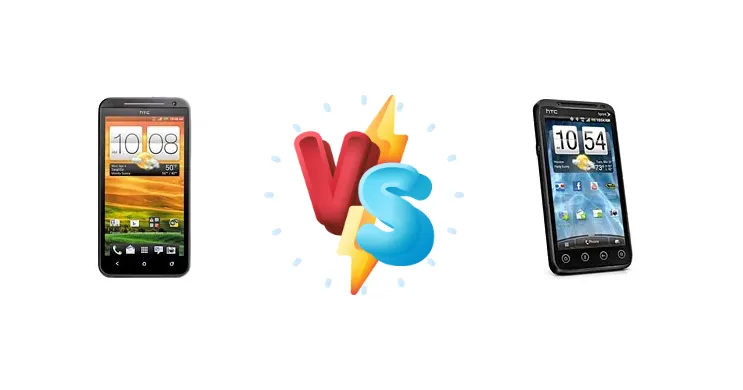
Remember the early days of Android smartphones? The HTC Evo series was at the forefront, pushing boundaries with 4G connectivity and innovative features. Today, we're revisiting two iconic models: the Evo 4G LTE and the Evo 3D CDMA. Let's see how they stack up.
🏆 Quick Verdict
The HTC Evo 4G LTE edges out the EVO 3D thanks to its significantly faster processor and 4G LTE connectivity. While the EVO 3D's 3D display was a novelty, the Evo 4G LTE offers a more practical and performant experience, even by today's standards.
| Network |
|---|
| 2G bands | CDMA 800 / 1900 | CDMA 800 / 1900 |
| 3G bands | CDMA2000 1xEV-DO | CDMA2000 1xEV-DO |
| 4G bands | 25 | - |
| Speed | LTE Cat3 100/50 Mbps, EV-DO Rev.A 3.1 Mbps | EV-DO Rev.A 3.1 Mbps |
| Technology | CDMA / EVDO / LTE | CDMA / EVDO |
| Launch |
|---|
| Announced | 2012, April. Released 2012, May | 2011, March. Released 2011, June |
| Status | Discontinued | Discontinued |
| Body |
|---|
| Dimensions | 134.8 x 68.9 x 8.9 mm (5.31 x 2.71 x 0.35 in) | 127 x 66 x 11.9 mm (5.0 x 2.60 x 0.47 in) |
| SIM | Mini-SIM | Mini-SIM |
| Weight | 134 g (4.73 oz) | 170.1 g (6.00 oz) |
| | Built-in kickstand | - |
| Display |
|---|
| Protection | Corning Gorilla Glass | - |
| Resolution | 720 x 1280 pixels, 16:9 ratio (~312 ppi density) | 540 x 960 pixels, 16:9 ratio (~256 ppi density) |
| Size | 4.7 inches, 60.9 cm2 (~65.6% screen-to-body ratio) | 4.3 inches, 51.0 cm2 (~60.8% screen-to-body ratio) |
| Type | Super IPS LCD2 | 3D S-LCD |
| Platform |
|---|
| CPU | Dual-core 1.5 GHz Krait | Dual-core 1.2 GHz Scorpion |
| Chipset | Qualcomm MSM8960 Snapdragon S4 Plus | Qualcomm MSM8660 Snapdragon S3 |
| GPU | Adreno 225 | Adreno 220 |
| OS | Android 4.0.3 (Ice Cream Sandwich), Sense UI 4 | Android 2.3 (Gingerbread), Sense UI 3 |
| Memory |
|---|
| Card slot | microSDHC (dedicated slot) | microSDHC (dedicated slot) |
| Internal | 16GB 1GB RAM | 4GB 1GB RAM |
| Main Camera |
|---|
| Features | LED flash | Dual-LED flash |
| Single | 8 MP, AF | 5 MP, AF |
| Video | 1080p@30fps, stereo sound rec. | 720p@30fps |
| Selfie camera |
|---|
| Single | 1.3 MP | 1.3 MP |
| Video | 720p | - |
| Sound |
|---|
| 3.5mm jack | Yes | Yes |
| 35mm jack | Yes | Yes |
| Loudspeaker | Yes | Yes |
| | - | SRS virtual surround sound (via wired headphones)
|
| Comms |
|---|
| Bluetooth | 4.0, A2DP | 3.0, A2DP, EDR |
| NFC | Yes | - |
| Positioning | GPS, A-GPS | GPS, A-GPS |
| Radio | Stereo FM radio, RDS | Stereo FM radio, RDS |
| USB | microUSB 2.0 (MHL TV-out) | microUSB 2.0 (MHL TV-out) |
| WLAN | Wi-Fi 802.11 a/b/g/n, Wi-Fi Direct, DLNA, hotspot | Wi-Fi 802.11 b/g/n, WiMAX 802.16 e, DLNA, hotspot |
| Features |
|---|
| Browser | - | HTML |
| Sensors | Accelerometer, gyro, proximity, compass | Accelerometer, gyro, proximity, compass |
| | MP4/DivX/Xvid/H.264/WMV player
MP3/eAAC+/WMA/WAV player
Document editor
Voice memo/dial/commands
Predictive text input | MP3/AAC+/WAV/WMA player
MP4/Xvid/H.264/WMV player
Organizer
Document viewer/editor
Voice memo/dial/commands
Predictive text input |
| Battery |
|---|
| Stand-by | - | Up to 200 h |
| Talk time | Up to 7 h 30 min | Up to 6 h |
| Type | Non-removable Li-Ion 2000 mAh battery | Removable Li-Ion 1730 mAh battery |
| Misc |
|---|
| Colors | Gray, White | Black, plum |
| Price | About 180 EUR | About 220 EUR |
| SAR | 0.72 W/kg (head) 1.29 W/kg (body) | 0.89 W/kg (head) |
HTC Evo 4G LTE
- Faster Processor
- 4G LTE Connectivity
- Slightly Better Performance
- Comparable Camera Quality
- Outdated Software
- Limited App Support
- Older Design
HTC EVO 3D CDMA
- Unique 3D Display
- Compact Size
- Nostalgic Design
- Slower Processor
- Limited 3D Content
- Outdated Software
- Limited App Support
Display Comparison
The HTC EVO 3D boasts a unique selling point: a glasses-free 3D display. Both phones feature 4.3-inch qHD (960 x 540) displays, but the EVO 3D's 3D capabilities offer a different visual experience, albeit with limited content availability and potential eye strain. The Evo 4G LTE's display is a standard 2D screen, offering better color accuracy and viewing angles.
Camera Comparison
The Evo 4G LTE features an 8-megapixel rear camera with autofocus and LED flash, while the EVO 3D has a similar 8-megapixel camera. Image quality is comparable, but the Evo 4G LTE's slightly more modern processing might yield marginally better results in certain lighting conditions. Both lack front-facing cameras.
Performance
Here's where the Evo 4G LTE truly shines. Its Qualcomm MSM8960 Snapdragon S4 Plus chipset with a 1.5 GHz Krait dual-core CPU provides a noticeable performance boost over the EVO 3D's Qualcomm MSM8660 Snapdragon S3 with a 1.2 GHz Scorpion dual-core CPU. Expect smoother multitasking, faster app loading times, and a more responsive user interface on the Evo 4G LTE.
Battery Life
The HTC Evo 4G LTE has a 1800 mAh battery, while the HTC EVO 3D has a 1620 mAh battery. Given the Evo 4G LTE's more powerful processor and 4G connectivity, battery life is generally comparable, potentially slightly favoring the Evo 4G LTE due to more efficient power management.
Buying Guide
The HTC Evo 4G LTE is for those seeking a faster, more responsive Android experience and appreciate the benefits of 4G. The HTC EVO 3D CDMA is for enthusiasts interested in experiencing a unique 3D display and a piece of smartphone history, understanding its limitations.
Frequently Asked Questions
❓ Is the HTC EVO 3D's 3D display worth it?
The 3D display was a novelty, but its usefulness is limited by the lack of 3D content and potential eye strain. It's more of a historical curiosity than a practical feature today.
❓ Can I update the software on either of these phones?
Both phones are running outdated versions of Android and are unlikely to receive further official updates. Custom ROMs might be available, but flashing them carries risks.