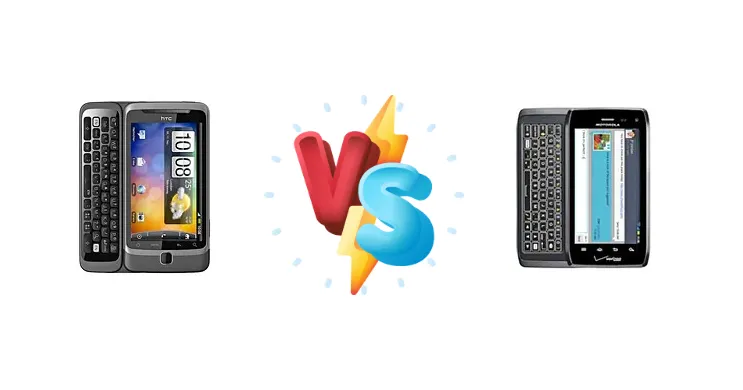
Remember the days of slide-out keyboards and early Android? The HTC Desire Z and Motorola DROID 4 represent a fascinating era in smartphone evolution. Both devices offer a unique blend of nostalgia and functionality, but which one holds up better today? Let's dive into a detailed comparison.
🏆 Quick Verdict
The Motorola DROID 4 takes the crown. Its dual-core processor and more modern chipset provide a noticeable performance boost over the Desire Z's single-core CPU. While both are dated, the DROID 4 offers a slightly smoother experience and better longevity.
| Network |
|---|
| 2G bands | GSM 850 / 900 / 1800 / 1900 | CDMA 800 / 1900 |
| 3G bands | HSDPA 900 / 2100 | CDMA2000 1xEV-DO |
| 4G bands | - | 13 |
| Speed | HSPA 14.4/5.76 Mbps | EV-DO Rev.A 3.1 Mbps, LTE, HSPA |
| Technology | GSM / HSPA | GSM / CDMA / HSPA / EVDO / LTE |
| | HSDPA 850 / 1900 - North America | HSDPA 850 / 900 / 1900 / 2100 |
| Launch |
|---|
| Announced | 2010, September. Released 2010, November | 2012, January. Released 2012, February |
| Status | Discontinued | Discontinued |
| Body |
|---|
| Dimensions | 119 x 60.4 x 14.2 mm (4.69 x 2.38 x 0.56 in) | 127 x 67.3 x 12.7 mm (5.0 x 2.65 x 0.5 in) |
| Keyboard | QWERTY | QWERTY |
| SIM | Mini-SIM | Micro-SIM |
| Weight | 180 g (6.35 oz) | 178.9 g (6.28 oz) |
| | Optical trackpad | - |
| Display |
|---|
| Protection | Corning Gorilla Glass | Corning Gorilla Glass |
| Resolution | 480 x 800 pixels, 5:3 ratio (~252 ppi density) | 540 x 960 pixels, 16:9 ratio (~275 ppi density) |
| Size | 3.7 inches, 39.0 cm2 (~54.2% screen-to-body ratio) | 4.0 inches, 44.1 cm2 (~51.6% screen-to-body ratio) |
| Type | S-LCD | TFT |
| Platform |
|---|
| CPU | 800 MHz Scorpion | Dual-core 1.2 GHz Cortex-A9 |
| Chipset | Qualcomm MSM7230 | TI OMAP 4430 |
| GPU | Adreno 205 | PowerVR SGX540 |
| OS | Android 2.2 (Froyo), upgradable to 2.3 (Gingerbread), Sense UI | Android 2.3 (Gingerbread), upgradable to 4.0 (Ice Cream Sandwich) |
| Memory |
|---|
| Card slot | microSDHC (dedicated slot) | microSDHC (dedicated slot) |
| Internal | 1.5GB; 512MB RAM | 16GB 1GB RAM |
| Main Camera |
|---|
| Features | LED flash | LED flash |
| Single | 5 MP, AF | 8 MP, AF |
| Video | 720p | 1080p@30fps |
| Selfie camera |
|---|
| Single | - | 1.3 MP |
| Video | - | 720p |
| | No | - |
| Sound |
|---|
| 3.5mm jack | Yes | Yes |
| 35mm jack | Yes | Yes |
| Loudspeaker | Yes | Yes |
| Comms |
|---|
| Bluetooth | 2.1, A2DP | 4.0, A2DP, LE, EDR |
| Positioning | GPS, A-GPS | GPS, A-GPS |
| Radio | Stereo FM radio, RDS | No |
| USB | microUSB 2.0 | microUSB 2.0, OTG |
| WLAN | Wi-Fi 802.11 b/g/n, DLNA, hotspot | Wi-Fi 802.11 b/g/n, hotspot |
| Features |
|---|
| Browser | HTML, Adobe Flash | - |
| Sensors | Accelerometer, proximity, compass | Accelerometer, proximity, compass |
| | Dedicated search key
MP3/WAV/AAC+ player
MP4/H.264/DivX/XviD player
Voice memo/dial
Predictive text input | HDMI port
MP3/WAV/WMA/eAAC+ player
MP4/H.264/WMV player
Document viewer
Photo viewer/editor
Organizer
Voice memo/dial
Predictive text input |
| Battery |
|---|
| Stand-by | Up to 430 h (2G) / Up to 430 h (3G) | Up to 204 h |
| Talk time | Up to 9 h 50 min (2G) / Up to 6 h 40 min (3G) | Up to 12 h 30 min |
| Type | Removable Li-Ion 1300 mAh battery | Non-removable Li-Ion 1785 mAh battery |
| Misc |
|---|
| Colors | Black | Black |
| Price | About 100 EUR | About 260 EUR |
| SAR | - | 0.70 W/kg (head) 0.58 W/kg (body) |
| SAR EU | 0.86 W/kg (head) | - |
| Tests |
|---|
| Audio quality |
Noise -90.1dB / Crosstalk -90.7dB | - |
| Camera |
Photo | - |
| Loudspeaker |
Voice 72dB / Noise 72dB / Ring 82dB
| - |
HTC Desire Z
- Unique slide-out keyboard
- Compact size
- Simple Android experience
- Durable build quality
- Slow performance
- Low-resolution display
- Poor camera quality
- Limited storage
Motorola DROID 4 XT894
- Better performance than Desire Z
- Slightly better display resolution
- Front-facing camera
- Improved battery life
- Physical keyboard
- Dated design
- Still slow by modern standards
- Limited storage
- Camera quality is still poor
Display Comparison
Both phones feature relatively small displays by today's standards. The HTC Desire Z has a 3.2-inch HVGA display, while the DROID 4 boasts a 3.5-inch qHD display. The DROID 4's higher resolution provides a slightly sharper image, though both screens are adequate for basic tasks. Viewing angles and color reproduction are typical for their time.
Camera Comparison
Camera quality on both devices is limited by their age. The HTC Desire Z has a single photo camera, while the DROID 4 also features a single photo camera and a front-facing camera. Expect grainy images and limited low-light performance from both. The DROID 4's slightly better processing might yield marginally better results in some scenarios.
Performance
This is where the DROID 4 shines. Its dual-core 1.2 GHz Cortex-A9 processor significantly outperforms the Desire Z's 800 MHz Scorpion single-core CPU. Apps launch faster, multitasking is smoother, and the overall user experience feels more responsive on the DROID 4. The DROID 4's TI OMAP 4430 chipset also offers better graphics capabilities.
Battery Life
The Motorola DROID 4 generally offers better battery life due to its more efficient chipset and slightly larger battery capacity (around 1900 mAh vs. Desire Z's 1200 mAh). Expect a full day of moderate use from the DROID 4, while the Desire Z might require more frequent charging.
Buying Guide
The HTC Desire Z is for hardcore nostalgia enthusiasts who appreciate the physical keyboard and a simpler Android experience. The Motorola DROID 4 is for those seeking a slightly more capable retro device with better performance and a more robust build, still appreciating the physical keyboard.
Frequently Asked Questions
❓ Are these phones still usable in 2024?
Yes, but with limitations. They won't receive software updates and app compatibility may be an issue. They are best suited for basic tasks like calls, texts, and light web browsing.
❓ Which phone has a better keyboard?
Both have decent physical keyboards, but the DROID 4's keyboard is generally considered slightly better due to its larger size and key spacing.