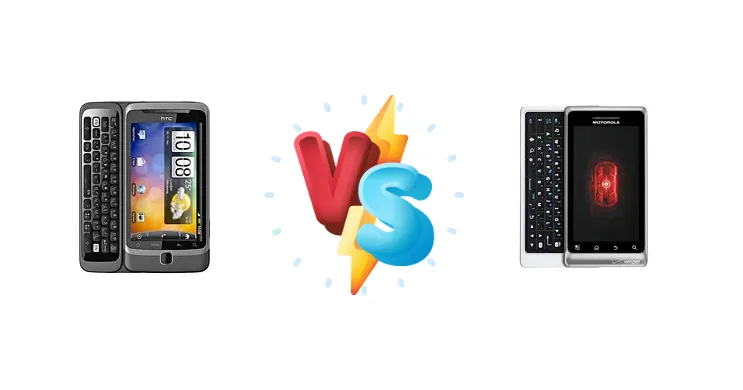
Remember the early days of Android? The HTC Desire Z and Motorola DROID 2 Global were key players, offering unique features and experiences. Today, we're revisiting these classic devices to see how they stack up against each other and whether they still hold any appeal.
🏆 Quick Verdict
The Motorola DROID 2 Global takes the win thanks to its significantly faster processor and generally more robust feature set. While the Desire Z's sliding keyboard was a novelty, the DROID 2's performance and slightly better overall design make it the stronger contender, even by today's standards.
| Network |
|---|
| 2G bands | GSM 850 / 900 / 1800 / 1900 | CDMA 800 / 1900 |
| 3G bands | HSDPA 900 / 2100 | CDMA2000 1xEV-DO |
| Speed | HSPA 14.4/5.76 Mbps | HSPA 10.2/5.76 Mbps, EV-DO Rev.A 3.1 Mbps |
| Technology | GSM / HSPA | GSM / CDMA / HSPA / EVDO |
| | HSDPA 850 / 1900 - North America | HSDPA 850 / 1900 / 2100 |
| Launch |
|---|
| Announced | 2010, September. Released 2010, November | 2010, November. Released 2010, November |
| Status | Discontinued | Discontinued |
| Body |
|---|
| Dimensions | 119 x 60.4 x 14.2 mm (4.69 x 2.38 x 0.56 in) | 116.3 x 60.5 x 13.7 mm (4.58 x 2.38 x 0.54 in) |
| Keyboard | QWERTY | QWERTY |
| SIM | Mini-SIM | Mini-SIM |
| Weight | 180 g (6.35 oz) | 173 g (6.10 oz) |
| | Optical trackpad | - |
| Display |
|---|
| Protection | Corning Gorilla Glass | Corning Gorilla Glass |
| Resolution | 480 x 800 pixels, 5:3 ratio (~252 ppi density) | 480 x 854 pixels, 16:9 ratio (~265 ppi density) |
| Size | 3.7 inches, 39.0 cm2 (~54.2% screen-to-body ratio) | 3.7 inches, 37.7 cm2 (~53.6% screen-to-body ratio) |
| Type | S-LCD | TFT |
| Platform |
|---|
| CPU | 800 MHz Scorpion | 1.2 GHz Cortex-A8 |
| Chipset | Qualcomm MSM7230 | TI OMAP 3640 |
| GPU | Adreno 205 | PowerVR SGX530 |
| OS | Android 2.2 (Froyo), upgradable to 2.3 (Gingerbread), Sense UI | Android 2.2 (Froyo), upgradable to 2.3 (Gingerbread) |
| Memory |
|---|
| Card slot | microSDHC (dedicated slot) | microSDHC (dedicated slot), 8 GB included |
| Internal | 1.5GB; 512MB RAM | 8GB 512MB RAM |
| Main Camera |
|---|
| Features | LED flash | - |
| Single | 5 MP, AF | 5 MP, AF |
| Video | 720p | 480p@30fps |
| Sound |
|---|
| 3.5mm jack | Yes | Yes |
| 35mm jack | Yes | Yes |
| Loudspeaker | Yes | Yes |
| Comms |
|---|
| Bluetooth | 2.1, A2DP | 2.1, A2DP |
| Positioning | GPS, A-GPS | GPS, A-GPS |
| Radio | Stereo FM radio, RDS | No |
| USB | microUSB 2.0 | microUSB 2.0 |
| WLAN | Wi-Fi 802.11 b/g/n, DLNA, hotspot | Wi-Fi 802.11 b/g/n, DLNA, hotspot |
| Features |
|---|
| Browser | HTML, Adobe Flash | HTML, Adobe Flash |
| Sensors | Accelerometer, proximity, compass | Accelerometer, proximity, compass |
| | Dedicated search key
MP3/WAV/AAC+ player
MP4/H.264/DivX/XviD player
Voice memo/dial
Predictive text input | MP3/WAV/WMA/AAC+ player
MP4/WMV/H.264 player
Document viewer
Photo viewer/editor
Organizer
Voice memo/dial/commands
Predictive text input (Swype) |
| Battery |
|---|
| Stand-by | Up to 430 h (2G) / Up to 430 h (3G) | Up to 230 h |
| Talk time | Up to 9 h 50 min (2G) / Up to 6 h 40 min (3G) | Up to 8 h 20 min |
| Type | Removable Li-Ion 1300 mAh battery | Removable Li-Po 1420 mAh battery |
| Misc |
|---|
| Colors | Black | White, Black |
| Price | About 100 EUR | About 200 EUR |
| SAR | - | 1.58 W/kg (head) 0.89 W/kg (body) |
| SAR EU | 0.86 W/kg (head) | - |
| Tests |
|---|
| Audio quality |
Noise -90.1dB / Crosstalk -90.7dB | - |
| Camera |
Photo | - |
| Loudspeaker |
Voice 72dB / Noise 72dB / Ring 82dB
| - |
HTC Desire Z
- Unique sliding keyboard design
- Compact size
- Decent build quality
- Slow processor
- Low-resolution display
- Poor camera quality
- Limited storage
Motorola DROID 2 Global
- Faster processor
- Larger display
- Better battery life
- More responsive user experience
- Outdated design
- Low-resolution display (compared to modern phones)
- Basic camera
Display Comparison
Both phones feature relatively small displays by modern standards. The HTC Desire Z has a 3.2-inch HVGA display, while the DROID 2 Global boasts a 3.7-inch QHD display. The DROID 2's larger size and higher resolution offer a noticeably better viewing experience, though both suffer from low pixel density compared to current phones.
Camera Comparison
Camera quality on both devices is underwhelming by today's standards. Both feature 5MP cameras, but image quality is generally poor, with noticeable noise and limited dynamic range. The DROID 2's camera might offer slightly better results in well-lit conditions, but neither is a standout.
Performance
This is where the DROID 2 Global truly shines. Its 1.2 GHz Cortex-A8 processor is significantly faster than the Desire Z's 800 MHz Scorpion. Expect smoother multitasking, quicker app loading times, and a generally more responsive user experience on the DROID 2. The Desire Z can feel sluggish by comparison.
Battery Life
The Motorola DROID 2 Global typically offers better battery life due to its more efficient processor and slightly larger battery capacity (1500 mAh vs. 1200 mAh in the Desire Z). Expect a full day of moderate use from the DROID 2, while the Desire Z might require more frequent charging.
Buying Guide
The HTC Desire Z might appeal to collectors or those seeking a nostalgic Android experience with a physical keyboard. The Motorola DROID 2 Global is a better choice for anyone needing a slightly more capable device, even if it's an older model, prioritizing performance and a more standard smartphone experience.
Frequently Asked Questions
❓ Are these phones still usable in 2024?
While technically usable, both phones are severely outdated. App compatibility and security updates are major concerns. They're best suited for niche uses like retro gaming or as collector's items.
❓ Which phone has better software support?
Neither phone receives official software updates anymore. Both are running older versions of Android, making them vulnerable to security threats.