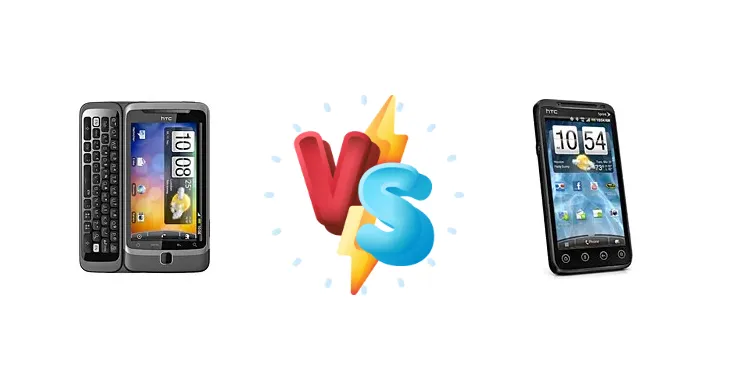
Remember the days of early Android smartphones? The HTC Desire Z and EVO 3D were both contenders, offering unique features and a glimpse into the future of mobile. Today, we're revisiting these devices to see how they stack up against each other and whether they still hold any appeal.
🏆 Quick Verdict
The HTC EVO 3D takes the crown. Its dual-core processor and Snapdragon chipset provide significantly better performance than the Desire Z's single-core offering. While both are dated, the EVO 3D's 3D display and faster internals make it the more compelling choice.
| Network |
|---|
| 2G bands | GSM 850 / 900 / 1800 / 1900 | CDMA 800 / 1900 |
| 3G bands | HSDPA 900 / 2100 | CDMA2000 1xEV-DO |
| Speed | HSPA 14.4/5.76 Mbps | EV-DO Rev.A 3.1 Mbps |
| Technology | GSM / HSPA | CDMA / EVDO |
| | HSDPA 850 / 1900 - North America | - |
| Launch |
|---|
| Announced | 2010, September. Released 2010, November | 2011, March. Released 2011, June |
| Status | Discontinued | Discontinued |
| Body |
|---|
| Dimensions | 119 x 60.4 x 14.2 mm (4.69 x 2.38 x 0.56 in) | 127 x 66 x 11.9 mm (5.0 x 2.60 x 0.47 in) |
| Keyboard | QWERTY | - |
| SIM | Mini-SIM | Mini-SIM |
| Weight | 180 g (6.35 oz) | 170.1 g (6.00 oz) |
| | Optical trackpad | - |
| Display |
|---|
| Protection | Corning Gorilla Glass | - |
| Resolution | 480 x 800 pixels, 5:3 ratio (~252 ppi density) | 540 x 960 pixels, 16:9 ratio (~256 ppi density) |
| Size | 3.7 inches, 39.0 cm2 (~54.2% screen-to-body ratio) | 4.3 inches, 51.0 cm2 (~60.8% screen-to-body ratio) |
| Type | S-LCD | 3D S-LCD |
| Platform |
|---|
| CPU | 800 MHz Scorpion | Dual-core 1.2 GHz Scorpion |
| Chipset | Qualcomm MSM7230 | Qualcomm MSM8660 Snapdragon S3 |
| GPU | Adreno 205 | Adreno 220 |
| OS | Android 2.2 (Froyo), upgradable to 2.3 (Gingerbread), Sense UI | Android 2.3 (Gingerbread), Sense UI 3 |
| Memory |
|---|
| Card slot | microSDHC (dedicated slot) | microSDHC (dedicated slot) |
| Internal | 1.5GB; 512MB RAM | 4GB 1GB RAM |
| Main Camera |
|---|
| Features | LED flash | Dual-LED flash |
| Single | 5 MP, AF | 5 MP, AF |
| Video | 720p | 720p@30fps |
| Selfie camera |
|---|
| Single | - | 1.3 MP |
| | No | - |
| Sound |
|---|
| 3.5mm jack | Yes | Yes |
| 35mm jack | Yes | Yes |
| Loudspeaker | Yes | Yes |
| | - | SRS virtual surround sound (via wired headphones)
|
| Comms |
|---|
| Bluetooth | 2.1, A2DP | 3.0, A2DP, EDR |
| Positioning | GPS, A-GPS | GPS, A-GPS |
| Radio | Stereo FM radio, RDS | Stereo FM radio, RDS |
| USB | microUSB 2.0 | microUSB 2.0 (MHL TV-out) |
| WLAN | Wi-Fi 802.11 b/g/n, DLNA, hotspot | Wi-Fi 802.11 b/g/n, WiMAX 802.16 e, DLNA, hotspot |
| Features |
|---|
| Browser | HTML, Adobe Flash | HTML |
| Sensors | Accelerometer, proximity, compass | Accelerometer, gyro, proximity, compass |
| | Dedicated search key
MP3/WAV/AAC+ player
MP4/H.264/DivX/XviD player
Voice memo/dial
Predictive text input | MP3/AAC+/WAV/WMA player
MP4/Xvid/H.264/WMV player
Organizer
Document viewer/editor
Voice memo/dial/commands
Predictive text input |
| Battery |
|---|
| Stand-by | Up to 430 h (2G) / Up to 430 h (3G) | Up to 200 h |
| Talk time | Up to 9 h 50 min (2G) / Up to 6 h 40 min (3G) | Up to 6 h |
| Type | Removable Li-Ion 1300 mAh battery | Removable Li-Ion 1730 mAh battery |
| Misc |
|---|
| Colors | Black | Black, plum |
| Price | About 100 EUR | About 220 EUR |
| SAR | - | 0.89 W/kg (head) |
| SAR EU | 0.86 W/kg (head) | - |
| Tests |
|---|
| Audio quality |
Noise -90.1dB / Crosstalk -90.7dB | - |
| Camera |
Photo | - |
| Loudspeaker |
Voice 72dB / Noise 72dB / Ring 82dB
| - |
HTC Desire Z
- Compact size
- Slide-out QWERTY keyboard
- Potentially more durable due to simpler hardware
- Slow performance
- Low-resolution display
- Basic camera
- Limited app compatibility
HTC EVO 3D CDMA
- Dual-core processor
- Higher resolution display
- 3D display (novelty factor)
- Likely better camera
- Dated 3D technology
- Bulky design compared to Desire Z
- Limited app compatibility
- CDMA only
Display Comparison
The HTC EVO 3D boasts a 4.3-inch qHD (960 x 540) display with 3D capabilities, a significant upgrade over the Desire Z's likely lower resolution display (estimated 3.2-inch HVGA). While the 3D effect is dated, the higher resolution provides a sharper image. The Desire Z likely has a more compact form factor, which some may prefer.
Camera Comparison
Both phones are described as having 'Photo' cameras, indicating basic camera capabilities. Given the era, expect low resolution and limited features. The EVO 3D likely has a slightly better camera due to its more advanced chipset, but don't expect stellar image quality from either.
Performance
Here's where the EVO 3D truly shines. Its Qualcomm MSM8660 Snapdragon S3 chipset with a dual-core 1.2 GHz Scorpion processor offers a substantial performance advantage over the Desire Z's single-core 800 MHz Scorpion CPU. Expect smoother multitasking and faster app loading on the EVO 3D.
Battery Life
The HTC Desire Z likely had a smaller battery (estimated 1200mAh) due to its smaller size. The HTC EVO 3D likely had a larger battery (estimated 1500mAh) to power its larger display and more demanding processor. Expect longer battery life on the EVO 3D.
Buying Guide
The HTC Desire Z might appeal to hardcore retro phone enthusiasts or those seeking a very basic, compact Android experience. The HTC EVO 3D is better suited for those wanting a slightly more capable device with a unique 3D display, though both are primarily collector's items now.
Frequently Asked Questions
❓ Are these phones still usable in 2024?
While technically possible, using these phones in 2024 will be challenging. Android support has long ended, limiting app compatibility and security updates. They are best suited for collectors or retro enthusiasts.
❓ Which phone is better for gaming?
The HTC EVO 3D is significantly better for gaming due to its dual-core processor and more powerful chipset. However, even with the EVO 3D, don't expect to play modern games.