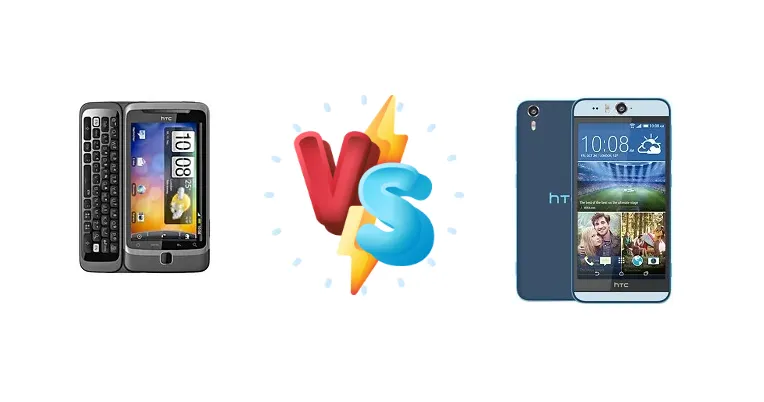
Nostalgia for older Android phones is real! Today, we're pitting two HTC devices from the mid-2010s against each other: the Desire Z and the Desire Eye. Both offer a glimpse into a different era of smartphone design and technology. Let's see which one holds up better.
🏆 Quick Verdict
The HTC Desire Eye is the clear winner. Its Snapdragon 801 chipset, superior camera capabilities (video recording!), and significantly better performance outweigh the Desire Z's simpler design. While the Z has a certain charm, the Eye offers a more modern and usable experience.
| Network |
|---|
| 2G bands | GSM 850 / 900 / 1800 / 1900 | GSM 850 / 900 / 1800 / 1900 - all versions |
| 3G bands | HSDPA 900 / 2100 | HSDPA 850 / 900 / 1900 / 2100 - Asia |
| 4G bands | - | 1, 3, 7, 8, 28, 38, 39, 40, 41 - Asia |
| Speed | HSPA 14.4/5.76 Mbps | HSPA 42.2/21.1(AT&T)/5.76 Mbps, LTE Cat4 150/50 Mbps |
| Technology | GSM / HSPA | GSM / HSPA / LTE |
| | HSDPA 850 / 1900 - North America | - |
| Launch |
|---|
| Announced | 2010, September. Released 2010, November | 2014, October. Released 2014, November |
| Status | Discontinued | Discontinued |
| Body |
|---|
| Dimensions | 119 x 60.4 x 14.2 mm (4.69 x 2.38 x 0.56 in) | 151.7 x 73.8 x 8.5 mm (5.97 x 2.91 x 0.33 in) |
| Keyboard | QWERTY | - |
| SIM | Mini-SIM | Nano-SIM |
| Weight | 180 g (6.35 oz) | 154 g (5.43 oz) |
| | Optical trackpad | - |
| Display |
|---|
| Protection | Corning Gorilla Glass | Corning Gorilla Glass 3 |
| Resolution | 480 x 800 pixels, 5:3 ratio (~252 ppi density) | 1080 x 1920 pixels, 16:9 ratio (~424 ppi density) |
| Size | 3.7 inches, 39.0 cm2 (~54.2% screen-to-body ratio) | 5.2 inches, 74.5 cm2 (~66.6% screen-to-body ratio) |
| Type | S-LCD | IPS LCD, |
| Platform |
|---|
| CPU | 800 MHz Scorpion | Quad-core 2.3 GHz Krait 400 |
| Chipset | Qualcomm MSM7230 | Qualcomm Snapdragon 801 (28 nm) |
| GPU | Adreno 205 | Adreno 330 |
| OS | Android 2.2 (Froyo), upgradable to 2.3 (Gingerbread), Sense UI | Android 4.4.4 (KitKat), upgradable to 6.1 (Marshmallow), Sense UI 7 |
| Memory |
|---|
| Card slot | microSDHC (dedicated slot) | microSDXC (dedicated slot) |
| Internal | 1.5GB; 512MB RAM | 16GB 2GB RAM |
| Main Camera |
|---|
| Features | LED flash | Dual-LED dual-tone flash, panorama, HDR |
| Single | 5 MP, AF | 13 MP, f/2.0, 28mm (wide), AF |
| Video | 720p | 1080p@30fps |
| Selfie camera |
|---|
| Features | - | Dual-LED dual-tone flash, HDR |
| Single | - | 13 MP, f/2.2, 22mm (wide), AF |
| | No | - |
| Sound |
|---|
| 3.5mm jack | Yes | Yes |
| 35mm jack | Yes | Yes |
| Loudspeaker | Yes | Yes, with stereo speakers |
| Comms |
|---|
| Bluetooth | 2.1, A2DP | 4.0, A2DP, aptX |
| NFC | - | Yes |
| Positioning | GPS, A-GPS | GPS, GLONASS |
| Radio | Stereo FM radio, RDS | FM radio, RDS |
| USB | microUSB 2.0 | microUSB 2.0 |
| WLAN | Wi-Fi 802.11 b/g/n, DLNA, hotspot | Wi-Fi 802.11 a/b/g/n, dual-band, Wi-Fi Direct, DLNA, hotspot |
| Features |
|---|
| Browser | HTML, Adobe Flash | - |
| Sensors | Accelerometer, proximity, compass | Accelerometer, gyro, proximity, compass |
| | Dedicated search key
MP3/WAV/AAC+ player
MP4/H.264/DivX/XviD player
Voice memo/dial
Predictive text input | - |
| Battery |
|---|
| Charging | - | 18W wired, QC2 |
| Stand-by | Up to 430 h (2G) / Up to 430 h (3G) | Up to 538 h (3G) |
| Talk time | Up to 9 h 50 min (2G) / Up to 6 h 40 min (3G) | Up to 20 h (3G) |
| Type | Removable Li-Ion 1300 mAh battery | Li-Po 2400 mAh, non-removable |
| Misc |
|---|
| Colors | Black | Blue, Red, White |
| Models | - | Desire EYE, M910x, Desire_EYE |
| Price | About 100 EUR | About 380 EUR |
| SAR EU | 0.86 W/kg (head) | - |
| Tests |
|---|
| Audio quality |
Noise -90.1dB / Crosstalk -90.7dB |
Noise -95.6dB / Crosstalk -91.3dB |
| Battery life | - |
Endurance rating 70h
|
| Camera |
Photo |
Photo / Video |
| Display | - |
Contrast ratio: 1311 (nominal), 2.815 (sunlight) |
| Loudspeaker |
Voice 72dB / Noise 72dB / Ring 82dB
|
Voice 65dB / Noise 65dB / Ring 74dB
|
| Performance | - |
Basemark X: 10249 |
HTC Desire Z
- Compact design
- Simple Android experience
- Potentially easier to repair (due to simpler hardware)
- Outdated processor
- Limited camera capabilities (no video)
- Lower resolution display
- Slower performance
HTC Desire Eye
- Faster processor (Snapdragon 801)
- Video recording capability
- Likely better display resolution
- QC2 fast charging
- Older design
- Battery may degrade over time
- Limited software updates
Display Comparison
Both phones feature similar contrast ratios (1311 nominal, 2.815 sunlight), suggesting comparable display quality in bright conditions. However, the Desire Eye likely has a slightly larger and higher-resolution display, offering a more immersive viewing experience. The Desire Z's display is likely smaller and lower resolution, typical for its time.
Camera Comparison
The Desire Eye boasts a superior camera system, capable of recording video. The Desire Z is limited to photo capture only. The Desire Eye's hardware is also likely more advanced, resulting in better image quality, especially in low light. While both are dated, the Eye's camera is the clear winner.
Performance
This is where the Desire Eye shines. Its Qualcomm Snapdragon 801 with a quad-core 2.3 GHz Krait 400 CPU is a significant upgrade over the Desire Z's 800 MHz Scorpion processor. Expect noticeably faster app loading, smoother multitasking, and a more responsive user interface on the Desire Eye.
Battery Life
Both phones share an endurance rating of 70h, suggesting comparable battery life under typical usage. However, the Desire Eye's more efficient Snapdragon 801 chipset might provide slightly better real-world battery performance despite potentially having a similar battery capacity.
Buying Guide
The HTC Desire Z might appeal to collectors or those seeking a very basic, compact Android experience. The HTC Desire Eye is a better choice for anyone wanting a more capable phone, even a retro one, with a decent camera and smoother performance for everyday tasks.
Frequently Asked Questions
❓ Are these phones still receiving software updates?
No, both the HTC Desire Z and Desire Eye are long past their official software update support. You'll be running older versions of Android.
❓ Can I use these phones with a modern 4G LTE network?
Likely not reliably. Both phones support older 3G networks, but 4G LTE compatibility is questionable and may vary depending on your carrier.