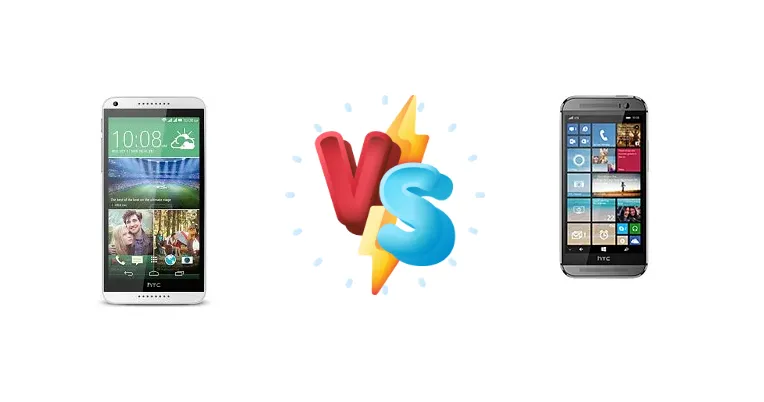
The HTC Desire 816G and the HTC One (M8) for Windows represent different eras and price points in HTC's history. The Desire 816G aimed for affordability and dual-SIM functionality, while the One (M8) was a flagship device boasting premium design and performance. Let's dive into a comprehensive comparison to see which phone holds up best today.
🏆 Quick Verdict
The HTC One (M8) for Windows is the clear winner in terms of performance and overall experience, thanks to its Snapdragon 801 processor and premium build. However, the Desire 816G offers dual-SIM capabilities and a lower price point, making it a viable option for budget-conscious users.
| Network |
|---|
| 2G bands | GSM 850 / 900 / 1800 / 1900 - SIM 1 & SIM 2 | GSM 850 / 900 / 1800 / 1900 |
| 3G bands | HSDPA 900 / 2100 | - |
| EDGE | - | Yes |
| GPRS | - | Yes |
| Speed | HSPA 21.1/5.76 Mbps | HSPA, LTE Cat4 150/50 Mbps, EV-DO Rev.A 3.1 Mbps |
| Technology | GSM / HSPA | GSM / CDMA / HSPA / EVDO |
| | - | 3, 4, 7, 13 - Verizon |
| Launch |
|---|
| Announced | 2014, September. Released 2014, October | 2014, August. Released 2014, September |
| Status | Discontinued | Discontinued |
| Body |
|---|
| Dimensions | 156.6 x 78.7 x 8 mm (6.17 x 3.10 x 0.31 in) | 146.4 x 70.6 x 9.4 mm (5.76 x 2.78 x 0.37 in) |
| SIM | Nano-SIM + Nano-SIM | Nano-SIM |
| Weight | 158 g (5.57 oz) | 160 g (5.64 oz) |
| Display |
|---|
| Protection | - | To be confirmed |
| Resolution | 720 x 1280 pixels, 16:9 ratio (~267 ppi density) | 1080 x 1920 pixels, 16:9 ratio (~441 ppi density) |
| Size | 5.5 inches, 83.4 cm2 (~67.7% screen-to-body ratio) | 5.0 inches, 68.9 cm2 (~66.7% screen-to-body ratio) |
| Type | Super LCD2 | Super LCD3 |
| Platform |
|---|
| CPU | Quad-core 1.3 GHz Cortex-A7 - India modelOcta-core 1.7 GHz - SEA model | Quad-core 2.3 GHz Krait 400 |
| Chipset | Mediatek MT6582 - India model | Qualcomm MSM8974AB Snapdragon 801 (28 nm) |
| GPU | Mali-400MP2 - India model | Adreno 330 |
| OS | Android 4.4.2 (KitKat), Sense UI 6 | Microsoft Windows Phone 8.1.1 |
| Memory |
|---|
| Card slot | microSDHC (dedicated slot) | microSDXC (dedicated slot) |
| Internal | 8GB (IN), 16GB (SEA), 1GB RAM | 32GB 2GB RAM |
| | - | eMMC 5.0 |
| Main Camera |
|---|
| Features | LED flash, HDR | Dual-LED dual-tone flash, panorama, HDR |
| Single | 13 MP, f/2.2, AF | 4 MP, f/2.0, 27mm (wide), 1/3.0", 2µm, AF
Auxiliary lens |
| Video | 1080p@30fps, 720p@60fps | 1080p@60fps, 720p@60fps, HDR, stereo sound rec. |
| Selfie camera |
|---|
| Features | - | HDR |
| Single | 5 MP | 5 MP |
| Video | 1080p@30fps | 1080p@30fps |
| Sound |
|---|
| 3.5mm jack | Yes | Yes |
| 35mm jack | Yes | Yes |
| Loudspeaker | Yes, with stereo speakers | Yes, with stereo speakers |
| Comms |
|---|
| Bluetooth | 4.0, A2DP, aptX | 4.0, A2DP, aptX |
| Infrared port | - | Yes |
| NFC | No | Yes |
| Positioning | GPS, GLONASS | GPS, GLONASS |
| Radio | FM radio | Stereo FM radio, RDS |
| USB | microUSB 2.0 | microUSB 2.0 |
| WLAN | Wi-Fi 802.11 b/g/n, hotspot | Wi-Fi 802.11 a/b/g/n/ac, dual-band, Wi-Fi Direct, DLNA, hotspot |
| Features |
|---|
| Sensors | Accelerometer, proximity, compass | Accelerometer, gyro, proximity, compass, barometer |
| Battery |
|---|
| Stand-by | Up to 460 h (3G) | Up to 387 h |
| Talk time | Up to 10 h (3G) | Up to 24 h |
| Type | Li-Po 2600 mAh, non-removable | Li-Ion 2600 mAh, non-removable |
| Misc |
|---|
| Colors | Black, White | Gunmetal Gray |
| Models | Desire 816G dual sim, Desire 816, Desire_816G_dual_sim, D816h | - |
| Price | About 260 EUR | About 300 EUR |
| SAR | 0.33 W/kg (head) 0.24 W/kg (body) | - |
HTC Desire 816G dual sim
- Affordable
- Dual-SIM support
- Larger screen
- Decent camera for the price
- Lower performance
- Lower resolution display
- Less premium build quality
- Outdated software
HTC One (M8) for Windows (CDMA)
- Powerful processor
- Premium design and build quality
- Excellent display
- Good camera with OIS
- BoomSound speakers
- Windows Phone OS (limited app availability)
- Older device
- CDMA only (limited carrier compatibility)
Display Comparison
The HTC One (M8) features a 5-inch Super LCD3 display with a resolution of 1920 x 1080 pixels, offering vibrant colors and sharp details. The Desire 816G has a larger 5.5-inch display with a resolution of 1280 x 720 pixels. While the Desire 816G offers a larger screen, the One (M8)'s higher resolution and superior display technology result in a noticeably better viewing experience.
Camera Comparison
The HTC One (M8) boasts a dual 4MP rear camera with Optical Image Stabilization (OIS) and a 5MP front camera. The Desire 816G features a 13MP rear camera and a 5MP front camera. While the Desire 816G has higher megapixel counts, the One (M8)'s OIS and image processing algorithms generally produce better photos, especially in low-light conditions.
Performance
This is where the One (M8) truly shines. Its Qualcomm Snapdragon 801 processor and 2.3 GHz Krait 400 CPU provide significantly more processing power than the Desire 816G's Mediatek MT6582 (1.3 GHz or 1.7 GHz depending on the region). Expect smoother multitasking, faster app loading times, and better gaming performance on the One (M8).
Battery Life
The HTC One (M8) has a 2840 mAh battery, while the Desire 816G has a 2600 mAh battery. Despite the smaller battery capacity, the One (M8)'s more efficient processor and optimized software often result in comparable or even slightly better battery life.
Buying Guide
The HTC Desire 816G dual sim is ideal for users needing dual-SIM functionality on a tight budget, prioritizing affordability over top-tier performance. The HTC One (M8) for Windows is best suited for users who value a premium design, powerful performance, and a smoother user experience, even if it's running an older Windows Phone OS.
Frequently Asked Questions
❓ Is the HTC One (M8) for Windows still worth buying?
It depends. If you're comfortable with Windows Phone and can find one at a very low price, it can still offer a decent experience. However, app availability is limited, and it won't receive further updates.
❓ Which phone is better for gaming?
The HTC One (M8) is significantly better for gaming due to its more powerful processor and GPU.