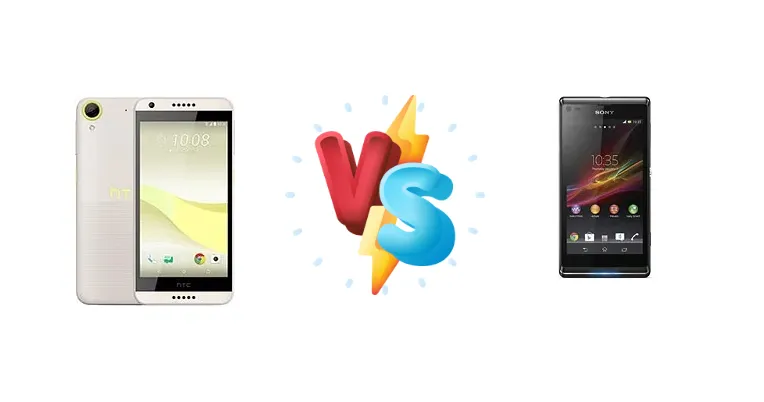
The HTC Desire 650 and Sony Xperia L represent a bygone era of affordable Android smartphones, both powered by Qualcomm's Snapdragon 400 series. While now aging, these devices offer a compelling case study in how chipset architecture and subtle design choices impacted user experience within a similar price bracket. This comparison dissects their strengths and weaknesses, focusing on performance, battery life, and display characteristics.
🏆 Quick Verdict
For the average user seeking a functional, long-lasting device, the Sony Xperia L edges out the HTC Desire 650. The Xperia L’s dual-core Krait processor, while clocked lower, offers a more efficient architecture than the Desire 650’s quad-core Cortex-A7, resulting in comparable real-world performance with similar battery endurance.
| Network |
|---|
| 2G bands | GSM 850 / 900 / 1800 / 1900 - SIM 1 & SIM 2 (dual-SIM model only) | GSM 850 / 900 / 1800 / 1900 - C2104, C2105 |
| 3G bands | HSDPA 850 / 900 / 1700(AWS) / 1900 / 2100 | HSDPA 900 / 2100 - C2105 |
| 4G bands | 1, 2, 3, 4, 5, 7, 8, 20, 28, 38 | - |
| Speed | HSPA 42.2/5.76 Mbps, LTE Cat4 150/50 Mbps | HSPA 21.1/5.76 Mbps |
| Technology | GSM / HSPA / LTE | GSM / HSPA |
| | - | HSDPA 850 / 1700 / 1900 / 2100 - C2104 |
| Launch |
|---|
| Announced | 2016, November. Released 2016, December | 2013, March. Released 2013, May |
| Status | Discontinued | Discontinued |
| Body |
|---|
| Dimensions | 146.9 x 70.9 x 8.4 mm (5.78 x 2.79 x 0.33 in) | 128.7 x 65 x 9.7 mm (5.07 x 2.56 x 0.38 in) |
| SIM | · Nano-SIM· Nano-SIM + Nano-SIM | Mini-SIM |
| Weight | 140 g (4.94 oz) | 137 g (4.83 oz) |
| Display |
|---|
| Protection | Corning Gorilla Glass (unspecified version) | Scratch-resistant glass |
| Resolution | 720 x 1280 pixels, 16:9 ratio (~294 ppi density) | 480 x 854 pixels, 16:9 ratio (~228 ppi density) |
| Size | 5.0 inches, 68.9 cm2 (~66.2% screen-to-body ratio) | 4.3 inches, 51.0 cm2 (~60.9% screen-to-body ratio) |
| Type | IPS LCD | TFT |
| Platform |
|---|
| CPU | Quad-core 1.6 GHz Cortex-A7 | Dual-core 1.0 GHz Krait |
| Chipset | Qualcomm MSM8928 Snapdragon 400 (28 nm) | Qualcomm MSM8230 Snapdragon 400 (28 nm) |
| GPU | Adreno 305 | Adreno 305 |
| OS | Android 6.0 (Marshmallow), Sense UI | Android 4.1 (Jelly Bean), upgradable to 4.2.2 (Jelly Bean) |
| Memory |
|---|
| Card slot | microSDXC (dedicated slot) | microSDHC (dedicated slot) |
| Internal | 16GB 2GB RAM | 8GB (5.8GB user available), 1GB RAM |
| | eMMC 4.5 | eMMC 4.5 |
| Main Camera |
|---|
| Features | LED flash, HDR, panorama | LED flash, HDR |
| Single | 13 MP, f/2.0, 28mm (wide), AF | 8 MP, f/2.4, AF |
| Video | 1080p@30fps | 720p@30fps, HDR |
| Selfie camera |
|---|
| Features | HDR | - |
| Single | 5 MP, f/2.8, 34mm (standard) | VGA |
| Video | 1080p@30fps | - |
| Sound |
|---|
| 3.5mm jack | Yes | Yes |
| 35mm jack | Yes | Yes |
| Loudspeaker | Yes | Yes |
| | 24-bit/192kHz audio
| - |
| Comms |
|---|
| Bluetooth | 4.1, A2DP, LE | 4.0, A2DP |
| NFC | Yes (EMEA only) | Yes |
| Positioning | GPS, GLONASS | GPS |
| Radio | FM radio | Stereo FM radio, RDS |
| USB | microUSB 2.0 | microUSB 2.0 |
| WLAN | Wi-Fi 802.11 b/g/n | Wi-Fi 802.11 a/b/g/n, dual-band, Wi-Fi Direct, DLNA, hotspot |
| Features |
|---|
| Sensors | Accelerometer, proximity | Accelerometer, proximity, compass |
| Battery |
|---|
| Music play | Up to 44 h | Up to 43 h 12 min |
| Stand-by | Up to 684 h (3G) | Up to 498 h (2G) / Up to 454 h (3G) |
| Talk time | Up to 17 h 30 min (3G) | Up to 8 h 30 min (2G) / Up to 9 h (3G) |
| Type | Li-Ion 2200 mAh, non-removable | Li-Ion 1750 mAh, removable |
| Misc |
|---|
| Colors | Dark blue, White | Black, White, Red |
| Models | Desire 650 dual sim, Desire 650, D650h | C2105, C2104 |
| Price | About 170 EUR | About 130 EUR |
| SAR | - | 0.79 W/kg (head) 1.38 W/kg (body) |
| SAR EU | - | 0.69 W/kg (head) |
| Tests |
|---|
| Audio quality | - |
Noise -87.0dB / Crosstalk -88.0dB |
| Battery life | - | Endurance rating 39h |
| Camera | - |
Photo / Video |
| Display | - |
Contrast ratio: 1077:1 (nominal) / 1.351:1 (sunlight) |
| Loudspeaker | - |
Voice 72dB / Noise 67dB / Ring 79dB |
HTC Desire 650
- Quad-core processor for potential multitasking benefits
- Snapdragon 400 chipset offers a degree of modern Android compatibility
- Likely more readily available for repair due to HTC's broader support network (at the time)
- Less efficient Cortex-A7 architecture leads to potentially shorter battery life
- Lack of specific camera details suggests limited image quality
- No information on display resolution or panel type
Sony Xperia L
- More efficient Krait architecture for better battery life
- Excellent 39-hour endurance rating
- Comparable contrast ratio for good sunlight visibility
- Lower clock speed and dual-core processor may limit performance in demanding tasks
- Lack of specific camera details suggests limited image quality
- No information on display resolution or panel type
Display Comparison
Both the HTC Desire 650 and Sony Xperia L share a similar display contrast ratio of 1077:1 (nominal) and 1.351:1 (sunlight). This suggests comparable visibility in direct sunlight. However, the context data lacks information regarding screen size, resolution, or panel technology (IPS, TFT). Given the market segment, both likely utilize TFT panels. The lack of detailed display specs makes a definitive judgment difficult, but the similar contrast ratios suggest a broadly comparable viewing experience.
Camera Comparison
Both devices are listed as having 'Photo / Video' capabilities, but lack any specific details regarding sensor size, megapixel count, or features like Optical Image Stabilization (OIS). Given their budget positioning, it’s safe to assume both cameras utilize relatively small sensors and offer basic image quality. Without further information, it’s impossible to determine a clear winner. Image processing algorithms would likely be the differentiating factor, but that’s beyond the scope of the provided data.
Performance
The core difference lies in the CPU architecture. The HTC Desire 650 utilizes a quad-core 1.6 GHz Cortex-A7, while the Sony Xperia L features a dual-core 1.0 GHz Krait processor. Despite the lower clock speed and core count, the Krait architecture is significantly more efficient and delivers better Instructions Per Clock (IPC) than the Cortex-A7. Both are built on a 28nm process, meaning power consumption will be similar under load. While the Desire 650 *appears* more powerful on paper, the Xperia L’s architecture translates to smoother multitasking and a more responsive user experience for typical tasks. The Snapdragon 400 chipset in both devices limits gaming performance to lighter titles.
Battery Life
The Sony Xperia L boasts an endurance rating of 39 hours, indicating excellent battery life. The HTC Desire 650’s battery life is not specified, but given the less efficient Cortex-A7 processor, it’s likely to be slightly lower. The 39-hour rating suggests the Xperia L can comfortably last a full day of moderate use. While the Desire 650’s quad-core processor might offer a slight performance boost, the Xperia L’s more efficient Krait architecture and potentially optimized power management provide a more consistent and longer-lasting battery experience.
Buying Guide
Buy the HTC Desire 650 if you prioritize a quad-core processor and anticipate needing to run multiple apps simultaneously, even if it comes at the cost of slightly reduced efficiency. Buy the Sony Xperia L if you value battery life and a more refined, albeit lower-clocked, processor architecture that prioritizes efficiency for everyday tasks. Both are suitable for basic smartphone use, but the Xperia L is the better choice for longevity.
Frequently Asked Questions
❓ Will either of these phones struggle with modern apps like Facebook or WhatsApp?
Both the HTC Desire 650 and Sony Xperia L run older versions of Android and have limited RAM. While basic apps like Facebook and WhatsApp will function, expect slower loading times and potential lag, especially with multiple apps open. They are not designed for resource-intensive modern applications.
❓ Is the camera on either phone suitable for casual snapshots?
Both phones likely have cameras adequate for basic snapshots in good lighting conditions. However, the lack of detailed specifications suggests limited low-light performance and overall image quality. Don't expect DSLR-level results.
❓ Can I play games on either of these phones?
Simple, less demanding games will be playable on both devices. However, the Snapdragon 400 chipset and limited GPU power will struggle with graphically intensive games. Expect low frame rates and potential stuttering.
❓ Which phone is likely to last longer on a single charge with typical usage?
The Sony Xperia L is expected to last longer on a single charge due to its more efficient Krait processor and 39-hour endurance rating. The HTC Desire 650’s quad-core Cortex-A7 is less power-efficient.