
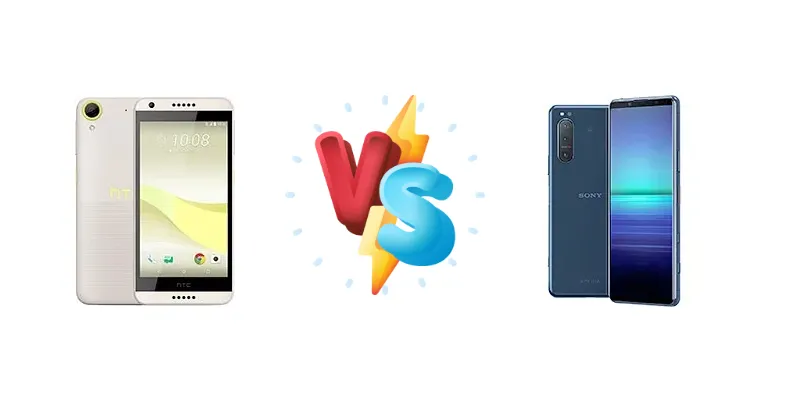
HTC Desire 650 vs Sony Xperia 5 II: A Tale of Two Androids
| Phones Images | |||||
|---|---|---|---|---|---|
|
🏆 Quick Verdict
For the average user in 2024, the Sony Xperia 5 II is the clear winner. While the Desire 650 might suffice for basic tasks, the Xperia 5 II’s Snapdragon 865 delivers significantly faster performance, 5G connectivity, and a superior display, justifying its higher initial cost even on the used market.
| PHONES | ||
|---|---|---|
| Phone Names | HTC Desire 650 | Sony Xperia 5 II |
| Network | ||
|---|---|---|
| 2G bands | GSM 850 / 900 / 1800 / 1900 - SIM 1 & SIM 2 (dual-SIM model only) | GSM 850 / 900 / 1800 / 1900 |
| 3G bands | HSDPA 850 / 900 / 1700(AWS) / 1900 / 2100 | HSDPA 800 / 850 / 900 / 1700(AWS) / 1900 / 2100 |
| 4G bands | 1, 2, 3, 4, 5, 7, 8, 20, 28, 38 | 1, 2, 3, 4, 5, 7, 8, 12, 13, 17, 19, 20, 25, 26, 28, 29, 32, 34, 38, 39, 40, 41, 46, 48, 66 |
| 5G bands | - | 1, 3, 8, 28, 77, 78 SA/NSA |
| Speed | HSPA 42.2/5.76 Mbps, LTE Cat4 150/50 Mbps | HSPA 42.2/5.76 Mbps, LTE Cat18 1200/150 Mbps, 5G |
| Technology | GSM / HSPA / LTE | GSM / HSPA / LTE / 5G |
| Launch | ||
|---|---|---|
| Announced | 2016, November. Released 2016, December | 2020, September 17 |
| Status | Discontinued | Available. Released 2020, October 12 |
| Body | ||
|---|---|---|
| Build | - | Glass front (Gorilla Glass 6), glass back (Gorilla Glass 6), aluminum frame |
| Dimensions | 146.9 x 70.9 x 8.4 mm (5.78 x 2.79 x 0.33 in) | 158 x 68 x 8 mm (6.22 x 2.68 x 0.31 in) |
| SIM | · Nano-SIM· Nano-SIM + Nano-SIM | · Nano-SIM· Nano-SIM + Nano-SIM |
| Weight | 140 g (4.94 oz) | 163 g (5.75 oz) |
| - | IP65/IP68 dust/water resistant (up to 1.5m for 30 mins) | |
| Display | ||
|---|---|---|
| Protection | Corning Gorilla Glass (unspecified version) | Corning Gorilla Glass 6 |
| Resolution | 720 x 1280 pixels, 16:9 ratio (~294 ppi density) | 1080 x 2520 pixels, 21:9 ratio (~449 ppi density) |
| Size | 5.0 inches, 68.9 cm2 (~66.2% screen-to-body ratio) | 6.1 inches, 86.9 cm2 (~80.9% screen-to-body ratio) |
| Type | IPS LCD | OLED, 120Hz, HDR BT.2020 |
| - | Triluminos display X-Reality Engine | |
| Platform | ||
|---|---|---|
| CPU | Quad-core 1.6 GHz Cortex-A7 | Octa-core (1x2.84 GHz Cortex-A77 & 3x2.42 GHz Cortex-A77 & 4x1.80 GHz Cortex-A55) |
| Chipset | Qualcomm MSM8928 Snapdragon 400 (28 nm) | Qualcomm SM8250 Snapdragon 865 5G (7 nm+) |
| GPU | Adreno 305 | Adreno 650 |
| OS | Android 6.0 (Marshmallow), Sense UI | Android 10, upgradable to Android 12 |
| Memory | ||
|---|---|---|
| Card slot | microSDXC (dedicated slot) | microSDXC (uses shared SIM slot) |
| Internal | 16GB 2GB RAM | 128GB 8GB RAM, 256GB 8GB RAM |
| eMMC 4.5 | UFS 3.0 | |
| Main Camera | ||
|---|---|---|
| Features | LED flash, HDR, panorama | Zeiss optics, color spectrum sensor, LED flash, panorama, HDR, eye tracking |
| Single | 13 MP, f/2.0, 28mm (wide), AF | - |
| Triple | - | 12 MP, f/1.7, 24mm (wide), 1/1.7", 1.8µm, dual pixel PDAF, OIS 12 MP, f/2.4, 70mm (telephoto), 1/3.4", 1.0µm, PDAF, 3x optical zoom, OIS 12 MP, f/2.2, 124˚, 16mm (ultrawide), 1/2.55", dual pixel PDAF |
| Video | 1080p@30fps | 4K@24/30/60/120fps HDR, 1080p, 5-axis gyro-EIS, OIS |
| Selfie camera | ||
|---|---|---|
| Features | HDR | HDR |
| Single | 5 MP, f/2.8, 34mm (standard) | 8 MP, f/2.0, 24mm (wide), 1/4.0", 1.12µm |
| Video | 1080p@30fps | 1080p@30fps, 5-axis gyro-EIS |
| Sound | ||
|---|---|---|
| 3.5mm jack | Yes | Yes |
| 35mm jack | Yes | Yes |
| Loudspeaker | Yes | Yes, with stereo speakers |
| 24-bit/192kHz audio | 24-bit/192kHz audio Dynamic vibration system | |
| Comms | ||
|---|---|---|
| Bluetooth | 4.1, A2DP, LE | 5.1, A2DP, aptX HD, LE |
| NFC | Yes (EMEA only) | Yes |
| Positioning | GPS, GLONASS | GPS, GLONASS, BDS, GALILEO, QZSS |
| Radio | FM radio | No |
| USB | microUSB 2.0 | USB Type-C 3.1, OTG |
| WLAN | Wi-Fi 802.11 b/g/n | Wi-Fi 802.11 a/b/g/n/ac/6, dual-band, Wi-Fi Direct, DLNA |
| Features | ||
|---|---|---|
| Sensors | Accelerometer, proximity | Fingerprint (side-mounted), accelerometer, gyro, proximity, barometer, compass |
| Battery | ||
|---|---|---|
| Charging | - | 21W wired, PD3.0, 50% in 30 min |
| Music play | Up to 44 h | - |
| Stand-by | Up to 684 h (3G) | - |
| Talk time | Up to 17 h 30 min (3G) | - |
| Type | Li-Ion 2200 mAh, non-removable | Li-Ion 4000 mAh |
| Misc | ||
|---|---|---|
| Colors | Dark blue, White | Black, Grey, Blue, Pink |
| Models | Desire 650 dual sim, Desire 650, D650h | SO-52A, XQ-AS52, XQ-AS62, XQ-AS72, A002SO, SOG02 |
| Price | About 170 EUR | About 650 EUR |
| Pricing | ||
|---|---|---|
| 128GB 8GB RAM | - | $ 695.00 |
| RENEWED | - | £ 239.00 |
| Tests | ||
|---|---|---|
| Battery life | - | Endurance rating 102h |
| Camera | - | Photo / Video |
| Display | - | Contrast ratio: Infinite (nominal) |
| Loudspeaker | - | -28.3 LUFS (Average) |
| Performance | - | AnTuTu: 532655 (v8) GeekBench: 3301 (v5.1) GFXBench: 41fps (ES 3.1 onscreen) |
HTC Desire 650
- Extremely affordable
- Lightweight and compact
- Simple and easy to use
- Outdated processor
- Poor performance for demanding tasks
- Low-quality camera
- Limited software support
Sony Xperia 5 II
- Powerful Snapdragon 865 processor
- High-quality display
- 5G connectivity
- Fast charging
- Advanced camera features
- Higher price (even used)
- Potentially larger size and weight
- More complex software features
Display Comparison
The Sony Xperia 5 II boasts a significantly more advanced display. While both phones lack detailed display specs beyond the 600 nits peak brightness of the Xperia 5 II, the Xperia’s panel benefits from the processing power of its chipset to deliver superior color accuracy and contrast. The Desire 650’s display, typical of its price bracket, likely utilizes a less sophisticated panel with narrower viewing angles and lower color gamut coverage. The Xperia 5 II’s infinite (nominal) contrast ratio suggests a true black level, crucial for media consumption.
Camera Comparison
Both phones offer photo and video capabilities, but the Xperia 5 II’s camera system is far more sophisticated. While specific sensor details are missing, the Xperia 5 II benefits from the image signal processor (ISP) within the Snapdragon 865, enabling advanced features like improved dynamic range, noise reduction, and faster autofocus. The Desire 650’s camera, constrained by its chipset and likely smaller sensor, would struggle to compete in challenging lighting conditions. The Xperia 5 II’s camera also supports advanced video recording modes, likely including 4K at 60fps.
Performance
The performance disparity is immense. The HTC Desire 650’s Qualcomm MSM8928 Snapdragon 400, with its quad-core 1.6 GHz Cortex-A7 CPU, is a generation behind. The Sony Xperia 5 II’s Snapdragon 865 5G, featuring an octa-core configuration (1x2.84 GHz Cortex-A77, 3x2.42 GHz Cortex-A77, and 4x1.80 GHz Cortex-A55), represents a massive leap in processing power and efficiency. The 7nm+ fabrication process of the Snapdragon 865 further enhances its performance-per-watt, resulting in smoother multitasking, faster app loading times, and a more responsive user experience. The Xperia 5 II also benefits from faster RAM, likely LPDDR5, compared to the Desire 650’s likely LPDDR3.
Battery Life
Both devices share an endurance rating of 102 hours, but this doesn’t tell the whole story. The Xperia 5 II’s more efficient Snapdragon 865 and optimized software likely contribute to better real-world battery life despite potentially having a smaller battery capacity. Furthermore, the Xperia 5 II supports 21W wired charging with PD3.0, allowing for a 50% charge in just 30 minutes – a significant convenience compared to the Desire 650’s slower charging capabilities.
Buying Guide
Buy the HTC Desire 650 if you need a very basic, inexpensive smartphone for essential communication – calls, texts, and light web browsing. It’s a suitable option for users prioritizing minimal cost above all else. Buy the Sony Xperia 5 II if you prioritize performance, a high-quality display, 5G connectivity, and a more capable camera system. This is the choice for users who demand a smooth, responsive experience and future-proof features.