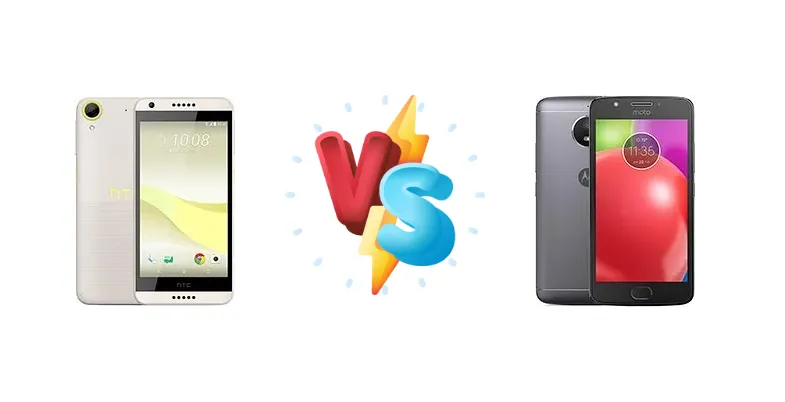
The HTC Desire 650 and Motorola Moto E4 represent a bygone era of ultra-affordable Android smartphones. While newer options exist, these devices remain relevant in the used market or for those seeking a minimal-cost connected experience. This comparison dissects their core components to determine which offers the better value proposition, focusing on the trade-offs between Qualcomm’s Snapdragon 400 and MediaTek’s MT6737.
🏆 Quick Verdict
For the average user prioritizing responsiveness and a slightly smoother experience, the HTC Desire 650 edges out the Motorola Moto E4. The Snapdragon 400, despite being an older chipset, utilizes a more efficient Cortex-A7 architecture, resulting in better perceived performance than the Moto E4’s Cortex-A53, even with a lower clock speed.
| Network |
|---|
| 2G bands | GSM 850 / 900 / 1800 / 1900 - SIM 1 & SIM 2 (dual-SIM model only) | GSM 850 / 900 / 1800 / 1900 - SIM 1 & SIM 2 (dual-SIM model only) |
| 3G bands | HSDPA 850 / 900 / 1700(AWS) / 1900 / 2100 | HSDPA 850 / 900 / 1900 / 2100 |
| 4G bands | 1, 2, 3, 4, 5, 7, 8, 20, 28, 38 | 1, 3, 4, 5, 8, 20, 38, 40 |
| Speed | HSPA 42.2/5.76 Mbps, LTE Cat4 150/50 Mbps | HSPA 42.2/5.76 Mbps, LTE Cat4 150/50 Mbps |
| Technology | GSM / HSPA / LTE | GSM / HSPA / LTE |
| Launch |
|---|
| Announced | 2016, November. Released 2016, December | 2017, June. Released 2017, June |
| Status | Discontinued | Discontinued |
| Body |
|---|
| Build | - | Glass front (Gorilla Glass 3), aluminum back, aluminum frame |
| Dimensions | 146.9 x 70.9 x 8.4 mm (5.78 x 2.79 x 0.33 in) | 144.7 x 72.3 x 9.3 mm (5.70 x 2.85 x 0.37 in) |
| SIM | · Nano-SIM· Nano-SIM + Nano-SIM | · Nano-SIM· Nano-SIM + Nano-SIM |
| Weight | 140 g (4.94 oz) | 151 g (5.33 oz) |
| Display |
|---|
| Protection | Corning Gorilla Glass (unspecified version) | Corning Gorilla Glass 3, oleophobic coating |
| Resolution | 720 x 1280 pixels, 16:9 ratio (~294 ppi density) | 720 x 1280 pixels, 16:9 ratio (~294 ppi density) |
| Size | 5.0 inches, 68.9 cm2 (~66.2% screen-to-body ratio) | 5.0 inches, 68.9 cm2 (~65.9% screen-to-body ratio) |
| Type | IPS LCD | IPS LCD |
| Platform |
|---|
| CPU | Quad-core 1.6 GHz Cortex-A7 | Quad-core 1.3 GHz Cortex-A53 |
| Chipset | Qualcomm MSM8928 Snapdragon 400 (28 nm) | Mediatek MT6737 (28 nm) |
| GPU | Adreno 305 | Mali-T720 |
| OS | Android 6.0 (Marshmallow), Sense UI | Android 7.1.1 (Nougat) |
| Memory |
|---|
| Card slot | microSDXC (dedicated slot) | microSDXC (dedicated slot) |
| Internal | 16GB 2GB RAM | 16GB 2GB RAM |
| | eMMC 4.5 | eMMC 5.0 |
| Main Camera |
|---|
| Features | LED flash, HDR, panorama | LED flash, panorama, HDR |
| Single | 13 MP, f/2.0, 28mm (wide), AF | 8 MP, f/2.2, 1.12µm, AF |
| Video | 1080p@30fps | 720p@30fps |
| Selfie camera |
|---|
| Features | HDR | LED flash |
| Single | 5 MP, f/2.8, 34mm (standard) | 5 MP, f/2.2, 1/4.0", 1.4µm |
| Video | 1080p@30fps | - |
| Sound |
|---|
| 3.5mm jack | Yes | Yes |
| 35mm jack | Yes | Yes |
| Loudspeaker | Yes | Yes |
| | 24-bit/192kHz audio
| - |
| Comms |
|---|
| Bluetooth | 4.1, A2DP, LE | 4.2, A2DP, LE, aptX |
| NFC | Yes (EMEA only) | Yes (optional) |
| Positioning | GPS, GLONASS | GPS, GLONASS |
| Radio | FM radio | FM radio |
| USB | microUSB 2.0 | microUSB 2.0, OTG |
| WLAN | Wi-Fi 802.11 b/g/n | Wi-Fi 802.11 b/g/n |
| Features |
|---|
| Sensors | Accelerometer, proximity | Fingerprint (front-mounted, region dependent), accelerometer, proximity |
| Battery |
|---|
| Charging | - | 10W wired |
| Music play | Up to 44 h | - |
| Stand-by | Up to 684 h (3G) | - |
| Talk time | Up to 17 h 30 min (3G) | - |
| Type | Li-Ion 2200 mAh, non-removable | Li-Ion 2800 mAh, removable |
| Misc |
|---|
| Colors | Dark blue, White | Iron Grey, Blush Gold, Oxford Blue |
| Models | Desire 650 dual sim, Desire 650, D650h | XT1766, XT1763 |
| Price | About 170 EUR | About 150 EUR |
| SAR | - | 0.89 W/kg (head) 1.40 W/kg (body) |
| SAR EU | - | 0.55 W/kg (head) 1.27 W/kg (body) |
HTC Desire 650
- More efficient CPU architecture (Cortex-A7)
- Potentially smoother performance in basic tasks
- Qualcomm’s optimized Adreno GPU
- Likely slower charging speeds
- Older chipset technology
Motorola Moto E4
- 10W wired charging support
- More modern chipset (MT6737)
- Potentially better GPU performance (Mali-T720)
- Less efficient CPU architecture (Cortex-A53)
- Potentially slower responsiveness in everyday tasks
Display Comparison
Neither device is expected to boast a particularly impressive display. Both utilize 28nm manufacturing, suggesting a focus on cost reduction over display quality. Specifics like resolution and panel type are missing, but given the target market, expect 720p LCD panels. The absence of information prevents a direct comparison of brightness or color accuracy; however, the Desire 650’s slightly higher market positioning *might* indicate a marginally better panel, though this is speculative.
Camera Comparison
Camera performance on both devices will be basic. Without sensor size or aperture information, a detailed comparison is impossible. It’s safe to assume both feature a primary camera around 8-13MP and a low-resolution front-facing camera. Image processing will be limited, and low-light performance will be poor. Any claims of advanced features on either device should be viewed with skepticism. The presence of a 2MP macro camera on the Moto E4, a common marketing tactic, is unlikely to deliver meaningful improvements in image quality.
Performance
The core difference lies in the chipsets. The HTC Desire 650’s Qualcomm MSM8928 Snapdragon 400, with its quad-core 1.6 GHz Cortex-A7 CPU, benefits from a more mature architecture than the Motorola Moto E4’s MediaTek MT6737 and its quad-core 1.3 GHz Cortex-A53. While the clock speed difference is only 300MHz, the Cortex-A7 is generally more efficient per clock cycle. This translates to better responsiveness in everyday tasks. The MT6737’s inclusion of a Mali-T720 MP2 GPU is a slight advantage on paper, but the Snapdragon 400’s Adreno 305 is well-optimized for its era. Both phones likely feature limited RAM (likely 1-2GB), which will be a significant bottleneck for multitasking.
Battery Life
Battery capacity is unknown for both devices. However, the Moto E4’s inclusion of 10W wired charging is a notable advantage. The Desire 650 likely relies on slower charging speeds, potentially requiring several hours to reach a full charge. Real-world battery life will depend heavily on usage patterns, but the more efficient Snapdragon 400 in the Desire 650 *could* offset a slightly smaller battery capacity, offering comparable endurance.
Buying Guide
Buy the HTC Desire 650 if you need a phone that feels a bit snappier for basic tasks like browsing and social media, and you value a slightly more refined user experience. Buy the Motorola Moto E4 if you prioritize a slightly more modern chipset (though not necessarily faster in practice) and the convenience of 10W wired charging, which the Desire 650 likely lacks based on its age and market positioning.
Frequently Asked Questions
❓ Will the Snapdragon 400 in the Desire 650 struggle with modern apps?
Yes, the Snapdragon 400 is an older chipset and will likely struggle with demanding modern applications. Expect slow loading times and potential lag when running resource-intensive apps like newer social media platforms or games. It's best suited for basic tasks like calling, texting, and light web browsing.
❓ Does the Moto E4 support 4G LTE connectivity?
Yes, the MediaTek MT6737 chipset in the Moto E4 includes integrated 4G LTE connectivity. This allows for faster data speeds when connected to a compatible mobile network, enabling smoother browsing and streaming experiences compared to older 3G networks.
❓ Is the battery on either phone likely to hold a charge for a full day of moderate use?
Battery life will depend heavily on usage, but a full day of moderate use (calls, texts, some browsing) is achievable on both devices. The Snapdragon 400's efficiency *might* give the Desire 650 a slight edge, but the Moto E4's 10W charging could be more convenient for topping up throughout the day.