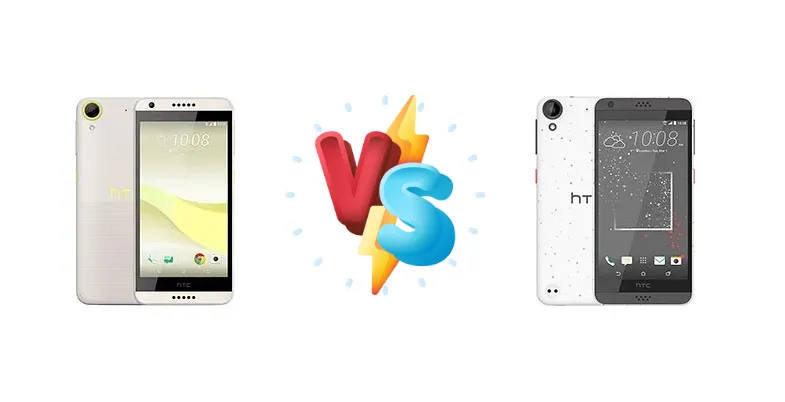
The HTC Desire 650 and 530 represent a segment of the market increasingly focused on affordability. Both devices leverage Qualcomm's Snapdragon platform, but at vastly different performance tiers. This comparison dissects the core differences between the Snapdragon 400 in the 650 and the Snapdragon 210 in the 530, revealing which phone delivers a more responsive and future-proof experience.
🏆 Quick Verdict
For the average user prioritizing responsiveness and multitasking, the HTC Desire 650 is the clear winner. Its Snapdragon 400 chipset, with a 1.6 GHz clock speed, provides a noticeable performance advantage over the Desire 530’s 1.1 GHz Snapdragon 210, making it better suited for everyday tasks and light app usage.
| Network |
|---|
| 2G bands | GSM 850 / 900 / 1800 / 1900 - SIM 1 & SIM 2 (dual-SIM model only) | GSM 850 / 900 / 1800 / 1900 |
| 3G bands | HSDPA 850 / 900 / 1700(AWS) / 1900 / 2100 | HSDPA 850 / 900 / 2100 |
| 4G bands | 1, 2, 3, 4, 5, 7, 8, 20, 28, 38 | 1, 3, 5, 7, 8, 20, 28 |
| Speed | HSPA 42.2/5.76 Mbps, LTE Cat4 150/50 Mbps | HSPA, LTE Cat4 150/50 Mbps |
| Technology | GSM / HSPA / LTE | GSM / HSPA / LTE |
| | - | 2, 4, 5, 7, 12, 13 - USA |
| Launch |
|---|
| Announced | 2016, November. Released 2016, December | 2016, February. Released 2016, March |
| Status | Discontinued | Discontinued |
| Body |
|---|
| Dimensions | 146.9 x 70.9 x 8.4 mm (5.78 x 2.79 x 0.33 in) | 146.9 x 70.9 x 8.3 mm (5.78 x 2.79 x 0.33 in) |
| SIM | · Nano-SIM· Nano-SIM + Nano-SIM | Nano-SIM |
| Weight | 140 g (4.94 oz) | 140 g (4.94 oz) |
| Display |
|---|
| Protection | Corning Gorilla Glass (unspecified version) | - |
| Resolution | 720 x 1280 pixels, 16:9 ratio (~294 ppi density) | 720 x 1280 pixels, 16:9 ratio (~294 ppi density) |
| Size | 5.0 inches, 68.9 cm2 (~66.2% screen-to-body ratio) | 5.0 inches, 68.9 cm2 (~66.2% screen-to-body ratio) |
| Type | IPS LCD | Super LCD |
| Platform |
|---|
| CPU | Quad-core 1.6 GHz Cortex-A7 | Quad-core 1.1 GHz Cortex-A7 |
| Chipset | Qualcomm MSM8928 Snapdragon 400 (28 nm) | Qualcomm MSM8909 Snapdragon 210 (28 nm) |
| GPU | Adreno 305 | Adreno 304 |
| OS | Android 6.0 (Marshmallow), Sense UI | Android 6.0 (Marshmallow) |
| Memory |
|---|
| Card slot | microSDXC (dedicated slot) | microSDXC (dedicated slot) |
| Internal | 16GB 2GB RAM | 16GB 1.5GB RAM |
| | eMMC 4.5 | eMMC 4.5 |
| Main Camera |
|---|
| Features | LED flash, HDR, panorama | LED flash, HDR, panorama |
| Single | 13 MP, f/2.0, 28mm (wide), AF | 8 MP, f/2.4, AF |
| Video | 1080p@30fps | 720p@30fps |
| Selfie camera |
|---|
| Features | HDR | - |
| Single | 5 MP, f/2.8, 34mm (standard) | 5 MP, f/2.8 |
| Video | 1080p@30fps | - |
| Sound |
|---|
| 3.5mm jack | Yes | Yes |
| 35mm jack | Yes | Yes |
| Loudspeaker | Yes | Yes |
| | 24-bit/192kHz audio
| - |
| Comms |
|---|
| Bluetooth | 4.1, A2DP, LE | 4.1, A2DP |
| NFC | Yes (EMEA only) | Yes (market dependant) |
| Positioning | GPS, GLONASS | GPS, GLONASS |
| Radio | FM radio | FM radio |
| USB | microUSB 2.0 | microUSB 2.0 |
| WLAN | Wi-Fi 802.11 b/g/n | Wi-Fi 802.11 b/g/nWi-Fi 802.11 a/b/g/n/ac, Wi-Fi Direct - USA version |
| Features |
|---|
| Sensors | Accelerometer, proximity | Accelerometer, proximity |
| Battery |
|---|
| Music play | Up to 44 h | - |
| Stand-by | Up to 684 h (3G) | - |
| Talk time | Up to 17 h 30 min (3G) | - |
| Type | Li-Ion 2200 mAh, non-removable | Li-Ion 2200 mAh, non-removable |
| Misc |
|---|
| Colors | Dark blue, White | Black, White |
| Models | Desire 650 dual sim, Desire 650, D650h | Desire 530, D530u, HTCD160LVW |
| Price | About 170 EUR | About 170 EUR |
HTC Desire 650
- Faster processor for smoother performance
- More responsive user interface
- Potentially better camera image processing
- Likely shorter battery life compared to the 530
- May be slightly more expensive
HTC Desire 530
- Potentially longer battery life
- Lower price point
- Sufficient for basic smartphone tasks
- Slower processor and overall performance
- Laggy user interface with multiple apps open
Display Comparison
Neither HTC explicitly details display specifications beyond size. However, given their market positioning, both likely utilize LCD panels. The key difference lies in the processing power driving them. The Desire 650’s Snapdragon 400 can render UI elements and graphics more quickly, resulting in a smoother visual experience, even if the panel technology is similar. The 650’s processor will also be better equipped to handle video playback without stuttering.
Camera Comparison
Without detailed camera specifications, a direct comparison is difficult. However, it’s reasonable to assume both phones feature entry-level camera sensors. The Snapdragon 400 in the Desire 650 offers a more capable Image Signal Processor (ISP), potentially leading to slightly better image quality, faster processing of photos, and improved low-light performance. The ISP handles noise reduction, color correction, and other image enhancements. The 650’s ISP will likely be more advanced, even if the sensor itself is similar.
Performance
The core distinction between these phones is the chipset. The HTC Desire 650’s Qualcomm MSM8928 Snapdragon 400, featuring a quad-core 1.6 GHz Cortex-A7 CPU, significantly outperforms the Desire 530’s MSM8909 Snapdragon 210 with its quad-core 1.1 GHz Cortex-A7 CPU. The 50% clock speed increase, coupled with architectural optimizations within the Snapdragon 400, translates to faster app launch times, smoother scrolling, and a more responsive user interface. While both are based on the Cortex-A7 architecture, the 400’s higher clock speed and potentially larger cache will provide a more fluid experience. The 28nm manufacturing process is shared, meaning thermal efficiency differences will be minimal, but the 650 will still be able to sustain higher performance for longer.
Battery Life
Battery capacity isn’t specified in the provided data. However, the Snapdragon 210 in the Desire 530, with its lower clock speed and reduced processing demands, will inherently consume less power. This translates to potentially longer battery life for the 530, even if the battery capacity is identical to the 650. The 650’s more powerful processor will draw more current, especially during intensive tasks, reducing overall battery endurance. However, the faster processing speed might allow for quicker completion of tasks, offsetting some of the power consumption.
Buying Guide
Buy the HTC Desire 650 if you need a phone capable of handling more demanding apps, occasional gaming, and smoother multitasking. The Snapdragon 400 offers a tangible performance boost for users who don't want to be constantly waiting for apps to load. Buy the HTC Desire 530 if your primary needs are basic communication – calls, texts, and light social media – and you prioritize maximizing battery life over raw processing power. It’s a suitable option for first-time smartphone users or those on a very tight budget.
Frequently Asked Questions
❓ Will the HTC Desire 650 handle basic games like Candy Crush or Angry Birds without significant lag?
Yes, the Snapdragon 400 in the Desire 650 is capable of running less demanding games like Candy Crush and Angry Birds without significant lag. While it won’t handle graphically intensive titles smoothly, it provides a much better gaming experience than the Snapdragon 210.
❓ Is the performance difference between the Snapdragon 400 and 210 noticeable for everyday tasks like browsing the web and checking email?
Absolutely. The Snapdragon 400’s faster processor results in noticeably quicker web page loading times, smoother scrolling, and faster app launch speeds. These improvements are particularly apparent when multitasking or switching between apps, making the Desire 650 a more pleasant daily driver.
❓ If I primarily use my phone for calls, texts, and WhatsApp, is the extra cost of the Desire 650 justified?
For those limited use cases, the extra cost of the Desire 650 is likely not justified. The Snapdragon 210 in the Desire 530 is perfectly adequate for basic communication and light social media use. The 530 will provide sufficient performance and potentially longer battery life for these tasks.