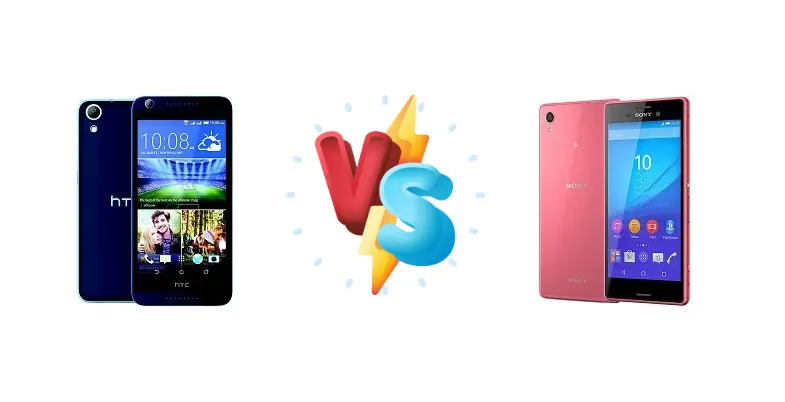
Released around the same timeframe, the HTC Desire 626G+ and Sony Xperia M4 Aqua represent attempts to deliver affordable Android experiences. While both target budget-conscious consumers, they diverge significantly in their core hardware, particularly in their chipset choices. This comparison dissects these differences to determine which device offers the best value.
🏆 Quick Verdict
For the average user prioritizing efficiency and a more modern architecture, the Sony Xperia M4 Aqua is the better choice. Its Qualcomm Snapdragon 615 chipset, with its Cortex-A53 cores, offers superior power management and a smoother overall experience compared to the HTC Desire 626G+'s older Mediatek MT6592 and Cortex-A7 cores.
| Network |
|---|
| 2G bands | GSM 850 / 900 / 1800 / 1900 - SIM 1 & SIM 2 | GSM 850 / 900 / 1800 / 1900 |
| 3G bands | HSDPA 850 / 900 / 2100 - SIM 1 & SIM 2 | HSDPA 850 / 900 / 1900 / 2100 - E2303, E2353 |
| 4G bands | - | 1, 2, 3, 5, 7, 8, 20 - E2303 |
| Speed | HSPA 21.1/5.76 Mbps | HSPA 42.2/5.76 Mbps, LTE Cat4 150/50 Mbps |
| Technology | GSM / HSPA | GSM / HSPA / LTE |
| | - | 1, 3, 5, 7, 8, 28, 40 - E2353 |
| Launch |
|---|
| Announced | 2015, April. Released 2015, April | 2015, March. Released 2015, June |
| Status | Discontinued | Discontinued |
| Body |
|---|
| Build | - | Glass front, plastic back, plastic frame |
| Dimensions | 146.9 x 70.9 x 8.2 mm (5.78 x 2.79 x 0.32 in) | 145.5 x 72.6 x 7.3 mm (5.73 x 2.86 x 0.29 in) |
| SIM | Nano-SIM + Nano-SIM | Nano-SIM |
| Weight | 138 g (4.87 oz) | 136 g (4.80 oz) |
| | - | IP68 dust/water resistant (up to 1.5m for 30 min) |
| Display |
|---|
| Protection | - | Scratch-resistant glass |
| Resolution | 720 x 1280 pixels, 16:9 ratio (~294 ppi density) | 720 x 1280 pixels, 16:9 ratio (~294 ppi density) |
| Size | 5.0 inches, 68.9 cm2 (~66.2% screen-to-body ratio) | 5.0 inches, 68.9 cm2 (~65.2% screen-to-body ratio) |
| Type | IPS LCD, | IPS LCD |
| Platform |
|---|
| CPU | Octa-core 1.7 GHz Cortex-A7 | Octa-core (4x1.5 GHz Cortex-A53 & 4x1.0 GHz Cortex-A53) |
| Chipset | Mediatek MT6592 (28 nm) | Qualcomm MSM8939 Snapdragon 615 (28 nm) |
| GPU | Mali-450MP4 | Adreno 405 |
| OS | Android 4.4.2 (KitKat) | Android 5.0.1 (Lollipop), upgradable to 6.0.1 (Marshmallow) |
| Memory |
|---|
| Card slot | microSDHC (dedicated slot) | microSDXC (dedicated slot) |
| Internal | 8GB 1GB RAM | 8GB 2GB RAM, 16GB 2GB RAM (E2306) |
| | - | eMMC 4.5 |
| Main Camera |
|---|
| Features | LED flash, panorama | LED flash, HDR, panorama |
| Single | 13 MP, f/2.2, 28mm (wide), AF | 13 MP, f/2.0, AF |
| Video | 1080p@30fps | 1080p@30fps |
| Selfie camera |
|---|
| Single | 5 MP, f/2.8, 34mm (standard) | 5 MP |
| Video | 1080p@30fps | 720p |
| Sound |
|---|
| 3.5mm jack | - | Yes |
| 35mm jack | Yes | Yes |
| Loudspeaker | Yes | Yes |
| Comms |
|---|
| Bluetooth | 4.0, A2DP, aptX | 4.1, A2DP |
| NFC | No | Yes |
| Positioning | GPS | GPS, GLONASS |
| Radio | FM radio | FM radio, RDS |
| USB | microUSB 2.0 | microUSB 2.0 |
| WLAN | Wi-Fi 802.11 b/g/n, Wi-Fi Direct, DLNA, hotspot | Wi-Fi 802.11 a/b/g/n, dual-band, Wi-Fi Direct, DLNA, hotspot |
| Features |
|---|
| Sensors | Accelerometer, proximity, compass | Accelerometer, proximity, compass |
| | - | ANT+ |
| Battery |
|---|
| Music play | - | Up to 64 h 40 min |
| Stand-by | Up to 521 h (2G) / Up to 458 h (3G) | Up to 681 h (2G) / Up to 685 h (3G) |
| Talk time | Up to 22 h 40 min (2G) / Up to 12 h 40 min (3G) | Up to 12 h 40 min (2G) / Up to 13 h 20 min (3G) |
| Type | Li-Po 2000 mAh, non-removable | Li-Ion 2400 mAh, non-removable |
| Misc |
|---|
| Colors | White Birch, Purple Fire, Blue Lagoon | Black, White, Coral, Silver |
| Models | Desire 626GPLUS dual, Desire_626GPLUS_dual | E2303, E2353, E2306 |
| Price | About 250 EUR | About 190 EUR |
| SAR | - | 1.19 W/kg (head) 1.19 W/kg (body) |
| SAR EU | - | 0.59 W/kg (head) 0.53 W/kg (body) |
| Tests |
|---|
| Camera | - |
Photo / Video |
HTC Desire 626G+
- Potentially higher peak CPU performance for single-threaded tasks.
- May be available at a lower price point in the used market.
- Simple Android experience (depending on the ROM).
- Older, less efficient Cortex-A7 CPU architecture.
- Likely shorter battery life.
- Potentially less refined camera performance.
Sony Xperia M4 Aqua
- More power-efficient Snapdragon 615 chipset.
- Modern Cortex-A53 architecture for better multitasking.
- Potentially better camera image processing.
- Slightly lower peak CPU clock speed.
- May be slightly more expensive.
- Software updates may be limited.
Display Comparison
Neither device boasts a standout display. Given the context data lacks display specifics, we can infer both likely utilized LCD panels common in this price bracket. The focus here isn't on visual fidelity, but rather on the underlying processing power needed to drive the UI. The Snapdragon 615's integrated GPU will likely handle basic display tasks with greater efficiency than the MT6592's Mali-450 MP4, contributing to overall battery savings.
Camera Comparison
Both devices are listed as having 'Photo / Video' capabilities, offering minimal insight. However, Sony historically prioritizes camera technology, even in its budget offerings. While sensor size and aperture data are missing, it's reasonable to assume the Xperia M4 Aqua benefits from Sony’s image processing algorithms, potentially delivering more detailed and vibrant photos. The Desire 626G+'s camera is likely more basic, focusing on functionality over quality. Without further specs, it's difficult to make a definitive statement, but Sony’s brand reputation suggests a slight advantage.
Performance
The core difference lies in the chipsets. The HTC Desire 626G+ uses the Mediatek MT6592, featuring an octa-core 1.7 GHz Cortex-A7 CPU. While 'octa-core' sounds impressive, the Cortex-A7 architecture is older and less efficient than the Cortex-A53 found in the Sony Xperia M4 Aqua. The Xperia M4 Aqua’s Qualcomm MSM8939 Snapdragon 615 employs a big.LITTLE architecture with 4x1.5 GHz Cortex-A53 and 4x1.0 GHz Cortex-A53 cores. This allows the phone to dynamically switch between power-efficient and performance cores, optimizing for both speed and battery life. The Snapdragon 615’s 28nm process node is comparable to the MT6592’s, but the architectural improvements give it an edge.
Battery Life
Battery capacity data is absent for both devices. However, the Snapdragon 615’s superior power efficiency is a significant advantage. The Cortex-A53 cores consume less power than the Cortex-A7 cores in the Desire 626G+, meaning the Xperia M4 Aqua will likely achieve longer battery life on a single charge, even with a similar capacity battery. The Snapdragon 615 also supports Quick Charge 2.0, potentially offering faster charging speeds, though this depends on the included charger.
Buying Guide
Buy the HTC Desire 626G+ if you prioritize raw, if slightly dated, CPU performance for basic tasks and are comfortable with potentially shorter battery life. Buy the Sony Xperia M4 Aqua if you value a more balanced experience with better power efficiency, a more modern processor architecture, and a potentially more refined software experience, even if peak CPU performance is slightly lower.
Frequently Asked Questions
❓ Is the Mediatek MT6592 in the HTC Desire 626G+ capable of running modern Android apps?
While the MT6592 can run many Android apps, its older Cortex-A7 cores and limited RAM (likely 1-2GB) may result in slower loading times and occasional lag with more demanding applications. The Snapdragon 615 in the Xperia M4 Aqua handles modern apps more smoothly due to its more efficient architecture.
❓ Does the Sony Xperia M4 Aqua support 4K video recording?
No, the Snapdragon 615 does not support 4K video recording. It is limited to 1080p at 30fps. While the Desire 626G+ likely has similar limitations, the Xperia M4 Aqua’s image processing may result in slightly better 1080p video quality.
❓ Which phone is better for light gaming?
The Sony Xperia M4 Aqua is better suited for light gaming. The Snapdragon 615’s Adreno 405 GPU offers better performance and thermal management than the Mali-450 MP4 in the Desire 626G+, allowing for smoother gameplay in less demanding titles.