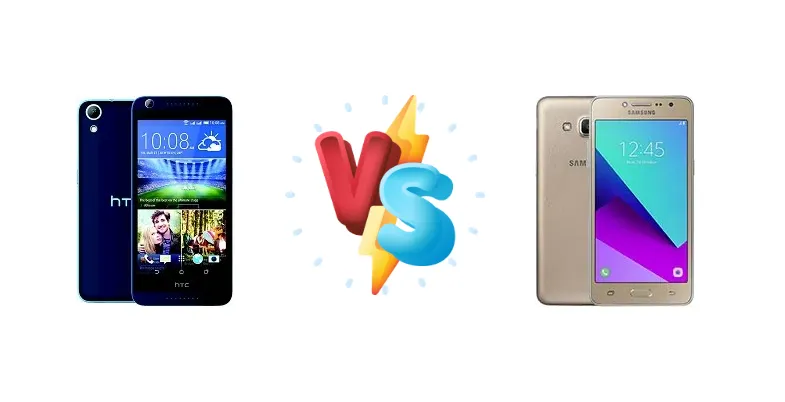
The HTC Desire 626G+ and Samsung Galaxy Grand Prime Plus represent a bygone era of ultra-affordable Android smartphones. Both devices aimed to deliver basic smartphone functionality at a minimal cost, but they approached this goal with different hardware choices. This comparison dissects those choices, focusing on the core performance differences stemming from their respective Mediatek chipsets.
🏆 Quick Verdict
For the average user prioritizing multitasking and responsiveness, the HTC Desire 626G+ is the better choice. Its octa-core Mediatek MT6592 processor, while older, offers significantly more processing power than the quad-core MT6737T in the Grand Prime Plus, making it more suitable for running multiple apps and handling moderately demanding tasks.
| Network |
|---|
| 2G bands | GSM 850 / 900 / 1800 / 1900 - SIM 1 & SIM 2 | GSM 850 / 900 / 1800 / 1900 - SIM 1 & SIM 2 |
| 3G bands | HSDPA 850 / 900 / 2100 - SIM 1 & SIM 2 | HSDPA 850 / 900 / 1900 / 2100 |
| 4G bands | - | 1, 3, 5, 7, 8, 20 |
| Speed | HSPA 21.1/5.76 Mbps | HSPA 42.2/5.76 Mbps, LTE Cat4 150/50 Mbps |
| Technology | GSM / HSPA | GSM / HSPA / LTE |
| Launch |
|---|
| Announced | 2015, April. Released 2015, April | 2016, November. Released 2016, November |
| Status | Discontinued | Discontinued |
| Body |
|---|
| Build | - | Glass front, plastic back, plastic frame |
| Dimensions | 146.9 x 70.9 x 8.2 mm (5.78 x 2.79 x 0.32 in) | 144.8 x 72.1 x 8.9 mm (5.70 x 2.84 x 0.35 in) |
| SIM | Nano-SIM + Nano-SIM | Hybrid Dual SIM (Micro-SIM, dual stand-by) |
| Weight | 138 g (4.87 oz) | 160 g (5.64 oz) |
| Display |
|---|
| Resolution | 720 x 1280 pixels, 16:9 ratio (~294 ppi density) | 540 x 960 pixels, 16:9 ratio (~220 ppi density) |
| Size | 5.0 inches, 68.9 cm2 (~66.2% screen-to-body ratio) | 5.0 inches, 68.9 cm2 (~66.0% screen-to-body ratio) |
| Type | IPS LCD, | PLS LCD |
| Platform |
|---|
| CPU | Octa-core 1.7 GHz Cortex-A7 | Quad-core 1.4 GHz Cortex-A53 |
| Chipset | Mediatek MT6592 (28 nm) | Mediatek MT6737T (28 nm) |
| GPU | Mali-450MP4 | Mali-T720MP2 |
| OS | Android 4.4.2 (KitKat) | Android 6.0 (Marshmallow) |
| Memory |
|---|
| Card slot | microSDHC (dedicated slot) | microSDXC (uses shared SIM slot) |
| Internal | 8GB 1GB RAM | 8GB 1.5GB RAM, 16GB 1.5GB RAM |
| | - | eMMC 5.0 |
| Main Camera |
|---|
| Features | LED flash, panorama | LED flash |
| Single | 13 MP, f/2.2, 28mm (wide), AF | 8 MP, f/2.2, AF |
| Video | 1080p@30fps | 720p@30fps |
| Selfie camera |
|---|
| Features | - | LED flash |
| Single | 5 MP, f/2.8, 34mm (standard) | 5 MP, f/2.2, 28mm (wide) |
| Video | 1080p@30fps | - |
| Sound |
|---|
| 3.5mm jack | - | Yes |
| 35mm jack | Yes | Yes |
| Loudspeaker | Yes | Yes |
| Comms |
|---|
| Bluetooth | 4.0, A2DP, aptX | 4.2, A2DP, LE |
| NFC | No | No |
| Positioning | GPS | GPS, GLONASS |
| Radio | FM radio | FM radio, RDS, recording |
| USB | microUSB 2.0 | microUSB 2.0, OTG |
| WLAN | Wi-Fi 802.11 b/g/n, Wi-Fi Direct, DLNA, hotspot | Wi-Fi 802.11 b/g/n, Wi-Fi Direct |
| Features |
|---|
| Sensors | Accelerometer, proximity, compass | Accelerometer, proximity |
| Battery |
|---|
| Music play | - | Up to 59 h |
| Stand-by | Up to 521 h (2G) / Up to 458 h (3G) | - |
| Talk time | Up to 22 h 40 min (2G) / Up to 12 h 40 min (3G) | Up to 12 h (3G) |
| Type | Li-Po 2000 mAh, non-removable | Li-Ion 2600 mAh, removable |
| Misc |
|---|
| Colors | White Birch, Purple Fire, Blue Lagoon | Black, Gold, Silver |
| Models | Desire 626GPLUS dual, Desire_626GPLUS_dual | SM-G532F |
| Price | About 250 EUR | About 140 EUR |
| SAR EU | - | 0.53 W/kg (head) 1.27 W/kg (body) |
HTC Desire 626G+
- Faster octa-core processor for better multitasking
- Potentially larger display size
- More responsive user experience
- Potentially shorter battery life
- Older processor architecture
Samsung Galaxy Grand Prime Plus
- More power-efficient processor
- Potentially longer battery life
- Samsung's software optimization
- Slower quad-core processor
- Less responsive user experience
- Limited multitasking capabilities
Display Comparison
Neither device is known for its display prowess. Both utilize 28nm chipsets, suggesting a focus on cost reduction over display features. Without specific display specs, we can assume both feature basic LCD panels with resolutions appropriate for their price point. The Grand Prime Plus likely benefits from Samsung's color tuning, potentially offering a more visually appealing experience, but the 626G+ may have a slightly larger display given its overall larger form factor (based on typical designs of the era).
Camera Comparison
Camera performance on both devices is expected to be basic. Without specific sensor details, it’s safe to assume both feature low-resolution primary sensors. The marketing materials of the time often emphasized megapixel count over sensor size and quality. Image processing will likely be minimal on both, resulting in images that are acceptable in good lighting conditions but struggle in low light. Any differences in image quality will likely be attributable to software tuning rather than hardware capabilities.
Performance
The core difference lies in the chipsets. The HTC Desire 626G+ boasts the Mediatek MT6592, an octa-core processor clocked at 1.7 GHz using Cortex-A7 cores. This contrasts sharply with the Samsung Galaxy Grand Prime Plus’s Mediatek MT6737T, a quad-core processor running at 1.4 GHz with Cortex-A53 cores. While both are built on a 28nm process, the A7 architecture in the 626G+ is older but benefits from sheer core count. The A53 cores in the Grand Prime Plus are more efficient *per core*, but the 626G+’s eight cores provide a significant advantage in multi-threaded tasks. This translates to faster app loading times and smoother multitasking on the HTC device. The 626G+'s higher clock speed further contributes to its performance edge.
Battery Life
Battery capacity is not specified, but given the era and target market, both likely feature batteries in the 2000-2500 mAh range. The MT6737T in the Grand Prime Plus, with its quad-core configuration and Cortex-A53 cores, is inherently more power-efficient than the MT6592 in the 626G+. This suggests the Grand Prime Plus may offer slightly longer battery life under similar usage conditions. However, the 626G+'s faster processing could also mean tasks are completed quicker, potentially offsetting some of the power consumption difference.
Buying Guide
Buy the HTC Desire 626G+ if you need a device capable of handling more than just basic calling and messaging. Its octa-core processor will provide a smoother experience when switching between apps or browsing the web. Buy the Samsung Galaxy Grand Prime Plus if you prioritize simplicity and potentially slightly better battery life due to the less power-hungry processor, and your usage is limited to essential functions.
Frequently Asked Questions
❓ Will the HTC Desire 626G+ struggle with modern apps?
Yes, the Desire 626G+’s Mediatek MT6592 is an older processor and will likely struggle with demanding modern apps. While it can handle basic tasks, resource-intensive applications may experience lag or crashes. It's best suited for lightweight usage.
❓ Is the Samsung Galaxy Grand Prime Plus a good option for a first smartphone?
The Grand Prime Plus is a very basic smartphone, making it potentially suitable for a first-time user who only needs essential features like calling, texting, and basic web browsing. However, its limited processing power means it won't be able to handle many modern apps or features.
❓ Which phone is better for playing older Android games?
The HTC Desire 626G+ is the better choice for playing older Android games. Its octa-core processor provides more processing power, resulting in smoother gameplay compared to the quad-core processor in the Grand Prime Plus.