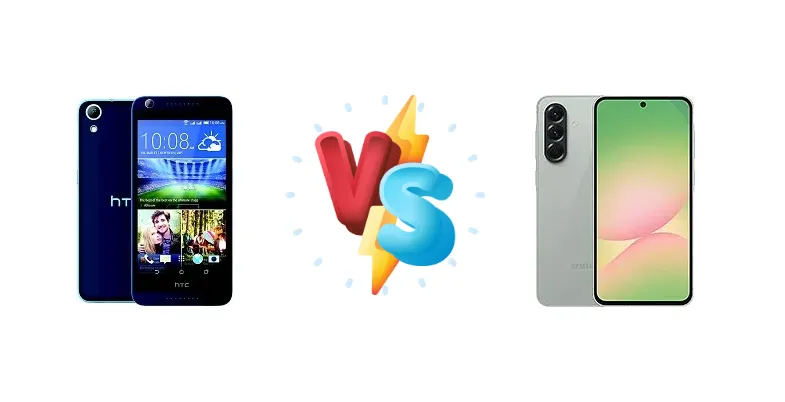
Comparing the Samsung Galaxy A56 and the HTC Desire 626G+ is akin to contrasting modern automotive engineering with a classic car. The A56 represents current-generation smartphone technology, while the 626G+ offers a look back at the mid-2010s. This comparison isn't about declaring a simple 'winner,' but understanding the vast differences in performance, efficiency, and user experience.
🏆 Quick Verdict
For the vast majority of users, the Samsung Galaxy A56 is the clear choice. Its Exynos 1580 chipset delivers significantly superior performance, coupled with a remarkably bright display and incredibly fast 45W charging. While the Desire 626G+ may appeal to those seeking a retro experience or a very low-cost device, it's severely outmatched in almost every key metric.
| Network |
|---|
| 2G bands | GSM 850 / 900 / 1800 / 1900 - SIM 1 & SIM 2 | GSM 850 / 900 / 1800 / 1900 |
| 3G bands | HSDPA 850 / 900 / 2100 - SIM 1 & SIM 2 | HSDPA 850 / 900 / 1700(AWS) / 1900 / 2100 |
| 4G bands | - | 1, 2, 3, 4, 5, 7, 8, 12, 17, 20, 25, 26, 28, 32, 38, 40, 41, 66 |
| 5G bands | - | 1, 3, 5, 7, 8, 20, 28, 38, 40, 41, 66, 77, 78 SA/NSA/Sub6 |
| Speed | HSPA 21.1/5.76 Mbps | HSPA, LTE, 5G |
| Technology | GSM / HSPA | GSM / HSPA / LTE / 5G |
| Launch |
|---|
| Announced | 2015, April. Released 2015, April | 2025, March 02 |
| Status | Discontinued | Available. Released 2025, March 10 |
| Body |
|---|
| Build | - | Glass front (Gorilla Glass Victus+), glass back (Gorilla Glass Victus+), aluminum frame |
| Dimensions | 146.9 x 70.9 x 8.2 mm (5.78 x 2.79 x 0.32 in) | 162.2 x 77.5 x 7.4 mm (6.39 x 3.05 x 0.29 in) |
| SIM | Nano-SIM + Nano-SIM | Nano-SIM + Nano-SIM + eSIM + eSIM (max 2 at a time) |
| Weight | 138 g (4.87 oz) | 198 g (6.98 oz) |
| Display |
|---|
| Protection | - | Corning Gorilla Glass Victus+, Mohs level 5 |
| Resolution | 720 x 1280 pixels, 16:9 ratio (~294 ppi density) | 1080 x 2340 pixels, 19.5:9 ratio (~385 ppi density) |
| Size | 5.0 inches, 68.9 cm2 (~66.2% screen-to-body ratio) | 6.7 inches, 110.2 cm2 (~87.7% screen-to-body ratio) |
| Type | IPS LCD, | Super AMOLED, 120Hz, HDR10+, 1200 nits (HBM), 1900 nits (peak) |
| Platform |
|---|
| CPU | Octa-core 1.7 GHz Cortex-A7 | Octa-core (1x2.9 GHz Cortex-A720 & 3x2.6 GHz Cortex-A720 & 4x1.9 GHz Cortex-A520) |
| Chipset | Mediatek MT6592 (28 nm) | Exynos 1580 (4 nm) |
| GPU | Mali-450MP4 | Xclipse 540 |
| OS | Android 4.4.2 (KitKat) | Android 15, up to 6 major Android upgrades, One UI 7 |
| Memory |
|---|
| Card slot | microSDHC (dedicated slot) | No |
| Internal | 8GB 1GB RAM | 128GB 6GB RAM, 128GB 8GB RAM, 256GB 6GB RAM, 256GB 8GB RAM, 256GB 12GB RAM |
| Main Camera |
|---|
| Features | LED flash, panorama | Best Face, LED flash, panorama, HDR |
| Single | 13 MP, f/2.2, 28mm (wide), AF | - |
| Triple | - | 50 MP, f/1.8, (wide), 1/1.56", 1.0µm, PDAF, OIS
12 MP, f/2.2, 123˚ (ultrawide), 1/3.06", 1.12µm
5 MP (macro) |
| Video | 1080p@30fps | 4K@30fps, 1080p@30/60fps, gyro-EIS |
| Selfie camera |
|---|
| Single | 5 MP, f/2.8, 34mm (standard) | 12 MP, f/2.2, (wide) |
| Video | 1080p@30fps | 4K@30fps, 1080p@30fps, 1080p@60fps (regional availability), 10-bit HDR |
| Sound |
|---|
| 35mm jack | Yes | No |
| Loudspeaker | Yes | Yes, with stereo speakers |
| Comms |
|---|
| Bluetooth | 4.0, A2DP, aptX | 5.3, A2DP, LE |
| NFC | No | Yes (market/region dependent) |
| Positioning | GPS | GPS, GALILEO, GLONASS, BDS, QZSS |
| Radio | FM radio | No |
| USB | microUSB 2.0 | USB Type-C 2.0, OTG |
| WLAN | Wi-Fi 802.11 b/g/n, Wi-Fi Direct, DLNA, hotspot | Wi-Fi 802.11 a/b/g/n/ac/6, dual-band, Wi-Fi Direct |
| Features |
|---|
| Sensors | Accelerometer, proximity, compass | Fingerprint (under display, optical), accelerometer, gyro, compass |
| Battery |
|---|
| Charging | - | 45W wired, 65% in 30 min, 100% in 68 min |
| Stand-by | Up to 521 h (2G) / Up to 458 h (3G) | - |
| Talk time | Up to 22 h 40 min (2G) / Up to 12 h 40 min (3G) | - |
| Type | Li-Po 2000 mAh, non-removable | 5000 mAh |
| Misc |
|---|
| Colors | White Birch, Purple Fire, Blue Lagoon | Pink, Olive, Graphite, Lightgray |
| Models | Desire 626GPLUS dual, Desire_626GPLUS_dual | SM-A566V, SM-A566B, SM-A566B/DS, SM-A566E, SM-A566E/DS, SM-A5660, SM-A566U, SM-A566U1, SM-A566W, SM-A566S |
| Price | About 250 EUR | € 286.99 / $ 308.29 / £ 249.00 / ₹ 38,999 |
| SAR | - | 1.32 W/kg (head) |
| SAR EU | - | 0.61 W/kg (head) 1.05 W/kg (body) |
| EU LABEL |
|---|
| Battery | - | 44:34h endurance, 2000 cycles |
| Energy | - | Class B |
| Free fall | - | Class A (270 falls) |
| Repairability | - | Class C |
HTC Desire 626G+
- Extremely affordable price point.
- Simple and straightforward user experience.
- Compact form factor (likely).
- Outdated chipset and slow performance.
- Poor battery efficiency.
- Low-resolution display (estimated).
Samsung Galaxy A56
- Powerful Exynos 1580 chipset.
- Bright and vibrant display.
- Ultra-fast 45W charging.
- Long battery life.
- Higher price compared to the Desire 626G+.
- May be larger and heavier than the 626G+.
Display Comparison
The Samsung Galaxy A56’s display is a standout feature, boasting a measured peak brightness of 1213 nits. This dramatically surpasses what the Desire 626G+ likely offered (typical panels of that era peaked around 400-500 nits), ensuring excellent visibility even in direct sunlight. While the 626G+’s resolution is unknown, the A56’s likely higher pixel density contributes to a sharper image. The A56’s panel technology is also likely to incorporate features like higher refresh rates and improved color accuracy, absent in the older HTC model.
Camera Comparison
Without specific camera specs for the Desire 626G+, it’s difficult to make a direct comparison. However, the A56 likely features a more advanced camera system with a larger main sensor, optical image stabilization (OIS), and sophisticated image processing algorithms. The A56’s image processing will likely prioritize dynamic range and detail, while the 626G+’s camera would have been limited by its older sensor and processing capabilities. The inclusion of a 2MP macro camera on the 626G+ (if present) would offer minimal benefit due to its low resolution.
Performance
The performance gap between these devices is substantial. The Samsung Galaxy A56’s Exynos 1580, built on a 4nm process, features a complex octa-core configuration (1x2.9 GHz Cortex-A720, 3x2.6 GHz Cortex-A720, and 4x1.9 GHz Cortex-A520). This architecture, combined with the smaller fabrication node, delivers significantly higher processing power and improved energy efficiency compared to the HTC Desire 626G+’s Mediatek MT6592 (28nm) and its octa-core 1.7 GHz Cortex-A7 CPUs. The A56 will handle multitasking, demanding apps, and modern games with ease, while the 626G+ will struggle with even moderate workloads. The A56 likely utilizes faster LPDDR5x RAM, further enhancing performance.
Battery Life
The Samsung Galaxy A56 excels in battery performance and charging speed. Its endurance rating of 44:34 hours and active use score of 12:08 hours demonstrate impressive longevity. Crucially, the 45W wired charging capability allows for a 65% charge in just 30 minutes and a full charge in 68 minutes. The Desire 626G+’s battery capacity is unknown, but its older chipset and larger fabrication node would result in significantly lower efficiency and slower charging times. The A56’s charging speed is a game-changer for users who need to quickly top up their battery.
Buying Guide
Buy the HTC Desire 626G+ if you need an extremely affordable device for basic tasks like calls, texts, and light web browsing, and are comfortable with significantly slower performance and limited features. Buy the Samsung Galaxy A56 if you prioritize a smooth user experience, fast charging, a vibrant display, and the ability to handle demanding applications and games without significant compromise.
Frequently Asked Questions
❓ Does the Exynos 1580 in the Galaxy A56 tend to overheat during prolonged gaming sessions?
The Exynos 1580, built on a 4nm process, is relatively efficient and incorporates thermal management features. While it may get warm during extended gaming, it's unlikely to experience significant throttling unless under extreme conditions. The larger surface area of the A56 compared to the 626G+ also aids in heat dissipation.
❓ Is the performance difference between the Exynos 1580 and the Mediatek MT6592 noticeable in everyday tasks like browsing and social media?
Absolutely. The Exynos 1580 offers a dramatically smoother and more responsive experience. While the 626G+ might handle basic tasks, you'll likely encounter lag and slowdowns with multiple apps open or when loading complex web pages. The A56’s faster processor and RAM ensure a fluid user experience.
❓ What kind of software updates can I expect on the Samsung Galaxy A56 compared to the HTC Desire 626G+?
The Samsung Galaxy A56 will receive regular software updates, including security patches and potentially Android version upgrades, for several years. The HTC Desire 626G+, being an older device, has likely reached its end-of-life in terms of software support, leaving it vulnerable to security risks and lacking new features.