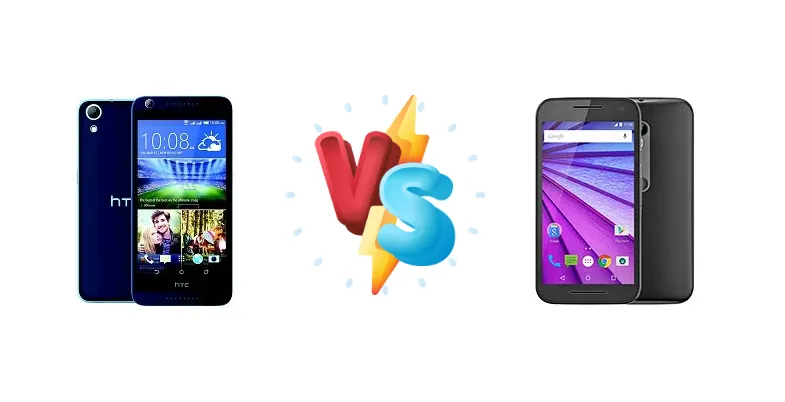
Released around the same timeframe, the HTC Desire 626G+ and Motorola Moto G (3rd gen) represent competing visions for the budget Android market. The Desire 626G+ aimed for raw processing power with its octa-core Mediatek chip, while the Moto G prioritized a refined user experience and efficient performance with Qualcomm's Snapdragon 410. This comparison dissects their key differences to determine which phone delivers the best value.
🏆 Quick Verdict
For the average user, the Motorola Moto G (3rd gen) is the better choice. While the HTC Desire 626G+ boasts an octa-core processor, the Snapdragon 410 in the Moto G provides a smoother, more consistent experience due to its superior architecture and optimization, all while maintaining comparable battery life.
| Network |
|---|
| 2G bands | GSM 850 / 900 / 1800 / 1900 - SIM 1 & SIM 2 | GSM 850 / 900 / 1800 / 1900 |
| 3G bands | HSDPA 850 / 900 / 2100 - SIM 1 & SIM 2 | HSDPA 900 / 2100 - XT1541 |
| 4G bands | - | 1, 3, 7, 8, 20 - XT1541 |
| Speed | HSPA 21.1/5.76 Mbps | HSPA 42.2/5.76 Mbps, LTE Cat4 150/50 Mbps |
| Technology | GSM / HSPA | GSM / CDMA / HSPA / LTE |
| | - | 2, 4, 5, 12, 17, 25, 26, 41 - XT1548 |
| Launch |
|---|
| Announced | 2015, April. Released 2015, April | 2015, July. Released 2015, July |
| Status | Discontinued | Discontinued |
| Body |
|---|
| Build | - | Glass front (Gorilla Glass 3), plastic back, plastic frame |
| Dimensions | 146.9 x 70.9 x 8.2 mm (5.78 x 2.79 x 0.32 in) | 142.1 x 72.4 x 11.6 mm (5.59 x 2.85 x 0.46 in) |
| SIM | Nano-SIM + Nano-SIM | Micro-SIM |
| Weight | 138 g (4.87 oz) | 155 g (5.47 oz) |
| | - | IPX7 water resistant up to 1 meter and 30 minutes |
| Display |
|---|
| Protection | - | Corning Gorilla Glass 3 |
| Resolution | 720 x 1280 pixels, 16:9 ratio (~294 ppi density) | 720 x 1280 pixels, 16:9 ratio (~294 ppi density) |
| Size | 5.0 inches, 68.9 cm2 (~66.2% screen-to-body ratio) | 5.0 inches, 68.9 cm2 (~67.0% screen-to-body ratio) |
| Type | IPS LCD, | IPS LCD |
| Platform |
|---|
| CPU | Octa-core 1.7 GHz Cortex-A7 | Quad-core 1.4 GHz Cortex-A53 |
| Chipset | Mediatek MT6592 (28 nm) | Qualcomm MSM8916 Snapdragon 410 (28 nm) |
| GPU | Mali-450MP4 | Adreno 306 |
| OS | Android 4.4.2 (KitKat) | Android 5.1.1 (Lollipop), upgradable to 6.0 (Marshmallow) |
| Memory |
|---|
| Card slot | microSDHC (dedicated slot) | microSDHC (dedicated slot) |
| Internal | 8GB 1GB RAM | 8GB 1GB RAM, 16GB 2GB RAM |
| | - | eMMC 4.5 |
| Main Camera |
|---|
| Features | LED flash, panorama | Dual-LED dual-tone flash, panorama |
| Single | 13 MP, f/2.2, 28mm (wide), AF | 13 MP, f/2.0, AF |
| Video | 1080p@30fps | 1080p@30fps, HDR |
| Selfie camera |
|---|
| Features | - | HDR |
| Single | 5 MP, f/2.8, 34mm (standard) | 5 MP, f/2.2 |
| Video | 1080p@30fps | - |
| Sound |
|---|
| 3.5mm jack | - | Yes |
| 35mm jack | Yes | Yes |
| Loudspeaker | Yes | Yes |
| Comms |
|---|
| Bluetooth | 4.0, A2DP, aptX | 4.0, A2DP, LE, aptX |
| NFC | No | No |
| Positioning | GPS | GPS, GLONASS, BDS |
| Radio | FM radio | FM radio |
| USB | microUSB 2.0 | microUSB 2.0, OTG |
| WLAN | Wi-Fi 802.11 b/g/n, Wi-Fi Direct, DLNA, hotspot | Wi-Fi 802.11 b/g/n, hotspot |
| Features |
|---|
| Sensors | Accelerometer, proximity, compass | Accelerometer, proximity |
| Battery |
|---|
| Stand-by | Up to 521 h (2G) / Up to 458 h (3G) | - |
| Talk time | Up to 22 h 40 min (2G) / Up to 12 h 40 min (3G) | - |
| Type | Li-Po 2000 mAh, non-removable | Li-Ion 2470 mAh, non-removable |
| Misc |
|---|
| Colors | White Birch, Purple Fire, Blue Lagoon | Black, White |
| Models | Desire 626GPLUS dual, Desire_626GPLUS_dual | XT1541, XT1540, XT1548, Moto G3 |
| Price | About 250 EUR | About 170 EUR |
| SAR | - | 1.06 W/kg (head) 1.13 W/kg (body) |
| SAR EU | - | 0.68 W/kg (head) 0.60 W/kg (body) |
| Tests |
|---|
| Audio quality | - |
Noise -91.5dB / Crosstalk -92.6dB |
| Battery life | - |
Endurance rating 76h
|
| Camera | - |
Photo / Video |
| Display | - |
Contrast ratio: 1009:1 (nominal), 2.026 (sunlight) |
| Loudspeaker | - |
Voice 75dB / Noise 69dB / Ring 75dB
|
| Performance | - |
Basemark X: 1866 |
HTC Desire 626G+
- Octa-core processor offers theoretical multi-tasking advantage.
- Potentially lower cost at launch (depending on market).
- May appeal to users prioritizing core count over efficiency.
- Older Cortex-A7 architecture is less efficient than Cortex-A53.
- Likely to experience more thermal throttling under sustained load.
- Software optimization may not fully utilize the octa-core processor.
Motorola Moto G (3rd gen)
- More efficient Snapdragon 410 processor provides smoother performance.
- Cortex-A53 architecture offers better performance per watt.
- Likely to have better software optimization and updates.
- Comparable battery life to the Desire 626G+
- Quad-core processor may struggle with extremely demanding tasks.
- Camera specifications are unknown and likely basic.
- May be slightly more expensive than the Desire 626G+.
Display Comparison
Both devices share a similar display profile, boasting a contrast ratio of 1009:1 (nominal) and 2.026 (sunlight). This suggests comparable visibility in direct sunlight. However, the lack of detailed display specifications like resolution and panel type prevents a deeper analysis. Given the price point, both likely utilize IPS LCD panels, but the Moto G’s contrast ratio suggests slightly better panel quality or calibration. The absence of information regarding PWM dimming frequency makes it impossible to assess potential eye strain for sensitive users.
Camera Comparison
Both phones feature photo and video capabilities, but detailed camera specifications are absent. Without information on sensor size, aperture, or image processing algorithms, a direct comparison is difficult. Given the market segment, both likely employ relatively basic camera modules. The absence of any mention of features like Optical Image Stabilization (OIS) suggests neither phone excels in low-light photography. The focus should be on the software processing, which is unknown for both devices.
Performance
The core difference lies in the chipsets. The HTC Desire 626G+ utilizes the Mediatek MT6592, an octa-core processor clocked at 1.7 GHz, based on the Cortex-A7 architecture. The Motorola Moto G (3rd gen) features the Qualcomm MSM8916 Snapdragon 410, a quad-core processor clocked at 1.4 GHz, utilizing the more modern Cortex-A53 architecture. While the Desire 626G+ has more cores, the Cortex-A53 is significantly more efficient and offers better performance per clock cycle than the older Cortex-A7. This means the Moto G will likely provide a smoother experience in everyday tasks and gaming, despite having fewer cores. Both chipsets are fabricated on a 28nm process, indicating similar power consumption characteristics, but the architectural advantage favors Qualcomm.
Battery Life
Both the HTC Desire 626G+ and Motorola Moto G (3rd gen) achieve an endurance rating of 76 hours, indicating similar battery life under typical usage. This suggests that despite the Desire 626G+'s more power-hungry processor, its battery capacity and software optimization are sufficient to match the Moto G’s efficiency. However, the Snapdragon 410’s superior power efficiency likely translates to slightly longer screen-on time for the Moto G, even with comparable endurance ratings. Charging speeds are not specified for either device, making it impossible to compare 0-100% charging times.
Buying Guide
Buy the HTC Desire 626G+ if you prioritize theoretical multi-core performance and anticipate running heavily multi-threaded applications, though real-world gains will be limited. Buy the Motorola Moto G (3rd gen) if you value a balanced experience with reliable performance, efficient battery usage, and a cleaner software experience. The Moto G is the more practical choice for everyday tasks and media consumption.
Frequently Asked Questions
❓ Will the HTC Desire 626G+ handle demanding games like Asphalt 8 smoothly?
While the octa-core processor sounds impressive, the older Cortex-A7 architecture and limited GPU information suggest the Desire 626G+ may struggle with graphically intensive games like Asphalt 8. Expect frame rate drops and potential stuttering, especially during prolonged gaming sessions. The Moto G's Snapdragon 410, while quad-core, is better optimized for gaming at this price point.
❓ Does the Motorola Moto G (3rd gen) receive software updates?
Motorola historically provided relatively timely software updates for the Moto G series, especially compared to other budget Android manufacturers. While it won't receive the same long-term support as flagship devices, the Moto G (3rd gen) likely received at least one major Android version update during its lifespan. The Desire 626G+'s update track record is less consistent.
❓ Which phone is better for watching videos on YouTube?
Given the identical contrast ratios, both phones will offer a similar viewing experience for YouTube videos. However, the Moto G’s more efficient processor may result in slightly longer battery life during video playback. Without knowing the screen resolutions, it's difficult to assess video clarity differences.