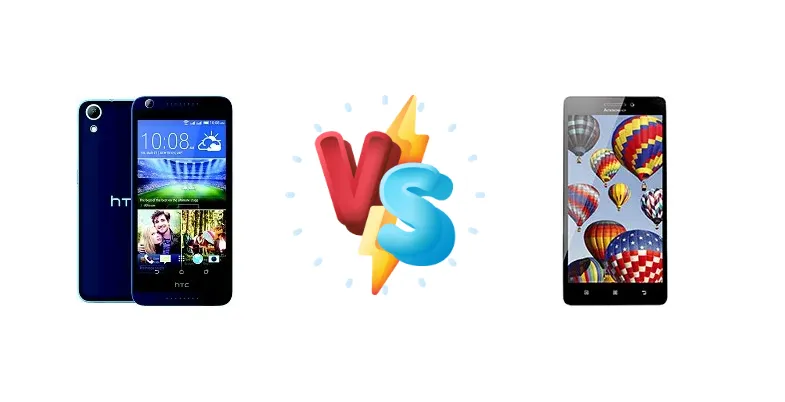
Released in a similar timeframe targeting the budget-conscious consumer, the Lenovo A7000 Turbo and HTC Desire 626G+ represent distinct approaches to affordable smartphone design. While both utilize Mediatek chipsets fabricated on a 28nm process, the core architectural differences between the MT6752 and MT6592 significantly impact performance and user experience. This comparison dissects these differences to help you choose the right device.
🏆 Quick Verdict
For the average user prioritizing responsiveness and future-proofing, the Lenovo A7000 Turbo is the superior choice. Its MT6752 chipset, featuring Cortex-A53 cores, offers a noticeable performance advantage over the Desire 626G+'s MT6592 and Cortex-A7 cores, making it better suited for multitasking and demanding applications.
| Network |
|---|
| 2G bands | GSM 850 / 900 / 1800 / 1900 - SIM 1 & SIM 2 | GSM 900 / 1800 / 1900 - SIM 1 & SIM 2 |
| 3G bands | HSDPA 850 / 900 / 2100 - SIM 1 & SIM 2 | HSDPA 2100 |
| 4G bands | - | LTE |
| Speed | HSPA 21.1/5.76 Mbps | HSPA, LTE Cat4 150/50 Mbps |
| Technology | GSM / HSPA | GSM / HSPA / LTE |
| Launch |
|---|
| Announced | 2015, April. Released 2015, April | 2016, January. Released 2016, January |
| Status | Discontinued | Discontinued |
| Body |
|---|
| Dimensions | 146.9 x 70.9 x 8.2 mm (5.78 x 2.79 x 0.32 in) | 152.6 x 76.2 x 8 mm (6.01 x 3.00 x 0.31 in) |
| SIM | Nano-SIM + Nano-SIM | Dual SIM (Micro-SIM, dual stand-by) |
| Weight | 138 g (4.87 oz) | 150 g (5.29 oz) |
| Display |
|---|
| Resolution | 720 x 1280 pixels, 16:9 ratio (~294 ppi density) | 1080 x 1920 pixels, 16:9 ratio (~401 ppi density) |
| Size | 5.0 inches, 68.9 cm2 (~66.2% screen-to-body ratio) | 5.5 inches, 83.4 cm2 (~71.7% screen-to-body ratio) |
| Type | IPS LCD, | IPS LCD |
| Platform |
|---|
| CPU | Octa-core 1.7 GHz Cortex-A7 | Octa-core 1.7 GHz Cortex-A53 |
| Chipset | Mediatek MT6592 (28 nm) | Mediatek MT6752 (28 nm) |
| GPU | Mali-450MP4 | Mali-T760MP2 |
| OS | Android 4.4.2 (KitKat) | Android 5 (Lollipop), Vibe UI 2 |
| Memory |
|---|
| Card slot | microSDHC (dedicated slot) | microSDHC (dedicated slot) |
| Internal | 8GB 1GB RAM | 16GB 2GB RAM |
| Main Camera |
|---|
| Features | LED flash, panorama | Dual-LED flash, HDR, panorama |
| Single | 13 MP, f/2.2, 28mm (wide), AF | 13 MP, f/2.0, AF |
| Video | 1080p@30fps | 1080p@30fps |
| Selfie camera |
|---|
| Single | 5 MP, f/2.8, 34mm (standard) | 5 MP, f/2.2 |
| Video | 1080p@30fps | - |
| Sound |
|---|
| 3.5mm jack | - | Yes |
| 35mm jack | Yes | Yes |
| Loudspeaker | Yes | Yes |
| Comms |
|---|
| Bluetooth | 4.0, A2DP, aptX | 4.1, A2DP, LE |
| NFC | No | No |
| Positioning | GPS | GPS |
| Radio | FM radio | FM radio |
| USB | microUSB 2.0 | microUSB 2.0, OTG |
| WLAN | Wi-Fi 802.11 b/g/n, Wi-Fi Direct, DLNA, hotspot | Wi-Fi 802.11 b/g/n, hotspot |
| Features |
|---|
| Sensors | Accelerometer, proximity, compass | Accelerometer, proximity, compass |
| Battery |
|---|
| Stand-by | Up to 521 h (2G) / Up to 458 h (3G) | - |
| Talk time | Up to 22 h 40 min (2G) / Up to 12 h 40 min (3G) | - |
| Type | Li-Po 2000 mAh, non-removable | Li-Ion 2900 mAh, removable |
| Misc |
|---|
| Colors | White Birch, Purple Fire, Blue Lagoon | Matte Black |
| Models | Desire 626GPLUS dual, Desire_626GPLUS_dual | - |
| Price | About 250 EUR | About 180 EUR |
HTC Desire 626G+
- Potentially lower price point (depending on market conditions)
- HTC’s historical software optimizations for color accuracy
- Simple and straightforward user experience
- Older Cortex-A7 CPU architecture limits performance
- Less efficient CPU compared to the MT6752
- Potentially weaker image processing capabilities
Lenovo A7000 Turbo
- More modern Cortex-A53 CPU architecture for improved performance
- Better image processing capabilities with the MT6752 chipset
- 64-bit computing support for future compatibility
- May be slightly more expensive than the Desire 626G+
- Lenovo’s software experience can be more cluttered
- Potentially similar battery life despite more efficient CPU
Display Comparison
Neither device boasts a standout display. Given the context data focuses on the chipset, we can infer both likely feature 720p panels common in this price bracket. The key difference lies in potential software optimizations; HTC historically focused on color accuracy, while Lenovo often prioritized brightness. However, without specific display specs, it's difficult to definitively declare a winner. Bezels were likely substantial on both, typical of the era.
Camera Comparison
Without detailed camera specifications, a direct comparison is challenging. Both devices likely featured a primary camera around 8-13 megapixels, common for this segment. However, the MT6752 chipset in the A7000 Turbo generally offered better image signal processing (ISP) capabilities than the MT6592 in the Desire 626G+. This means the A7000 Turbo could potentially produce sharper images with better dynamic range and noise reduction. The inclusion of features like HDR and panorama modes would also be more likely and better implemented on the A7000 Turbo.
Performance
The core distinction lies in the CPU architecture. The Lenovo A7000 Turbo’s Mediatek MT6752 utilizes eight Cortex-A53 cores clocked at 1.7 GHz, while the HTC Desire 626G+ employs the older Cortex-A7 architecture, also at 1.7 GHz. While the clock speeds are identical, the Cortex-A53 offers significantly improved Instructions Per Clock (IPC) compared to the A7. This translates to better single-core and multi-core performance in real-world applications. The MT6752 also supports 64-bit computing, offering potential advantages with optimized software. The 28nm fabrication process is shared, meaning thermal efficiency will be comparable, but the A7000 Turbo will complete tasks faster, reducing sustained load.
Battery Life
Battery capacity is not specified, but both devices likely featured batteries in the 2000-2500 mAh range. The MT6752’s more efficient CPU architecture in the A7000 Turbo would likely result in slightly better battery life despite potentially similar capacity. Charging wattage is also unknown, but both would likely have supported standard 5W charging, with the A7000 Turbo potentially supporting faster charging if Lenovo included a compatible charger.
Buying Guide
Buy the HTC Desire 626G+ if you need a basic smartphone for essential tasks like calls, texts, and light social media use, and are on an extremely tight budget. Buy the Lenovo A7000 Turbo if you prefer a smoother, more responsive experience for everyday tasks, occasional gaming, and appreciate the benefits of a more modern CPU architecture, even if it comes at a slightly higher price point.
Frequently Asked Questions
❓ Will the Lenovo A7000 Turbo handle modern mobile games like PUBG or Call of Duty?
While not designed for high-end gaming, the MT6752 in the A7000 Turbo can run PUBG and Call of Duty Mobile at lower settings. Expect frame rate drops during intense scenes, but it's playable. The Desire 626G+'s MT6592 will struggle significantly more with these titles.
❓ Is the 64-bit architecture of the MT6752 in the A7000 Turbo important for everyday use?
In 2015/2016, the transition to 64-bit was becoming increasingly important. While many apps weren't fully optimized, 64-bit support allowed for accessing more than 4GB of RAM and offered potential performance improvements with optimized software. The Desire 626G+'s 32-bit processor lacked this capability.
❓ Which phone is better for multitasking – running multiple apps simultaneously?
The Lenovo A7000 Turbo is significantly better for multitasking. The Cortex-A53 cores and improved memory management of the MT6752 chipset allow for smoother switching between apps and less lag compared to the HTC Desire 626G+'s MT6592.