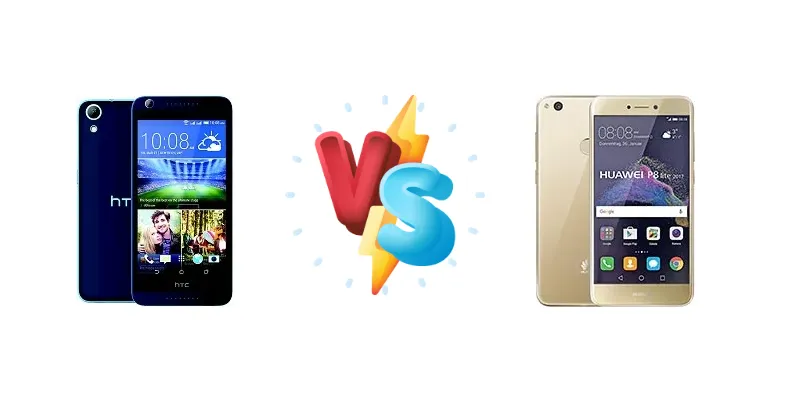
Released in different eras of the budget smartphone market, the HTC Desire 626G+ and Huawei P8 Lite (2017) represent distinct approaches to delivering affordable mobile experiences. The Desire 626G+, leveraging an older Mediatek chipset, aimed for raw core count, while the P8 Lite (2017) adopted Huawei’s in-house Kirin processor, prioritizing efficiency and a more refined software experience. This comparison dissects their key differences to help you determine which device best suits your needs.
🏆 Quick Verdict
For the average user in 2024, the Huawei P8 Lite (2017) is the better choice. Its Kirin 655 chipset, built on a 16nm process, offers superior power efficiency and a more responsive user experience compared to the HTC Desire 626G+'s older 28nm Mediatek MT6592, despite the latter's octa-core configuration.
| Network |
|---|
| 2G bands | GSM 850 / 900 / 1800 / 1900 - SIM 1 & SIM 2 | GSM 850 / 900 / 1800 / 1900 - SIM 1 & SIM 2 |
| 3G bands | HSDPA 850 / 900 / 2100 - SIM 1 & SIM 2 | HSDPA 850 / 900 / 1900 / 2100 |
| 4G bands | - | 1, 3, 7, 8, 20 |
| Speed | HSPA 21.1/5.76 Mbps | HSPA 42.2/5.76 Mbps, LTE Cat4 150/50 Mbps |
| Technology | GSM / HSPA | GSM / HSPA / LTE |
| Launch |
|---|
| Announced | 2015, April. Released 2015, April | 2017, January. Released 2017, January |
| Status | Discontinued | Discontinued |
| Body |
|---|
| Build | - | Glass front, glass back, aluminum frame |
| Dimensions | 146.9 x 70.9 x 8.2 mm (5.78 x 2.79 x 0.32 in) | 147.2 x 72.9 x 7.6 mm (5.80 x 2.87 x 0.30 in) |
| SIM | Nano-SIM + Nano-SIM | Nano-SIM + Nano-SIM |
| Weight | 138 g (4.87 oz) | 147 g (5.19 oz) |
| Display |
|---|
| Resolution | 720 x 1280 pixels, 16:9 ratio (~294 ppi density) | 1080 x 1920 pixels, 16:9 ratio (~424 ppi density) |
| Size | 5.0 inches, 68.9 cm2 (~66.2% screen-to-body ratio) | 5.2 inches, 74.5 cm2 (~69.5% screen-to-body ratio) |
| Type | IPS LCD, | IPS LCD |
| Platform |
|---|
| CPU | Octa-core 1.7 GHz Cortex-A7 | Octa-core (4x2.1 GHz Cortex-A53 & 4x1.7 GHz Cortex-A53) |
| Chipset | Mediatek MT6592 (28 nm) | Kirin 655 (16 nm) |
| GPU | Mali-450MP4 | Mali-T830MP2 |
| OS | Android 4.4.2 (KitKat) | Android 7.0 (Nougat), upgradable to Android 8.0 (Oreo), EMUI 9 |
| Memory |
|---|
| Card slot | microSDHC (dedicated slot) | microSDXC (uses shared SIM slot) |
| Internal | 8GB 1GB RAM | 16GB 3GB RAM, 32GB 4GB RAM, 64GB 4GB RAM |
| Main Camera |
|---|
| Features | LED flash, panorama | LED flash, panorama, HDR |
| Single | 13 MP, f/2.2, 28mm (wide), AF | 12 MP, AF |
| Video | 1080p@30fps | 1080p@30fps |
| Selfie camera |
|---|
| Single | 5 MP, f/2.8, 34mm (standard) | 8 MP, f/2.0 |
| Video | 1080p@30fps | 1080p@30fps |
| Sound |
|---|
| 3.5mm jack | - | Yes |
| 35mm jack | Yes | Yes |
| Loudspeaker | Yes | Yes |
| Comms |
|---|
| Bluetooth | 4.0, A2DP, aptX | 4.1, A2DP, EDR, LE |
| NFC | No | Yes (market dependent) |
| Positioning | GPS | GPS, GLONASS |
| Radio | FM radio | FM radio |
| USB | microUSB 2.0 | microUSB 2.0, OTG |
| WLAN | Wi-Fi 802.11 b/g/n, Wi-Fi Direct, DLNA, hotspot | Wi-Fi 802.11 b/g/n, Wi-Fi Direct |
| Features |
|---|
| Sensors | Accelerometer, proximity, compass | Fingerprint (rear-mounted), accelerometer, proximity, compass |
| Battery |
|---|
| Stand-by | Up to 521 h (2G) / Up to 458 h (3G) | - |
| Talk time | Up to 22 h 40 min (2G) / Up to 12 h 40 min (3G) | - |
| Type | Li-Po 2000 mAh, non-removable | Li-Ion 3000 mAh, non-removable |
| Misc |
|---|
| Colors | White Birch, Purple Fire, Blue Lagoon | Black, White, Gold, Blue |
| Models | Desire 626GPLUS dual, Desire_626GPLUS_dual | PRA-TL10, PRA-TL20, PRA-LA1, PRA-LX1, PRA-LX2, TAG-L21, PRA-AL00X, TAG-L32, PRA-LX3, PRA-AL00 |
| Price | About 250 EUR | About 170 EUR |
HTC Desire 626G+
- Potentially lower initial cost.
- Octa-core processor (though older architecture).
- May offer more storage options (depending on variant).
- Less power efficient chipset.
- Older processor architecture (Cortex-A7).
- Likely slower performance in real-world usage.
Huawei P8 Lite (2017)
- More efficient Kirin 655 chipset.
- Modern big.LITTLE processor architecture.
- Better overall performance and responsiveness.
- Potentially better camera image processing.
- May be slightly more expensive.
- Potentially less storage space (depending on variant).
Display Comparison
Neither device boasts a particularly impressive display. Specifics regarding panel type (IPS vs. TFT) and resolution are missing, but both likely target the entry-level segment. The key difference lies in the underlying chipsets' ability to efficiently drive the display. The Kirin 655's more advanced image signal processor (ISP) *could* translate to slightly better color reproduction, but this is speculative without display panel details. Bezels are expected to be substantial on both devices, reflective of their release timelines.
Camera Comparison
Without detailed camera specifications, a direct comparison is difficult. However, it’s safe to assume both devices feature entry-level camera sensors. The Kirin 655’s ISP likely offers superior image processing capabilities, potentially resulting in better dynamic range and noise reduction in photos taken with the P8 Lite (2017). The Desire 626G+'s ISP is likely more basic, leading to less refined image quality. The presence of any optical image stabilization (OIS) is unlikely on either device, given their price points.
Performance
The core architectural difference is stark. The HTC Desire 626G+ utilizes the Mediatek MT6592, an octa-core processor based on the Cortex-A7 architecture. While eight cores sound impressive, the Cortex-A7 is an older, less efficient design. The Huawei P8 Lite (2017) features the Kirin 655, an octa-core chip with a big.LITTLE configuration – four Cortex-A53 cores clocked at 2.1 GHz and four at 1.7 GHz. This allows the Kirin 655 to dynamically allocate tasks to the appropriate cores, maximizing efficiency. The 16nm manufacturing process of the Kirin 655 further enhances its power efficiency compared to the 28nm process of the MT6592. This translates to less heat generation and potentially less thermal throttling during sustained use. Users engaging in moderate multitasking or light gaming will see a noticeable performance advantage with the P8 Lite (2017).
Battery Life
Battery capacity details are missing for both devices. However, the Kirin 655’s superior power efficiency is the deciding factor. The 16nm process allows the P8 Lite (2017) to achieve longer battery life on a single charge, even if it has a slightly smaller battery capacity than the Desire 626G+. Charging wattage is also likely to be similar – slow, likely 5W or 10W – on both devices, meaning 0-100% charge times will be comparable, but the P8 Lite (2017) will provide more usable time before needing a recharge.
Buying Guide
Buy the HTC Desire 626G+ if you absolutely need the lowest possible upfront cost and primarily use your phone for very basic tasks like calls, texts, and light social media. Buy the Huawei P8 Lite (2017) if you value a smoother, more responsive user experience, better battery life, and a more modern chipset architecture, even if it means spending slightly more.
Frequently Asked Questions
❓ Will the HTC Desire 626G+ struggle with modern apps like Facebook or WhatsApp?
The Desire 626G+'s older Mediatek MT6592 chipset and limited RAM may result in noticeable lag and slowdowns when running modern, resource-intensive apps like Facebook or WhatsApp, especially with multiple apps open simultaneously. The P8 Lite (2017) will handle these apps much more smoothly.
❓ Is the Kirin 655 capable of playing popular mobile games like PUBG Mobile or Call of Duty Mobile?
The Kirin 655 can run PUBG Mobile and Call of Duty Mobile, but likely at lower graphics settings and frame rates to maintain a playable experience. The Desire 626G+'s MT6592 will struggle significantly with these games, potentially exhibiting severe frame drops and lag even at the lowest settings.
❓ Which phone is likely to receive more software updates?
Neither phone is likely to receive significant software updates at this point, given their age. However, Huawei generally provided slightly longer software support for its devices compared to HTC, so the P8 Lite (2017) *might* have received one more minor update during its lifespan.