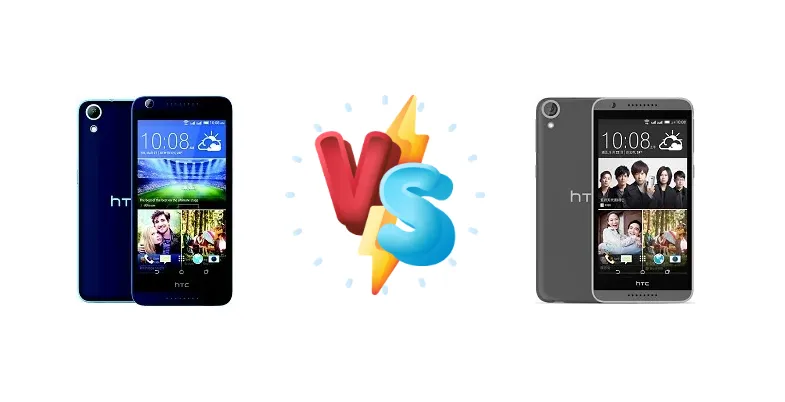
The HTC Desire 626G+ and 820G+ dual sim represent HTC's attempts to capture the mid-range Android market. Both devices are powered by the same Mediatek MT6592 chipset, making a direct performance comparison less about raw power and more about feature set and user experience. This comparison will dissect the nuances between these two models, focusing on the value proposition of the dual SIM functionality offered by the 820G+.
🏆 Quick Verdict
For the average user, the HTC Desire 820G+ dual sim is the better choice. While performance is identical to the 626G+, the addition of dual SIM support significantly increases its versatility, particularly for travelers or those managing multiple numbers. The price difference, if minimal, justifies the added convenience.
| Network |
|---|
| 2G bands | GSM 850 / 900 / 1800 / 1900 - SIM 1 & SIM 2 | GSM 850 / 900 / 1800 / 1900 - SIM 1 & SIM 2 |
| 3G bands | HSDPA 850 / 900 / 2100 - SIM 1 & SIM 2 | HSDPA 850 / 900 / 2100 |
| Speed | HSPA 21.1/5.76 Mbps | HSPA |
| Technology | GSM / HSPA | GSM / HSPA |
| Launch |
|---|
| Announced | 2015, April. Released 2015, April | 2015, May. Released 2015, June |
| Status | Discontinued | Discontinued |
| Body |
|---|
| Dimensions | 146.9 x 70.9 x 8.2 mm (5.78 x 2.79 x 0.32 in) | 157.7 x 78.7 x 7.7 mm (6.21 x 3.10 x 0.30 in) |
| SIM | Nano-SIM + Nano-SIM | Nano-SIM + Nano-SIM |
| Weight | 138 g (4.87 oz) | 154.5 g (5.47 oz) |
| Display |
|---|
| Resolution | 720 x 1280 pixels, 16:9 ratio (~294 ppi density) | 720 x 1280 pixels, 16:9 ratio (~267 ppi density) |
| Size | 5.0 inches, 68.9 cm2 (~66.2% screen-to-body ratio) | 5.5 inches, 83.4 cm2 (~67.2% screen-to-body ratio) |
| Type | IPS LCD, | IPS LCD |
| Platform |
|---|
| CPU | Octa-core 1.7 GHz Cortex-A7 | Octa-core 1.7 GHz Cortex-A7 |
| Chipset | Mediatek MT6592 (28 nm) | Mediatek MT6592 (28 nm) |
| GPU | Mali-450MP4 | Mali-450MP4 |
| OS | Android 4.4.2 (KitKat) | Android 4.4.2 (KitKat), Sense UI 6 |
| Memory |
|---|
| Card slot | microSDHC (dedicated slot) | microSDHC (dedicated slot) |
| Internal | 8GB 1GB RAM | 16GB 1GB RAM |
| Main Camera |
|---|
| Features | LED flash, panorama | LED flash, HDR, panorama |
| Single | 13 MP, f/2.2, 28mm (wide), AF | 13 MP, f/2.2, 28mm (wide), AF |
| Video | 1080p@30fps | 1080p@30fps |
| Selfie camera |
|---|
| Single | 5 MP, f/2.8, 34mm (standard) | 8 MP, f/2.3 |
| Video | 1080p@30fps | 1080p@30fps |
| Sound |
|---|
| 35mm jack | Yes | Yes |
| Loudspeaker | Yes | Yes, with stereo speakers |
| Comms |
|---|
| Bluetooth | 4.0, A2DP, aptX | 4.0, A2DP |
| NFC | No | No |
| Positioning | GPS | GPS |
| Radio | FM radio | FM radio |
| USB | microUSB 2.0 | microUSB 2.0 |
| WLAN | Wi-Fi 802.11 b/g/n, Wi-Fi Direct, DLNA, hotspot | Wi-Fi 802.11 b/g/n, hotspot |
| Features |
|---|
| Sensors | Accelerometer, proximity, compass | Accelerometer, proximity, compass |
| Battery |
|---|
| Stand-by | Up to 521 h (2G) / Up to 458 h (3G) | Up to 600 h (2G) / Up to 560 h (3G) |
| Talk time | Up to 22 h 40 min (2G) / Up to 12 h 40 min (3G) | Up to 32 h (2G) / Up to 12 h (3G) |
| Type | Li-Po 2000 mAh, non-removable | Li-Po 2600 mAh, non-removable |
| Misc |
|---|
| Colors | White Birch, Purple Fire, Blue Lagoon | Marble White, Dovetail gray |
| Models | Desire 626GPLUS dual, Desire_626GPLUS_dual | Desire 820G PLUS dua, Desire_820G_PLUS_dua |
| Price | About 250 EUR | About 180 EUR |
HTC Desire 626G+
- Simple, straightforward Android experience
- Potentially slightly lower price (depending on market)
- No unnecessary features for basic users
- Lacks dual SIM functionality
- Outdated chipset architecture
- Limited upgrade path
HTC Desire 820G+ dual sim
- Dual SIM support for increased versatility
- Identical performance to the 626G+
- Suitable for travelers and multi-number users
- Potentially slightly higher price
- Outdated chipset architecture
- Limited upgrade path
Display Comparison
Both the HTC Desire 626G+ and 820G+ likely feature similar LCD panels, given their market positioning. Without specific display specs like resolution or brightness, it's safe to assume they offer a standard viewing experience for the price point. The absence of information regarding PWM dimming rates means we cannot assess potential eye strain for sensitive users. Bezels are likely substantial on both devices, reflecting the design trends of the time.
Camera Comparison
Without detailed camera specifications, it's difficult to assess the imaging capabilities of either device. Given the market segment, we can expect a primary camera sensor of moderate resolution, likely around 8-13 megapixels. Image quality will likely be acceptable in good lighting conditions but will suffer in low light. The inclusion of a secondary camera is probable, but its resolution (likely 2MP or less) won't significantly impact overall image quality. The image processing algorithms employed by HTC will play a crucial role in determining the final output.
Performance
The core of both devices is the Mediatek MT6592, an octa-core 1.7 GHz Cortex-A7 processor built on a 28nm process. This chipset delivers adequate performance for everyday tasks like browsing, social media, and light gaming. However, the Cortex-A7 architecture is relatively dated, meaning demanding games or multitasking will likely result in noticeable slowdowns. Thermal management will be a key factor; the 28nm node isn't the most efficient, and sustained loads could lead to throttling. The identical chipset means performance will be virtually indistinguishable between the two phones.
Battery Life
Battery capacity is not specified, but both devices likely house batteries in the 2000-2500 mAh range, typical for phones of this era. Given the power consumption of the MT6592 and the LCD displays, users can expect a day of moderate use. Charging wattage is also unknown, but it's unlikely to be fast charging, meaning a full charge will take several hours. The 820G+'s dual SIM functionality *could* slightly impact battery life due to the increased radio activity.
Buying Guide
Buy the HTC Desire 626G+ if you prioritize simplicity and are certain you only need a single SIM card. It's a straightforward, no-frills Android experience. Buy the HTC Desire 820G+ dual sim if you frequently travel internationally, need to separate work and personal lines, or simply prefer the flexibility of managing two active SIMs simultaneously. The dual SIM capability is a significant advantage for a connected lifestyle.
Frequently Asked Questions
❓ Will the dual SIM functionality of the 820G+ significantly impact battery life?
While the impact won't be drastic, actively using two SIM cards simultaneously will consume more power than a single SIM. The phone has to constantly scan for and maintain connections to two networks, increasing radio activity. Expect a slight reduction in overall battery life, particularly if both SIMs are frequently used for data.
❓ Can I use two 4G/LTE SIM cards simultaneously in the HTC Desire 820G+?
The HTC Desire 820G+ supports dual SIM, but the specific implementation of dual SIM functionality is crucial. It's likely to be 'dual SIM dual standby' (DSDS), meaning only one SIM can actively use 4G/LTE data at a time. The other SIM will revert to 3G or 2G when the primary SIM is active on 4G. Check the phone's specifications or user manual to confirm the exact capabilities.
❓ Is the Mediatek MT6592 chipset capable of running modern Android apps smoothly?
The Mediatek MT6592 is a relatively old chipset. While it can handle basic Android apps and everyday tasks, it will struggle with more demanding applications and games. Expect slowdowns and lag when running resource-intensive software. It's best suited for users who primarily use their phone for communication, browsing, and social media.