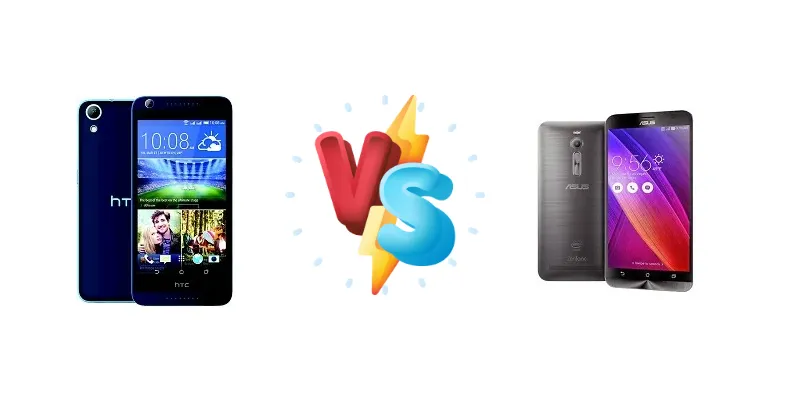
Released around the same timeframe, the Asus Zenfone 2 and HTC Desire 626G+ represent competing approaches to the budget smartphone market. The Zenfone 2 aimed to disrupt with Intel's Atom processor and generous RAM options, while the Desire 626G+ relied on Mediatek's established octa-core platform. This comparison dissects their strengths and weaknesses to determine which offers the best value.
🏆 Quick Verdict
For the average user prioritizing performance and future-proofing, the Asus Zenfone 2 ZE551ML (especially the 4GB RAM variant) is the clear winner. Its Intel Atom Z3580 chipset delivers significantly faster processing speeds than the Mediatek MT6592 in the Desire 626G+, making it better suited for multitasking and demanding applications.
| Network |
|---|
| 2G bands | GSM 850 / 900 / 1800 / 1900 - SIM 1 & SIM 2 | GSM 850 / 900 / 1800 / 1900 - SIM 1 & SIM 2 |
| 3G bands | HSDPA 850 / 900 / 2100 - SIM 1 & SIM 2 | HSDPA 850 / 900 / 1900 / 2100 |
| 4G bands | - | 1, 2, 3, 4, 5, 8, 9, 18, 19, 28 - Taiwan |
| Speed | HSPA 21.1/5.76 Mbps | HSPA 42.2/5.76 Mbps, LTE Cat4 150/50 Mbps |
| Technology | GSM / HSPA | GSM / HSPA / LTE |
| Launch |
|---|
| Announced | 2015, April. Released 2015, April | 2015, January. Released 2015, March |
| Status | Discontinued | Discontinued |
| Body |
|---|
| Build | - | Glass front (Gorilla Glass 3), plastic back, plastic frame |
| Dimensions | 146.9 x 70.9 x 8.2 mm (5.78 x 2.79 x 0.32 in) | 152.5 x 77.2 x 10.9 mm (6.00 x 3.04 x 0.43 in) |
| SIM | Nano-SIM + Nano-SIM | Dual SIM (Micro-SIM, dual stand-by) |
| Weight | 138 g (4.87 oz) | 170 g (6.00 oz) |
| Display |
|---|
| Protection | - | Corning Gorilla Glass 3 |
| Resolution | 720 x 1280 pixels, 16:9 ratio (~294 ppi density) | 1080 x 1920 pixels, 16:9 ratio (~401 ppi density) |
| Size | 5.0 inches, 68.9 cm2 (~66.2% screen-to-body ratio) | 5.5 inches, 83.4 cm2 (~70.8% screen-to-body ratio) |
| Type | IPS LCD, | IPS LCD |
| Platform |
|---|
| CPU | Octa-core 1.7 GHz Cortex-A7 | Quad-core 2.3 GHz (4 GB RAM model)Quad-core 1.8 GHz (2 GB RAM model) |
| Chipset | Mediatek MT6592 (28 nm) | Intel Atom Z3580 (4 GB RAM model)Intel Atom Z3560 (2 GB RAM model) |
| GPU | Mali-450MP4 | PowerVR G6430 |
| OS | Android 4.4.2 (KitKat) | Android 5.0 (Lollipop), upgradable to 6.0 (Marshmallow) |
| Memory |
|---|
| Card slot | microSDHC (dedicated slot) | microSDXC (dedicated slot) |
| Internal | 8GB 1GB RAM | 16GB 2GB RAM, 32GB 2GB RAM, 32GB 4GB RAM, 64GB 4GB RAM, 128GB 4GB RAM |
| Main Camera |
|---|
| Features | LED flash, panorama | Dual-LED dual-tone flash, panorama, HDR |
| Single | 13 MP, f/2.2, 28mm (wide), AF | 13 MP, f/2.0, AF |
| Video | 1080p@30fps | 1080p@30fps |
| Selfie camera |
|---|
| Single | 5 MP, f/2.8, 34mm (standard) | 5 MP, f/2.0 |
| Video | 1080p@30fps | - |
| Sound |
|---|
| 3.5mm jack | - | Yes |
| 35mm jack | Yes | Yes |
| Loudspeaker | Yes | Yes |
| Comms |
|---|
| Bluetooth | 4.0, A2DP, aptX | 4.0, A2DP, EDR |
| NFC | No | Yes |
| Positioning | GPS | GPS, GLONASS |
| Radio | FM radio | FM radio, RDS |
| USB | microUSB 2.0 | microUSB 2.0, OTG |
| WLAN | Wi-Fi 802.11 b/g/n, Wi-Fi Direct, DLNA, hotspot | Wi-Fi 802.11 a/b/g/n/ac, Wi-Fi Direct, hotspot |
| Features |
|---|
| Sensors | Accelerometer, proximity, compass | Accelerometer, gyro, proximity, compass |
| Battery |
|---|
| Charging | - | 18W wired, 60% in 40 min |
| Stand-by | Up to 521 h (2G) / Up to 458 h (3G) | - |
| Talk time | Up to 22 h 40 min (2G) / Up to 12 h 40 min (3G) | - |
| Type | Li-Po 2000 mAh, non-removable | Li-Po 3000 mAh, non-removable |
| Misc |
|---|
| Colors | White Birch, Purple Fire, Blue Lagoon | Osmium Black, Sheer Gold, Glacier Gray, Glamor Red, Ceramic White |
| Models | Desire 626GPLUS dual, Desire_626GPLUS_dual | Z00AD, Z00A |
| Price | About 250 EUR | About 300 EUR |
| SAR EU | - | 0.35 W/kg (head) |
| Tests |
|---|
| Battery life | - | Endurance rating 59h |
| Camera | - |
Photo / Video |
| Loudspeaker | - |
Voice 62dB / Noise 61dB / Ring 67dB |
| Performance | - |
Basemark OS II 2.0: 1090Basemark X: 12565 |
HTC Desire 626G+
- Potentially lower initial cost.
- Reliable for basic smartphone functions.
- Octa-core processor offers decent performance for everyday tasks.
- Significantly slower processor than the Zenfone 2.
- Limited multitasking capabilities.
- Likely inferior camera performance.
Asus Zenfone 2 ZE551ML
- Faster Intel Atom processor for smoother performance.
- Available with 4GB of RAM for enhanced multitasking.
- 18W fast charging for quicker top-ups.
- Potentially higher initial cost.
- Intel Atom processor may have limited software support over time.
- Battery life is comparable, but efficiency is better.
Display Comparison
Neither device boasts a standout display. Specifics regarding panel type (IPS, TFT) and resolution are missing, but both likely featured 720p displays common in this price bracket. The focus here isn't on visual fidelity. The Zenfone 2’s slightly larger screen size (5.5” vs. the Desire 626G+'s 5”) offers a marginally more immersive experience, but the difference is minimal. Bezels were substantial on both devices, typical for the era.
Camera Comparison
Both phones feature 'Photo / Video' capabilities, but detailed camera specifications are lacking. Given the market segment, image quality is unlikely to be a strong suit for either device. Sensor size and aperture are unknown, but it’s safe to assume both utilize relatively small sensors. The Zenfone 2’s potential for better image processing, thanks to its more powerful chipset, *might* offer a slight edge in image clarity and detail, but this is speculative without further data. Avoid relying on either phone for serious photography.
Performance
The performance gap is the most significant differentiator. The Asus Zenfone 2, equipped with the Intel Atom Z3580 (in the 4GB RAM model) or Z3560 (in the 2GB RAM model), offers a substantial leap in processing power compared to the HTC Desire 626G+'s Mediatek MT6592. The Z3580’s 2.3 GHz quad-core configuration significantly outperforms the MT6592’s 1.7 GHz octa-core, despite the core count difference. This is due to Intel’s more efficient architecture. The Zenfone 2’s RAM options (2GB or 4GB) further amplify this advantage; the 4GB model provides smoother multitasking and prevents apps from frequently reloading. The MT6592, while capable for basic tasks, will struggle with more demanding applications and heavier multitasking loads.
Battery Life
Both the HTC Desire 626G+ and Asus Zenfone 2 ZE551ML share an endurance rating of 59 hours, suggesting comparable battery life under similar usage conditions. However, the Zenfone 2 benefits from 18W wired charging, capable of reaching 60% charge in 40 minutes. The Desire 626G+'s charging speed is unknown but likely slower. While the mAh capacity of both batteries is unspecified, the Zenfone 2’s more efficient Intel Atom processor could contribute to slightly better real-world battery performance, especially during intensive tasks.
Buying Guide
Buy the HTC Desire 626G+ if you need a simple, reliable smartphone for basic tasks like calling, texting, and light social media use, and prioritize a potentially lower initial cost. Buy the Asus Zenfone 2 ZE551ML if you prefer a more responsive user experience, better multitasking capabilities, and faster app loading times, even if it means spending slightly more upfront. The Zenfone 2’s RAM options are crucial; prioritize the 4GB model.
Frequently Asked Questions
❓ Is the Intel Atom Z3580 in the Zenfone 2 known to have overheating issues?
While the Z3580 was a capable processor, it was known to generate more heat than some competing chips. However, the Zenfone 2’s thermal design generally managed this adequately for typical usage. Prolonged, intensive gaming could lead to some throttling, but it wasn’t a widespread or crippling issue.
❓ Does the Asus Zenfone 2 support expandable storage via microSD card?
Yes, the Asus Zenfone 2 ZE551ML features a microSD card slot, allowing users to expand the internal storage. This is a significant advantage over devices that lack expandable storage, especially considering the limited internal storage options available on some models.
❓ How does the Mediatek MT6592 handle gaming on the HTC Desire 626G+?
The Mediatek MT6592 can handle casual gaming, but struggles with more demanding titles. Expect lower frame rates and potential lag in graphically intensive games. The processor’s limitations become apparent when multitasking while gaming, leading to noticeable slowdowns.