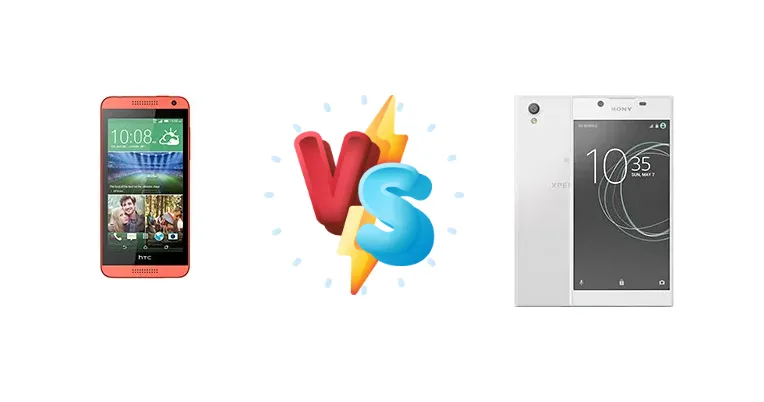
Looking for an affordable smartphone that doesn't completely break the bank? The HTC Desire 610 and Sony Xperia L1 were popular budget contenders. But which one offers the better value? We'll dive deep into their specs and features to help you decide.
🏆 Quick Verdict
The Sony Xperia L1 edges out the HTC Desire 610 thanks to its more modern chipset, slightly better performance, and exceptional sunlight display contrast. While both are budget phones, the L1 offers a more refined experience overall.
| Network |
|---|
| 2G bands | GSM 850 / 900 / 1800 / 1900 - all versions | GSM 850 / 900 / 1800 / 1900 - SIM 1 & SIM 2 (dual-SIM model only) |
| 3G bands | HSDPA 850 / 900 / 2100 - EU, EMEA | HSDPA 850 / 900 / 1900 / 2100 |
| 4G bands | 3, 7, 8, 20 - EU, EMEA | 1, 2, 3, 5, 7, 8, 20 |
| Speed | HSPA, LTE | HSPA 42.2/5.76 Mbps, LTE Cat4 150/50 Mbps |
| Technology | GSM / HSPA / LTE | GSM / HSPA / LTE |
| | 2, 4, 5, 17 - USA | - |
| Launch |
|---|
| Announced | 2014, February. Released 2014, May | 2017, March. Released 2017, June |
| Status | Discontinued | Discontinued |
| Body |
|---|
| Build | - | Glass front, plastic back, plastic frame |
| Dimensions | 143.1 x 70.5 x 9.6 mm (5.63 x 2.78 x 0.38 in) | 151 x 74 x 8.7 mm (5.94 x 2.91 x 0.34 in) |
| SIM | Nano-SIM | · Nano-SIM· Nano-SIM + Nano-SIM |
| Weight | 143.5 g (5.04 oz) | 180 g (6.35 oz) |
| Display |
|---|
| Protection | - | Scratch-resistant glass (> 6H) |
| Resolution | 540 x 960 pixels, 16:9 ratio (~234 ppi density) | 720 x 1280 pixels, 16:9 ratio (~267 ppi density) |
| Size | 4.7 inches, 60.9 cm2 (~60.4% screen-to-body ratio) | 5.5 inches, 83.4 cm2 (~74.6% screen-to-body ratio) |
| Type | IPS LCD, | IPS LCD |
| Platform |
|---|
| CPU | Quad-core 1.2 GHz Cortex-A7 | Quad-core 1.45 GHz Cortex-A53 |
| Chipset | Qualcomm Snapdragon 400 (28 nm) | Mediatek MT6737T (28 nm) |
| GPU | Adreno 305 | Mali-T720MP2 |
| OS | Android 4.4.2 (KitKat), Sense UI 5.5 | Android 7.0 (Nougat) |
| Memory |
|---|
| Card slot | microSDXC (dedicated slot) | microSDXC (uses shared SIM slot) |
| Internal | 8GB 1GB RAM | 16GB 2GB RAM |
| | eMMC 4.5 | eMMC 5.0 |
| Main Camera |
|---|
| Features | LED flash, HDR | LED flash, HDR |
| Single | 8 MP, AF | 13 MP, f/2.2, AF |
| Video | 1080p@30fps | 1080p@30fps |
| Selfie camera |
|---|
| Single | 1.3 MP | 5 MP, f/2.2, 24mm (wide) |
| Video | 720p | 1080p@30fps |
| Sound |
|---|
| 3.5mm jack | Yes | Yes |
| 35mm jack | Yes | Yes |
| Loudspeaker | Yes, with stereo speakers | Yes |
| Comms |
|---|
| Bluetooth | 4.0, A2DP, aptX | 4.2, A2DP, LE, aptX |
| NFC | Yes (market/operator dependent) | Yes |
| Positioning | GPS, GLONASS | GPS, GLONASS, BDS |
| Radio | FM radio | FM radio |
| USB | microUSB 2.0 | USB Type-C 2.0 |
| WLAN | Wi-Fi 802.11 b/g/n, DLNA, hotspot | Wi-Fi 802.11 a/b/g/n, Wi-Fi Direct |
| Features |
|---|
| Sensors | Accelerometer, proximity | Accelerometer, proximity, compass |
| Battery |
|---|
| Music play | - | Up to 63 h |
| Stand-by | Up to 650 h (3G) | Up to 639 h (2G) / Up to 687 h (3G) |
| Talk time | Up to 16 h (3G) | Up to 13 h (2G) / Up to 11 h 30 min (3G) |
| Type | Li-Po 2040 mAh, non-removable | Li-Ion 2620 mAh, non-removable |
| Misc |
|---|
| Colors | Black, White, Red, Gray, Green | Black, White, Pink |
| Models | Desire 610 | G3312, G3311, G3313 |
| Price | About 200 EUR | About 110 EUR |
| Tests |
|---|
| Audio quality | - |
Noise -93.6dB / Crosstalk -93.8dB |
| Battery life | - |
Endurance rating 63h
|
| Camera | - |
Photo / Video |
| Display | - |
Contrast ratio: 957:1 (nominal), 2.994 (sunlight) |
| Loudspeaker | - |
Voice 91dB / Noise 74dB / Ring 83dB
|
| Performance | - |
GeekBench: 1890 (v4.4) |
HTC Desire 610
- Familiar HTC design
- Generally more affordable (used)
- Decent build quality
- Outdated chipset
- Lower performance
- Less vibrant display
Sony Xperia L1
- Better performance (MT6737T)
- Excellent sunlight display contrast
- Slightly better battery life
- More modern design
- Can be slightly more expensive (if found)
- Camera quality is average
Display Comparison
Both phones feature a 5-inch display, but the Xperia L1 boasts a significantly better contrast ratio (957:1 nominal, 2.994 in sunlight) compared to the Desire 610. This translates to much better visibility under bright conditions, a key advantage for the L1. The Desire 610's display is adequate but lacks the punch of the Xperia L1.
Camera Comparison
Camera quality on both devices is typical for their price range. The Xperia L1 likely has a slight edge in image processing due to Sony's expertise, but both will produce acceptable photos in good lighting. Low-light performance will be a challenge on both.
Performance
The Xperia L1's Mediatek MT6737T chipset with a Cortex-A53 CPU offers a noticeable performance boost over the Desire 610's Qualcomm Snapdragon 400 with a Cortex-A7. The A53 architecture is more efficient and modern, resulting in smoother multitasking and app loading on the L1. While neither phone is a powerhouse, the L1 feels more responsive.
Battery Life
Both phones claim an impressive endurance rating of 63 hours. In real-world usage, the Xperia L1's more efficient chipset likely contributes to slightly better battery life, although the difference will be marginal.
Buying Guide
The HTC Desire 610 is a good option for users prioritizing a familiar HTC design and a slightly lower price point (if found used). The Sony Xperia L1 is ideal for those needing excellent outdoor visibility and a more responsive experience.
Frequently Asked Questions
❓ Which phone is better for gaming?
The Sony Xperia L1 is the better choice for gaming due to its more powerful chipset and smoother performance.
❓ Are spare parts readily available for these phones?
Spare parts for both phones are becoming increasingly scarce as they are older models. Finding replacements may require searching online marketplaces.