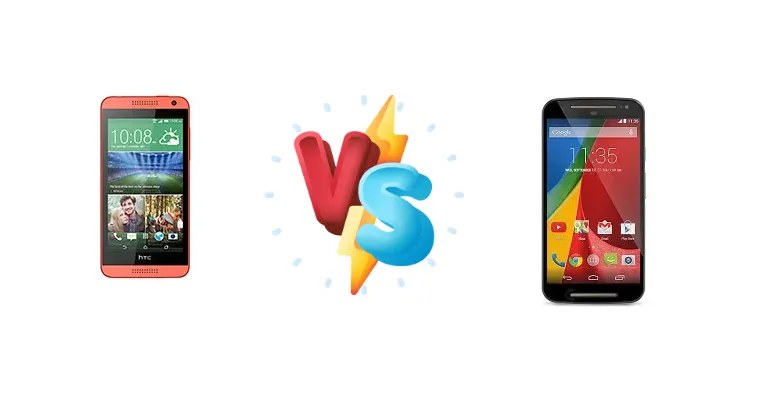
The HTC Desire 610 and Motorola Moto G (2nd generation) were popular budget smartphones vying for the attention of cost-conscious consumers. Both offered a decent Android experience, but which one truly delivered the best value? Let's dive into a comprehensive comparison to help you decide.
🏆 Quick Verdict
The Motorola Moto G (2nd gen) edges out the HTC Desire 610 thanks to its slightly better software support, more reliable battery life, and a generally more polished user experience. While both share similar specs, Motorola's execution proved superior in this generation.
| Network |
|---|
| 2G bands | GSM 850 / 900 / 1800 / 1900 - all versions | GSM 850 / 900 / 1800 / 1900 |
| 3G bands | HSDPA 850 / 900 / 2100 - EU, EMEA | HSDPA 850 / 900 / 1900 / 2100 - Global model |
| 4G bands | 3, 7, 8, 20 - EU, EMEA | - |
| Speed | HSPA, LTE | HSPA 21.1/5.76 Mbps |
| Technology | GSM / HSPA / LTE | GSM / HSPA |
| | 2, 4, 5, 17 - USA | HSDPA 850 / 1700 / 1900 / 2100 - USA model |
| Launch |
|---|
| Announced | 2014, February. Released 2014, May | 2014, September. Released 2014, September |
| Status | Discontinued | Discontinued |
| Body |
|---|
| Dimensions | 143.1 x 70.5 x 9.6 mm (5.63 x 2.78 x 0.38 in) | 141.5 x 70.7 x 11 mm (5.57 x 2.78 x 0.43 in) |
| SIM | Nano-SIM | Micro-SIM |
| Weight | 143.5 g (5.04 oz) | 149 g (5.26 oz) |
| Display |
|---|
| Protection | - | Corning Gorilla Glass 3 |
| Resolution | 540 x 960 pixels, 16:9 ratio (~234 ppi density) | 720 x 1280 pixels, 16:9 ratio (~294 ppi density) |
| Size | 4.7 inches, 60.9 cm2 (~60.4% screen-to-body ratio) | 5.0 inches, 68.9 cm2 (~68.9% screen-to-body ratio) |
| Type | IPS LCD, | IPS LCD |
| Platform |
|---|
| CPU | Quad-core 1.2 GHz Cortex-A7 | Quad-core 1.2 GHz Cortex-A7 |
| Chipset | Qualcomm Snapdragon 400 (28 nm) | Qualcomm MSM8226 Snapdragon 400 (28 nm) |
| GPU | Adreno 305 | Adreno 305 |
| OS | Android 4.4.2 (KitKat), Sense UI 5.5 | Android 4.4.4 (KitKat), upgradable to 6.0 (Marshmallow) |
| Memory |
|---|
| Card slot | microSDXC (dedicated slot) | microSDHC (dedicated slot) |
| Internal | 8GB 1GB RAM | 8GB 1GB RAM |
| | eMMC 4.5 | eMMC 4.5 |
| Main Camera |
|---|
| Features | LED flash, HDR | LED flash, HDR, panorama |
| Single | 8 MP, AF | 8 MP, f/2.0, AF |
| Video | 1080p@30fps | 720p@30fps, stereo sound rec., HDR |
| Selfie camera |
|---|
| Single | 1.3 MP | 2 MP, f/2.2 |
| Video | 720p | - |
| Sound |
|---|
| 3.5mm jack | Yes | Yes |
| 35mm jack | Yes | Yes |
| Loudspeaker | Yes, with stereo speakers | Yes, with stereo speakers |
| Comms |
|---|
| Bluetooth | 4.0, A2DP, aptX | 4.0, A2DP, LE, aptX |
| NFC | Yes (market/operator dependent) | No |
| Positioning | GPS, GLONASS | GPS, GLONASS |
| Radio | FM radio | FM radio |
| USB | microUSB 2.0 | microUSB 2.0, OTG |
| WLAN | Wi-Fi 802.11 b/g/n, DLNA, hotspot | Wi-Fi 802.11 b/g/n, hotspot |
| Features |
|---|
| Sensors | Accelerometer, proximity | Accelerometer, gyro, proximity, compass |
| | - | Digital TV (DS DTV 16GB model only) |
| Battery |
|---|
| Stand-by | Up to 650 h (3G) | - |
| Talk time | Up to 16 h (3G) | - |
| Type | Li-Po 2040 mAh, non-removable | Li-Ion 2070 mAh, non-removable |
| Misc |
|---|
| Colors | Black, White, Red, Gray, Green | White, Black |
| Models | Desire 610 | XT1068, XT1063, XT1064, XT1069, XT1077 |
| Price | About 200 EUR | About 160 EUR |
| Tests |
|---|
| Audio quality | - |
Noise -91.6dB / Crosstalk -91.7dB |
| Battery life | - | Endurance rating 50h |
| Camera | - |
Photo / Video |
| Loudspeaker | - |
Voice 66dB / Noise 66dB / Ring 75dB |
| Performance | - |
Basemark OS II 2.0: 497Basemark X: 3142 |
HTC Desire 610
- Compact design
- Potentially more vibrant display (subjective)
- Slightly more premium build materials (depending on variant)
- Shorter battery life
- Occasional performance lag
- Less frequent software updates
Motorola Moto G (2nd gen)
- Excellent battery life
- Clean Android experience
- Durable build quality
- More reliable software updates
- Camera not exceptional
- Design can be considered bland by some
Display Comparison
Both phones featured 5-inch displays, but the Moto G's screen often received praise for its slightly better color accuracy and viewing angles. The Desire 610's display was adequate but sometimes criticized for being a bit washed out. Resolution was similar, around 720p on both.
Camera Comparison
The Moto G's camera, while not exceptional, generally produced slightly better images in various lighting conditions. Both phones struggled in low light. Video recording capabilities were similar on both devices.
Performance
Performance was comparable given the identical Snapdragon 400 chipset and Cortex-A7 CPU. However, Motorola's software optimization often resulted in a smoother, more responsive experience. The Desire 610 could occasionally feel a bit sluggish, especially with multiple apps open.
Battery Life
The Motorola Moto G (2nd gen) consistently outperformed the Desire 610 in battery life, often achieving the advertised 50-hour endurance rating. The Desire 610's battery life was decent but not as impressive.
Buying Guide
The HTC Desire 610 is a good option for users prioritizing a slightly more compact design and a potentially more vibrant display (though this is subjective). The Motorola Moto G (2nd gen) is ideal for those seeking longer battery life, a cleaner Android experience, and a phone with a reputation for durability.
Frequently Asked Questions
❓ Which phone received more software updates?
The Motorola Moto G (2nd gen) generally received more timely and consistent software updates from Motorola, providing a longer lifespan for the device.
❓ Is the HTC Desire 610 still worth buying?
While it's an older device, the HTC Desire 610 might be a budget option if found at a very low price. However, consider the limited software support and shorter battery life compared to newer alternatives.