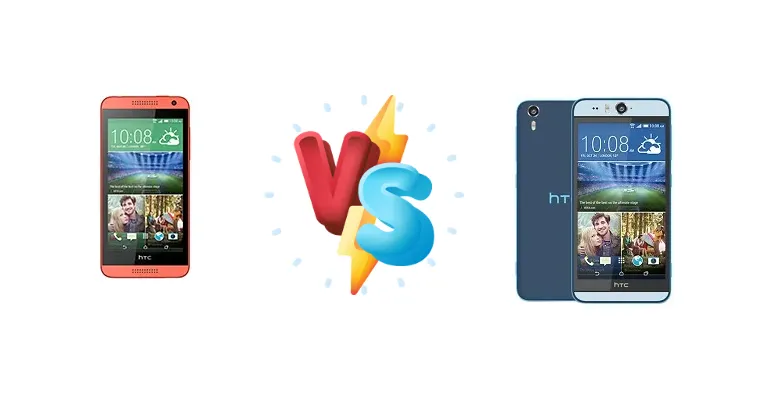
The HTC Desire series has always offered affordable smartphones with a focus on usability. Today, we're pitting two models against each other: the Desire 610 and the Desire Eye. Which one delivers the best value for your money?
🏆 Quick Verdict
The HTC Desire Eye is the clear winner. Its Snapdragon 801 chipset and faster CPU provide significantly better performance, while the impressive contrast ratio and 18W charging offer a superior user experience compared to the Desire 610's older Snapdragon 400.
| Network |
|---|
| 2G bands | GSM 850 / 900 / 1800 / 1900 - all versions | GSM 850 / 900 / 1800 / 1900 - all versions |
| 3G bands | HSDPA 850 / 900 / 2100 - EU, EMEA | HSDPA 850 / 900 / 1900 / 2100 - Asia |
| 4G bands | 3, 7, 8, 20 - EU, EMEA | 1, 3, 7, 8, 28, 38, 39, 40, 41 - Asia |
| Speed | HSPA, LTE | HSPA 42.2/21.1(AT&T)/5.76 Mbps, LTE Cat4 150/50 Mbps |
| Technology | GSM / HSPA / LTE | GSM / HSPA / LTE |
| | 2, 4, 5, 17 - USA | - |
| Launch |
|---|
| Announced | 2014, February. Released 2014, May | 2014, October. Released 2014, November |
| Status | Discontinued | Discontinued |
| Body |
|---|
| Dimensions | 143.1 x 70.5 x 9.6 mm (5.63 x 2.78 x 0.38 in) | 151.7 x 73.8 x 8.5 mm (5.97 x 2.91 x 0.33 in) |
| SIM | Nano-SIM | Nano-SIM |
| Weight | 143.5 g (5.04 oz) | 154 g (5.43 oz) |
| Display |
|---|
| Protection | - | Corning Gorilla Glass 3 |
| Resolution | 540 x 960 pixels, 16:9 ratio (~234 ppi density) | 1080 x 1920 pixels, 16:9 ratio (~424 ppi density) |
| Size | 4.7 inches, 60.9 cm2 (~60.4% screen-to-body ratio) | 5.2 inches, 74.5 cm2 (~66.6% screen-to-body ratio) |
| Type | IPS LCD, | IPS LCD, |
| Platform |
|---|
| CPU | Quad-core 1.2 GHz Cortex-A7 | Quad-core 2.3 GHz Krait 400 |
| Chipset | Qualcomm Snapdragon 400 (28 nm) | Qualcomm Snapdragon 801 (28 nm) |
| GPU | Adreno 305 | Adreno 330 |
| OS | Android 4.4.2 (KitKat), Sense UI 5.5 | Android 4.4.4 (KitKat), upgradable to 6.1 (Marshmallow), Sense UI 7 |
| Memory |
|---|
| Card slot | microSDXC (dedicated slot) | microSDXC (dedicated slot) |
| Internal | 8GB 1GB RAM | 16GB 2GB RAM |
| | eMMC 4.5 | - |
| Main Camera |
|---|
| Features | LED flash, HDR | Dual-LED dual-tone flash, panorama, HDR |
| Single | 8 MP, AF | 13 MP, f/2.0, 28mm (wide), AF |
| Video | 1080p@30fps | 1080p@30fps |
| Selfie camera |
|---|
| Features | - | Dual-LED dual-tone flash, HDR |
| Single | 1.3 MP | 13 MP, f/2.2, 22mm (wide), AF |
| Video | 720p | - |
| Sound |
|---|
| 3.5mm jack | Yes | Yes |
| 35mm jack | Yes | Yes |
| Loudspeaker | Yes, with stereo speakers | Yes, with stereo speakers |
| Comms |
|---|
| Bluetooth | 4.0, A2DP, aptX | 4.0, A2DP, aptX |
| NFC | Yes (market/operator dependent) | Yes |
| Positioning | GPS, GLONASS | GPS, GLONASS |
| Radio | FM radio | FM radio, RDS |
| USB | microUSB 2.0 | microUSB 2.0 |
| WLAN | Wi-Fi 802.11 b/g/n, DLNA, hotspot | Wi-Fi 802.11 a/b/g/n, dual-band, Wi-Fi Direct, DLNA, hotspot |
| Features |
|---|
| Sensors | Accelerometer, proximity | Accelerometer, gyro, proximity, compass |
| Battery |
|---|
| Charging | - | 18W wired, QC2 |
| Stand-by | Up to 650 h (3G) | Up to 538 h (3G) |
| Talk time | Up to 16 h (3G) | Up to 20 h (3G) |
| Type | Li-Po 2040 mAh, non-removable | Li-Po 2400 mAh, non-removable |
| Misc |
|---|
| Colors | Black, White, Red, Gray, Green | Blue, Red, White |
| Models | Desire 610 | Desire EYE, M910x, Desire_EYE |
| Price | About 200 EUR | About 380 EUR |
| Tests |
|---|
| Audio quality | - |
Noise -95.6dB / Crosstalk -91.3dB |
| Battery life | - |
Endurance rating 70h
|
| Camera | - |
Photo / Video |
| Display | - |
Contrast ratio: 1311 (nominal), 2.815 (sunlight) |
| Loudspeaker | - |
Voice 65dB / Noise 65dB / Ring 74dB
|
| Performance | - |
Basemark X: 10249 |
HTC Desire 610
- Affordable
- Compact size
- Decent build quality
- Outdated chipset
- Slow performance
- Basic camera
- Slow charging
HTC Desire Eye
- Faster performance
- Better camera
- Faster charging (18W)
- Good contrast ratio display
- May be slightly larger
- Older model (potential software support issues)
Display Comparison
Both phones feature similar contrast ratios (1311 nominal, 2.815 sunlight), suggesting comparable outdoor visibility. However, the Desire Eye likely has a slightly better display due to its more modern panel technology and potentially higher resolution, though specific resolution details are missing. The Desire 610's display is adequate but may lack the vibrancy of the Eye.
Camera Comparison
While both phones offer 'Photo/Video' capabilities, the Desire Eye's superior chipset likely translates to better image processing and potentially higher resolution photos and videos. The Desire 610's camera is functional but won't deliver exceptional results. Specific megapixel counts are missing for both, but the Eye is expected to perform better.
Performance
This is where the Desire Eye shines. The Snapdragon 801 with a 2.3 GHz Krait 400 CPU is a substantial upgrade over the Desire 610's Snapdragon 400 (1.2 GHz Cortex-A7). Expect noticeably faster app loading, smoother multitasking, and better gaming performance on the Desire Eye. The 610 will feel sluggish by comparison.
Battery Life
Both phones boast an endurance rating of 70 hours, suggesting comparable battery life under typical usage. However, the Desire Eye's 18W wired charging with QC2 support offers significantly faster charging speeds compared to the 610, which likely uses a slower charging standard.
Buying Guide
The HTC Desire 610 is a good option for users on a very tight budget who prioritize basic functionality and a compact size. The HTC Desire Eye is ideal for those seeking a smoother experience, better camera capabilities, and faster charging, even within a budget-friendly price range.
Frequently Asked Questions
❓ Is the HTC Desire Eye worth the extra cost over the Desire 610?
Yes, the Desire Eye's significantly improved performance and faster charging make it a worthwhile upgrade if your budget allows.
❓ Are there software updates available for either of these phones?
Both phones are older models, so active software updates are unlikely. Check HTC's website for any remaining support, but don't expect major Android version upgrades.