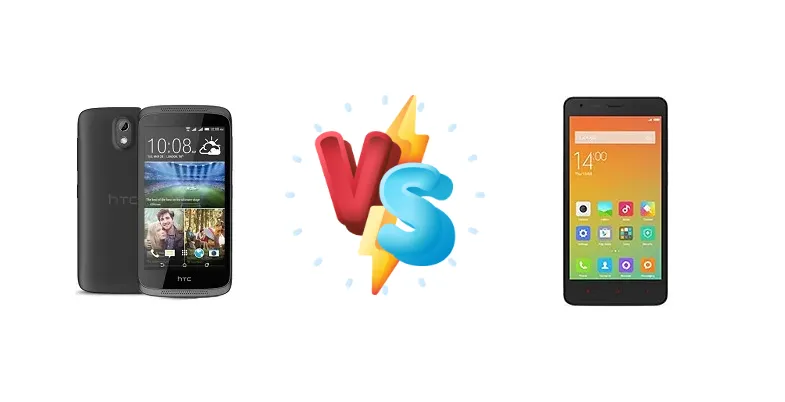
The HTC Desire 526G+ and Xiaomi Redmi 2 Pro represent distinct approaches to the budget smartphone market. The Desire 526G+ offers a potentially faster octa-core processor, while the Redmi 2 Pro leverages Qualcomm's Snapdragon 410 chipset for optimized efficiency and Quick Charge support. This comparison dissects their strengths and weaknesses to determine which device delivers the best value.
🏆 Quick Verdict
For the average user prioritizing efficiency and a more refined software experience, the Xiaomi Redmi 2 Pro is the better choice. While the HTC Desire 526G+ boasts a potentially faster octa-core CPU, the Snapdragon 410's optimized architecture and Quick Charge 1.0 support provide a smoother, more reliable daily experience.
| Network |
|---|
| 2G bands | GSM 850 / 900 / 1800 / 1900 - SIM 1 & SIM 2 | GSM 850 / 900 / 1800 / 1900 - SIM 1 & SIM 2 |
| 3G bands | HSDPA 900 / 2100 | HSDPA 850 / 900 / 1900 / 2100 |
| 4G bands | - | 2, 4, 7 |
| Speed | HSPA 21.1/5.76 Mbps | HSPA, LTE Cat4 150/50 Mbps |
| Technology | GSM / HSPA | GSM / HSPA / LTE |
| Launch |
|---|
| Announced | 2015, January. Released 2015, January | 2015, October. Released 2015, October |
| Status | Discontinued | Discontinued |
| Body |
|---|
| Dimensions | 139.8 x 69.8 x 9.9 mm (5.50 x 2.75 x 0.39 in) | 134 x 67 x 9 mm (5.28 x 2.64 x 0.35 in) |
| SIM | Dual SIM (Micro-SIM, dual stand-by) | Dual SIM |
| Weight | 154 g (5.43 oz) | 133 g (4.69 oz) |
| Display |
|---|
| Resolution | 540 x 960 pixels, 16:9 ratio (~234 ppi density) | 720 x 1280 pixels, 16:9 ratio (~312 ppi density) |
| Size | 4.7 inches, 60.9 cm2 (~62.4% screen-to-body ratio) | 4.7 inches, 60.9 cm2 (~67.8% screen-to-body ratio) |
| Type | IPS LCD, | IPS LCD |
| Platform |
|---|
| CPU | Octa-core 1.7 GHz - 526G+ modelQuad-core 1.3 GHz - 526G model | Quad-core 1.2 GHz Cortex-A53 |
| Chipset | - | Qualcomm MSM8916 Snapdragon 410 (28 nm) |
| GPU | - | Adreno 306 |
| OS | Android 4.4.2 (KitKat) | Android 4.4.4 (KitKat), MIUI 6 |
| Memory |
|---|
| Card slot | microSDHC (dedicated slot) | microSDHC (dedicated slot) |
| Internal | 8GB 1GB RAM, 16GB 1GB RAM | 16GB 2GB RAM |
| | - | eMMC 4.5 |
| Main Camera |
|---|
| Features | LED flash | LED flash, HDR |
| Single | 8 MP, f/2.2, AF | 8 MP, f/2.2, 28mm (wide), 1/3.2", 1.4µm, AF |
| Video | 1080p@30fps | 1080p@30fps |
| Selfie camera |
|---|
| Single | 2 MP | 2 MP |
| Video | 720p | 720p |
| Sound |
|---|
| 3.5mm jack | - | Yes |
| 35mm jack | Yes | Yes |
| Loudspeaker | Yes | Yes |
| Comms |
|---|
| Bluetooth | 4.0, A2DP, aptX | 4.0, A2DP, LE |
| NFC | No | No |
| Positioning | GPS | GPS, GLONASS, BDS |
| Radio | FM radio | Stereo FM radio |
| USB | microUSB 2.0 | microUSB 2.0, OTG |
| WLAN | Wi-Fi 802.11 b/g/n, hotspot | Wi-Fi 802.11 b/g/n, Wi-Fi Direct, hotspot |
| Features |
|---|
| Sensors | Accelerometer, proximity | Accelerometer, gyro, proximity, compass |
| Battery |
|---|
| Charging | - | 10W wired, QC1 |
| Stand-by | Up to 622 h (3G) | - |
| Talk time | Up to 15 h (3G) | - |
| Type | Li-Ion 2000 mAh, removable | Li-Po 2200 mAh, removable |
| Misc |
|---|
| Colors | Glacier blue, Stealth black, Lacquer black, Fervor red - 526G+Glacier blue, Stealth black - 526G | Dark gray |
| Models | Desire 526GPLUS dual, Desire 526G dual sim, Desire_526G_dual_sim, D526h | wt88047 |
| Price | About 160 EUR | About 100 EUR |
HTC Desire 526G+ dual sim
- Potentially higher peak CPU performance (depending on variant)
- Octa-core processor may handle multitasking better in short bursts
- Dual SIM functionality
- Likely less efficient processor
- No Quick Charge support
- Potentially more thermal throttling
Xiaomi Redmi 2 Pro
- Qualcomm Snapdragon 410 offers efficient performance
- Quick Charge 1.0 support for faster charging
- Qualcomm Adreno 306 GPU for better graphics
- Quad-core processor may not match peak performance of 526G+'s octa-core variant
- Lower core count may impact heavy multitasking
- Older chipset
Display Comparison
Neither device is known for display prowess. Given the age of both phones, expect TN or low-quality IPS panels. Specifics like brightness nits and color accuracy are unavailable, but based on the market segment, both likely offer basic viewing experiences. Bezels are expected to be substantial on both devices, typical for phones released during this era. The Redmi 2 Pro likely benefits from Qualcomm's image processing, potentially offering slightly better color reproduction, but this is speculative.
Camera Comparison
Camera performance on both devices is expected to be basic. Details regarding sensor sizes and apertures are unavailable. However, given the market positioning, both likely feature low-resolution primary sensors. The Redmi 2 Pro may have a slight edge due to Qualcomm's image signal processor (ISP), which generally provides better noise reduction and color accuracy. Any 2MP or lower resolution secondary cameras on either device are unlikely to provide meaningful image quality and should be disregarded.
Performance
The core difference lies in the CPU architecture. The HTC Desire 526G+ features an octa-core processor clocked at 1.7 GHz (or 1.3 GHz in some variants). While the core count is higher, the Xiaomi Redmi 2 Pro utilizes a quad-core 1.2 GHz Qualcomm Snapdragon 410. The Snapdragon 410, built on a 28nm process, employs Cortex-A53 cores, known for their efficiency. This means the Redmi 2 Pro will likely exhibit better sustained performance and thermal management, avoiding throttling under load. The 526G+'s octa-core setup may show higher benchmark scores in short bursts, but the Snapdragon 410's architecture is more suited for consistent, real-world performance. The Redmi 2 Pro also benefits from Qualcomm's Adreno 306 GPU, offering a more capable graphics experience than the GPU found in the 526G+.
Battery Life
Battery capacity details for both devices are unavailable. However, the Xiaomi Redmi 2 Pro's inclusion of 10W wired charging with Quick Charge 1.0 support is a significant advantage. Quick Charge, even in its first iteration, allows for faster charging speeds compared to standard charging. This translates to less downtime and a more convenient user experience. While the Desire 526G+ likely supports standard charging, the Redmi 2 Pro's ability to replenish its battery more quickly is a clear benefit, especially considering the likely similar battery capacities.
Buying Guide
Buy the HTC Desire 526G+ dual sim if you absolutely need the potential for peak CPU performance for occasional demanding tasks and are comfortable with potentially less optimized software. Buy the Xiaomi Redmi 2 Pro if you prioritize consistent performance, battery life, and the convenience of Qualcomm's Quick Charge technology, making it ideal for everyday use and users who value efficiency.
Frequently Asked Questions
❓ Will the HTC Desire 526G+ handle demanding games like PUBG Mobile?
While the octa-core processor might suggest gaming capability, the GPU and overall system resources are likely insufficient for a smooth PUBG Mobile experience, even on low settings. Expect significant frame drops and potential overheating. The Redmi 2 Pro's Adreno 306 GPU offers a slightly better, but still limited, gaming experience.
❓ Does the Xiaomi Redmi 2 Pro support 4G LTE bands in North America?
The Xiaomi Redmi 2 Pro was primarily designed for Asian markets. Compatibility with North American 4G LTE bands is limited and may require checking specific carrier compatibility. The Desire 526G+ may have better band support depending on the specific regional variant.
❓ Is the battery life significantly different between these two phones?
Without specific battery capacity details, it's difficult to say definitively. However, the Snapdragon 410 in the Redmi 2 Pro is known for its power efficiency, suggesting it will likely offer comparable or slightly better battery life than the Desire 526G+, especially when combined with Quick Charge for faster top-ups.