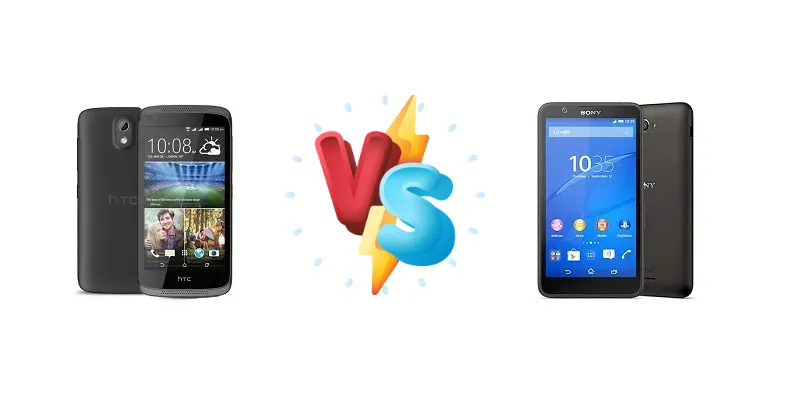
The HTC Desire 526G+ and Sony Xperia E4 Dual represent a segment of the market increasingly focused on affordability and dual-SIM functionality. While both aim to provide essential smartphone features at a low price point, they take different approaches to achieving this, particularly in their core processing power. This comparison dissects these differences to determine which device offers the best value.
🏆 Quick Verdict
For the average user prioritizing multitasking and responsiveness, the HTC Desire 526G+ (specifically the 1.7GHz octa-core variant) emerges as the better choice. Its octa-core processor offers a significant performance advantage over the Sony Xperia E4’s quad-core chipset, making it more suitable for running multiple apps and handling demanding tasks, despite potential battery trade-offs.
| Network |
|---|
| 2G bands | GSM 850 / 900 / 1800 / 1900 - SIM 1 & SIM 2 | GSM 850 / 900 / 1800 / 1900 - SIM 1 & SIM 2 |
| 3G bands | HSDPA 900 / 2100 | HSDPA 850 / 1900 / 2100 - E2114, E2124 |
| Speed | HSPA 21.1/5.76 Mbps | HSPA 21.1/5.76 Mbps |
| Technology | GSM / HSPA | GSM / HSPA |
| | - | HSDPA 900 / 2100 - E2115 |
| Launch |
|---|
| Announced | 2015, January. Released 2015, January | 2015, February. Released 2015, March |
| Status | Discontinued | Discontinued |
| Body |
|---|
| Dimensions | 139.8 x 69.8 x 9.9 mm (5.50 x 2.75 x 0.39 in) | 137 x 74.6 x 10.5 mm (5.39 x 2.94 x 0.41 in) |
| SIM | Dual SIM (Micro-SIM, dual stand-by) | Dual SIM (Micro-SIM, dual stand-by) |
| Weight | 154 g (5.43 oz) | 144 g (5.08 oz) |
| Display |
|---|
| Protection | - | Scratch-resistant glass |
| Resolution | 540 x 960 pixels, 16:9 ratio (~234 ppi density) | 540 x 960 pixels, 16:9 ratio (~220 ppi density) |
| Size | 4.7 inches, 60.9 cm2 (~62.4% screen-to-body ratio) | 5.0 inches, 68.9 cm2 (~67.4% screen-to-body ratio) |
| Type | IPS LCD, | IPS LCD |
| Platform |
|---|
| CPU | Octa-core 1.7 GHz - 526G+ modelQuad-core 1.3 GHz - 526G model | Quad-core 1.3 GHz Cortex-A7 |
| Chipset | - | Mediatek MT6582 (28 nm) |
| GPU | - | Mali-400MP2 |
| OS | Android 4.4.2 (KitKat) | Android 4.4.4 (KitKat) |
| Memory |
|---|
| Card slot | microSDHC (dedicated slot) | microSDHC (dedicated slot) |
| Internal | 8GB 1GB RAM, 16GB 1GB RAM | 8GB 1GB RAM |
| Main Camera |
|---|
| Features | LED flash | LED flash, HDR, panorama |
| Single | 8 MP, f/2.2, AF | 5 MP, f/2.6, AF |
| Video | 1080p@30fps | 1080p@30fps |
| Selfie camera |
|---|
| Single | 2 MP | 2 MP, f/2.8 |
| Video | 720p | 720p |
| Sound |
|---|
| 3.5mm jack | - | Yes |
| 35mm jack | Yes | Yes |
| Loudspeaker | Yes | Yes |
| Comms |
|---|
| Bluetooth | 4.0, A2DP, aptX | 4.1, A2DP, aptX |
| NFC | No | No |
| Positioning | GPS | GPS |
| Radio | FM radio | FM radio, RDS |
| USB | microUSB 2.0 | microUSB 2.0 |
| WLAN | Wi-Fi 802.11 b/g/n, hotspot | Wi-Fi 802.11 b/g/n, Wi-Fi Direct, hotspot |
| Features |
|---|
| Sensors | Accelerometer, proximity | Accelerometer, proximity |
| Battery |
|---|
| Music play | - | Up to 48 h |
| Stand-by | Up to 622 h (3G) | Up to 552 h (2G) / Up to 548 h (3G) |
| Talk time | Up to 15 h (3G) | Up to 12 h (2G) / Up to 12 h 40 min (3G) |
| Type | Li-Ion 2000 mAh, removable | Li-Ion 2300 mAh, non-removable |
| Misc |
|---|
| Colors | Glacier blue, Stealth black, Lacquer black, Fervor red - 526G+Glacier blue, Stealth black - 526G | Black, White |
| Models | Desire 526GPLUS dual, Desire 526G dual sim, Desire_526G_dual_sim, D526h | E2114, E2115, E2124 |
| Price | About 160 EUR | About 120 EUR |
| SAR | - | 1.01 W/kg (head) 0.77 W/kg (body) |
| SAR EU | - | 0.62 W/kg (head) 0.58 W/kg (body) |
HTC Desire 526G+ dual sim
- Octa-core processor (in some models) offers superior multitasking.
- Potentially faster performance for demanding apps.
- Dual SIM functionality for convenient connectivity.
- Potentially shorter battery life due to the more powerful processor.
- Likely lower build quality compared to higher-end devices.
Sony Xperia E4 Dual
- Power-efficient processor for longer battery life.
- Dual SIM functionality.
- Likely more affordable than the octa-core variant of the Desire 526G+.
- Slower performance compared to the octa-core Desire 526G+.
- May struggle with multitasking and demanding applications.
Display Comparison
Neither device boasts a particularly impressive display. Given the limited context data, we can assume both utilize LCD panels common in this price bracket. The focus here isn't on resolution or color accuracy, but rather usability. The absence of information regarding screen size or resolution suggests both are targeting a similar, functional experience. Bezels are likely substantial on both, reflecting their budget nature. Without specific data, it's difficult to definitively state a display advantage.
Camera Comparison
Camera performance is likely to be similar on both devices, leaning towards basic functionality. Without sensor size or aperture information, it's safe to assume both feature entry-level cameras. The inclusion of a dual-SIM feature suggests a focus on communication, not photography. Image processing will likely be minimal on both, resulting in images that are acceptable in good lighting conditions but struggle in low light. Any claims of advanced features should be viewed skeptically.
Performance
The core difference lies in the CPU. The HTC Desire 526G+ offers two CPU configurations: a 1.7 GHz octa-core processor and a 1.3 GHz quad-core. The Xperia E4 Dual is equipped with a Mediatek MT6582, a 1.3 GHz quad-core Cortex-A7 processor built on a 28nm process. The octa-core configuration of the 526G+ provides a clear advantage in multi-threaded tasks, allowing for smoother operation when running multiple applications simultaneously. While the MT6582 is power-efficient due to its 28nm fabrication, its quad-core architecture will struggle with demanding applications compared to the 526G+'s octa-core option. The 526G+’s higher clock speed, even in its quad-core variant, offers a performance boost. The lack of RAM specifications makes it difficult to assess multitasking capabilities fully, but the CPU difference is the dominant factor.
Battery Life
Battery life is a potential strength for the Sony Xperia E4 Dual. The Mediatek MT6582’s 28nm process is more power-efficient than the likely larger process node used in the HTC Desire 526G+. While the Desire 526G+’s octa-core processor offers performance gains, it will inevitably consume more power. Without knowing the battery capacity of either device, it’s difficult to provide a precise estimate of battery life. However, users prioritizing longevity should lean towards the Xperia E4. Charging speeds are also unknown, but likely slow on both devices given their budget positioning.
Buying Guide
Buy the HTC Desire 526G+ dual sim if you need a phone capable of handling moderate multitasking, enjoy occasional gaming, and prioritize a more responsive user experience. Buy the Sony Xperia E4 Dual if you prioritize battery life above all else, primarily use your phone for basic communication (calls, texts, WhatsApp), and require a reliable, if less powerful, device for essential tasks. The Xperia E4 is best suited for users who are less demanding of their smartphone's processing capabilities.
Frequently Asked Questions
❓ Will the HTC Desire 526G+ handle popular games like PUBG Mobile?
The 1.7 GHz octa-core variant of the Desire 526G+ *may* be able to run PUBG Mobile at lower settings, but expect frame rate drops and potential lag. The 1.3 GHz quad-core version will likely struggle significantly. The Xperia E4’s MT6582 is not powerful enough for a playable PUBG experience.
❓ How does the dual SIM functionality work on both phones?
Both the HTC Desire 526G+ and Sony Xperia E4 Dual support active dual SIM functionality, meaning both SIM cards can be active simultaneously, allowing you to receive calls and messages on either number. However, data connectivity may be limited to one SIM at a time, depending on the software implementation.
❓ Is the performance difference between the 1.7GHz and 1.3GHz versions of the Desire 526G+ significant?
Yes, the performance difference is substantial. The 1.7GHz octa-core processor offers a noticeable improvement in multitasking and app responsiveness compared to the 1.3GHz quad-core version. If performance is a priority, ensure you are purchasing the 1.7GHz model.