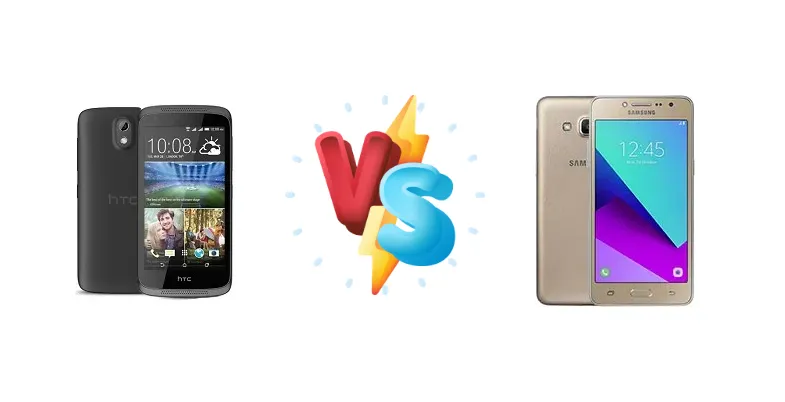
Both the HTC Desire 526G+ dual sim and the Samsung Galaxy Grand Prime Plus represent entry-level Android options, often found at similar price points. However, they take distinctly different approaches to achieving affordability. The Desire 526G+ boasts an octa-core processor, while the Grand Prime Plus relies on Mediatek’s MT6737T chipset. This comparison dives deep into the implications of these choices, helping you determine which device best suits your needs.
🏆 Quick Verdict
For the average user prioritizing efficiency and consistent performance, the Samsung Galaxy Grand Prime Plus is the better choice. While the HTC Desire 526G+’s octa-core CPU sounds impressive on paper, the Mediatek MT6737T’s Cortex-A53 cores and 28nm process offer a more refined and power-efficient experience, leading to better sustained performance.
| Network |
|---|
| 2G bands | GSM 850 / 900 / 1800 / 1900 - SIM 1 & SIM 2 | GSM 850 / 900 / 1800 / 1900 - SIM 1 & SIM 2 |
| 3G bands | HSDPA 900 / 2100 | HSDPA 850 / 900 / 1900 / 2100 |
| 4G bands | - | 1, 3, 5, 7, 8, 20 |
| Speed | HSPA 21.1/5.76 Mbps | HSPA 42.2/5.76 Mbps, LTE Cat4 150/50 Mbps |
| Technology | GSM / HSPA | GSM / HSPA / LTE |
| Launch |
|---|
| Announced | 2015, January. Released 2015, January | 2016, November. Released 2016, November |
| Status | Discontinued | Discontinued |
| Body |
|---|
| Build | - | Glass front, plastic back, plastic frame |
| Dimensions | 139.8 x 69.8 x 9.9 mm (5.50 x 2.75 x 0.39 in) | 144.8 x 72.1 x 8.9 mm (5.70 x 2.84 x 0.35 in) |
| SIM | Dual SIM (Micro-SIM, dual stand-by) | Hybrid Dual SIM (Micro-SIM, dual stand-by) |
| Weight | 154 g (5.43 oz) | 160 g (5.64 oz) |
| Display |
|---|
| Resolution | 540 x 960 pixels, 16:9 ratio (~234 ppi density) | 540 x 960 pixels, 16:9 ratio (~220 ppi density) |
| Size | 4.7 inches, 60.9 cm2 (~62.4% screen-to-body ratio) | 5.0 inches, 68.9 cm2 (~66.0% screen-to-body ratio) |
| Type | IPS LCD, | PLS LCD |
| Platform |
|---|
| CPU | Octa-core 1.7 GHz - 526G+ modelQuad-core 1.3 GHz - 526G model | Quad-core 1.4 GHz Cortex-A53 |
| Chipset | - | Mediatek MT6737T (28 nm) |
| GPU | - | Mali-T720MP2 |
| OS | Android 4.4.2 (KitKat) | Android 6.0 (Marshmallow) |
| Memory |
|---|
| Card slot | microSDHC (dedicated slot) | microSDXC (uses shared SIM slot) |
| Internal | 8GB 1GB RAM, 16GB 1GB RAM | 8GB 1.5GB RAM, 16GB 1.5GB RAM |
| | - | eMMC 5.0 |
| Main Camera |
|---|
| Features | LED flash | LED flash |
| Single | 8 MP, f/2.2, AF | 8 MP, f/2.2, AF |
| Video | 1080p@30fps | 720p@30fps |
| Selfie camera |
|---|
| Features | - | LED flash |
| Single | 2 MP | 5 MP, f/2.2, 28mm (wide) |
| Video | 720p | - |
| Sound |
|---|
| 3.5mm jack | - | Yes |
| 35mm jack | Yes | Yes |
| Loudspeaker | Yes | Yes |
| Comms |
|---|
| Bluetooth | 4.0, A2DP, aptX | 4.2, A2DP, LE |
| NFC | No | No |
| Positioning | GPS | GPS, GLONASS |
| Radio | FM radio | FM radio, RDS, recording |
| USB | microUSB 2.0 | microUSB 2.0, OTG |
| WLAN | Wi-Fi 802.11 b/g/n, hotspot | Wi-Fi 802.11 b/g/n, Wi-Fi Direct |
| Features |
|---|
| Sensors | Accelerometer, proximity | Accelerometer, proximity |
| Battery |
|---|
| Music play | - | Up to 59 h |
| Stand-by | Up to 622 h (3G) | - |
| Talk time | Up to 15 h (3G) | Up to 12 h (3G) |
| Type | Li-Ion 2000 mAh, removable | Li-Ion 2600 mAh, removable |
| Misc |
|---|
| Colors | Glacier blue, Stealth black, Lacquer black, Fervor red - 526G+Glacier blue, Stealth black - 526G | Black, Gold, Silver |
| Models | Desire 526GPLUS dual, Desire 526G dual sim, Desire_526G_dual_sim, D526h | SM-G532F |
| Price | About 160 EUR | About 140 EUR |
| SAR EU | - | 0.53 W/kg (head) 1.27 W/kg (body) |
HTC Desire 526G+ dual sim
- Potentially better multitasking with octa-core CPU (depending on model)
- Dual SIM functionality for convenient use of two networks
- May be available at a slightly lower price point
- Octa-core CPU may suffer from throttling due to less efficient process node
- Likely less consistent performance compared to the Grand Prime Plus
- Potentially shorter battery life
Samsung Galaxy Grand Prime Plus
- More efficient Mediatek MT6737T chipset
- Better sustained performance due to 28nm process node
- Likely longer battery life
- Samsung’s image processing may improve camera quality
- Quad-core CPU may struggle with heavy multitasking
- May be slightly more expensive than the Desire 526G+
- Basic camera performance
Display Comparison
Neither device is expected to deliver a premium display experience. Specifics regarding panel type (IPS, TFT) and resolution are missing, but given the price bracket, both likely utilize lower-resolution TFT panels. The focus here isn't on visual fidelity, but rather basic usability. Bezels are likely substantial on both, maximizing screen real estate within a compact form factor. Color accuracy and brightness are expected to be average at best.
Camera Comparison
Camera performance on both devices will be basic. Details are sparse, but both are likely to feature a primary camera around 8MP. The Samsung Galaxy Grand Prime Plus may have a slight advantage due to Samsung’s image processing algorithms, which often deliver more pleasing results even with lower-end sensors. The presence of a 2MP macro camera on either device is largely marketing fluff; its limited resolution provides minimal detail. Expect acceptable photos in good lighting conditions, but struggles in low light.
Performance
The core difference lies in the CPU architecture. The HTC Desire 526G+ offers two CPU configurations: a 1.7 GHz octa-core version and a 1.3 GHz quad-core version. The octa-core configuration *could* offer a theoretical advantage in multi-threaded tasks, but the Mediatek MT6737T’s quad-core Cortex-A53 cores, built on a 28nm process, are more efficient. The 28nm process node is crucial; it allows for lower power consumption and reduced heat generation compared to potentially older, larger process nodes used in the Desire 526G+. This translates to less throttling under sustained load, giving the Grand Prime Plus an edge in consistent performance. RAM details are missing for both, but likely hover around 1-2GB, further limiting multitasking capabilities.
Battery Life
Battery capacity is not specified for either device. However, the Mediatek MT6737T’s power efficiency gives the Samsung Galaxy Grand Prime Plus a significant advantage. The 28nm process node consumes less power than the likely larger process node used in the Desire 526G+’s octa-core processor. This translates to longer battery life and potentially faster charging times, even with a similar battery capacity. Expect both phones to require daily charging with moderate use.
Buying Guide
Buy the HTC Desire 526G+ dual sim if you prioritize the *potential* for multitasking and are willing to accept occasional slowdowns. The octa-core processor might handle more apps open simultaneously, though real-world performance will vary. Buy the Samsung Galaxy Grand Prime Plus if you prefer a smoother, more consistent user experience, especially for everyday tasks like browsing, social media, and light gaming. Its Mediatek chipset is optimized for efficiency, resulting in better battery life and less lag.
Frequently Asked Questions
❓ Does the HTC Desire 526G+’s octa-core processor actually make a noticeable difference in everyday use?
While an octa-core processor sounds impressive, the specific implementation and the underlying process node are crucial. In this case, the Mediatek MT6737T’s Cortex-A53 cores, built on a 28nm process, are likely to provide a smoother and more consistent experience for typical tasks like browsing and social media. The Desire 526G+ may show benefits in heavily multi-threaded applications, but these are unlikely to be common on these devices.
❓ Is the Samsung Galaxy Grand Prime Plus a good choice for mobile gaming?
The Samsung Galaxy Grand Prime Plus is suitable for *light* mobile gaming. The Mediatek MT6737T can handle less demanding titles, but don’t expect to run graphically intensive games at high settings. Frame rates will likely be limited, and you may experience some lag. It’s best suited for casual gaming rather than competitive or demanding titles.
❓ Which phone is better for taking quick photos of documents?
Both phones will struggle with document scanning due to their low-resolution cameras and lack of dedicated document scanning features. However, the Samsung Galaxy Grand Prime Plus’s image processing might offer slightly sharper results, making it marginally better for this purpose, provided there is ample lighting.