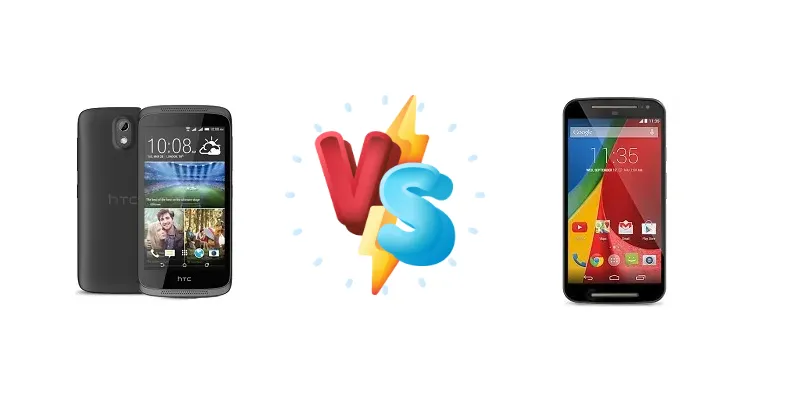
Released in similar timeframes and targeting the budget-conscious consumer, the HTC Desire 526G+ dual sim and the Motorola Moto G (2nd gen) represent distinct approaches to affordable Android. The Desire 526G+ boasts an octa-core processor, while the Moto G relies on Qualcomm’s Snapdragon 400. This comparison dissects these key differences and determines which device delivers the best overall experience.
🏆 Quick Verdict
For the average user prioritizing consistent performance and a refined software experience, the Motorola Moto G (2nd gen) is the better choice. While the HTC Desire 526G+’s octa-core CPU appears impressive on paper, the Snapdragon 400’s optimized architecture and Motorola’s near-stock Android provide a smoother, more reliable daily experience.
| Network |
|---|
| 2G bands | GSM 850 / 900 / 1800 / 1900 - SIM 1 & SIM 2 | GSM 850 / 900 / 1800 / 1900 |
| 3G bands | HSDPA 900 / 2100 | HSDPA 850 / 900 / 1900 / 2100 - Global model |
| Speed | HSPA 21.1/5.76 Mbps | HSPA 21.1/5.76 Mbps |
| Technology | GSM / HSPA | GSM / HSPA |
| | - | HSDPA 850 / 1700 / 1900 / 2100 - USA model |
| Launch |
|---|
| Announced | 2015, January. Released 2015, January | 2014, September. Released 2014, September |
| Status | Discontinued | Discontinued |
| Body |
|---|
| Dimensions | 139.8 x 69.8 x 9.9 mm (5.50 x 2.75 x 0.39 in) | 141.5 x 70.7 x 11 mm (5.57 x 2.78 x 0.43 in) |
| SIM | Dual SIM (Micro-SIM, dual stand-by) | Micro-SIM |
| Weight | 154 g (5.43 oz) | 149 g (5.26 oz) |
| Display |
|---|
| Protection | - | Corning Gorilla Glass 3 |
| Resolution | 540 x 960 pixels, 16:9 ratio (~234 ppi density) | 720 x 1280 pixels, 16:9 ratio (~294 ppi density) |
| Size | 4.7 inches, 60.9 cm2 (~62.4% screen-to-body ratio) | 5.0 inches, 68.9 cm2 (~68.9% screen-to-body ratio) |
| Type | IPS LCD, | IPS LCD |
| Platform |
|---|
| CPU | Octa-core 1.7 GHz - 526G+ modelQuad-core 1.3 GHz - 526G model | Quad-core 1.2 GHz Cortex-A7 |
| Chipset | - | Qualcomm MSM8226 Snapdragon 400 (28 nm) |
| GPU | - | Adreno 305 |
| OS | Android 4.4.2 (KitKat) | Android 4.4.4 (KitKat), upgradable to 6.0 (Marshmallow) |
| Memory |
|---|
| Card slot | microSDHC (dedicated slot) | microSDHC (dedicated slot) |
| Internal | 8GB 1GB RAM, 16GB 1GB RAM | 8GB 1GB RAM |
| | - | eMMC 4.5 |
| Main Camera |
|---|
| Features | LED flash | LED flash, HDR, panorama |
| Single | 8 MP, f/2.2, AF | 8 MP, f/2.0, AF |
| Video | 1080p@30fps | 720p@30fps, stereo sound rec., HDR |
| Selfie camera |
|---|
| Single | 2 MP | 2 MP, f/2.2 |
| Video | 720p | - |
| Sound |
|---|
| 3.5mm jack | - | Yes |
| 35mm jack | Yes | Yes |
| Loudspeaker | Yes | Yes, with stereo speakers |
| Comms |
|---|
| Bluetooth | 4.0, A2DP, aptX | 4.0, A2DP, LE, aptX |
| NFC | No | No |
| Positioning | GPS | GPS, GLONASS |
| Radio | FM radio | FM radio |
| USB | microUSB 2.0 | microUSB 2.0, OTG |
| WLAN | Wi-Fi 802.11 b/g/n, hotspot | Wi-Fi 802.11 b/g/n, hotspot |
| Features |
|---|
| Sensors | Accelerometer, proximity | Accelerometer, gyro, proximity, compass |
| | - | Digital TV (DS DTV 16GB model only) |
| Battery |
|---|
| Stand-by | Up to 622 h (3G) | - |
| Talk time | Up to 15 h (3G) | - |
| Type | Li-Ion 2000 mAh, removable | Li-Ion 2070 mAh, non-removable |
| Misc |
|---|
| Colors | Glacier blue, Stealth black, Lacquer black, Fervor red - 526G+Glacier blue, Stealth black - 526G | White, Black |
| Models | Desire 526GPLUS dual, Desire 526G dual sim, Desire_526G_dual_sim, D526h | XT1068, XT1063, XT1064, XT1069, XT1077 |
| Price | About 160 EUR | About 160 EUR |
| Tests |
|---|
| Audio quality | - |
Noise -91.6dB / Crosstalk -91.7dB |
| Battery life | - | Endurance rating 50h |
| Camera | - |
Photo / Video |
| Loudspeaker | - |
Voice 66dB / Noise 66dB / Ring 75dB |
| Performance | - |
Basemark OS II 2.0: 497Basemark X: 3142 |
HTC Desire 526G+ dual sim
- Potentially better multitasking with octa-core processor (depending on model)
- Dual SIM functionality for users needing multiple numbers
- May offer more storage options (specification not provided)
- Octa-core processor may suffer from thermal throttling
- Likely less optimized software experience
- Unknown RAM specification
Motorola Moto G (2nd gen)
- Qualcomm Snapdragon 400 offers efficient performance
- Near-stock Android provides a clean and responsive experience
- Reliable battery life with 50-hour endurance rating
- Quad-core processor may struggle with demanding tasks
- Camera performance is likely basic
- No dual SIM support
Display Comparison
Neither device boasts a standout display. Context data lacks specifics on panel type or resolution, suggesting both utilize standard LCD panels common in this price bracket. The absence of information regarding brightness levels or color accuracy implies neither phone excels in outdoor visibility or color reproduction. Bezels are likely substantial on both, reflecting the design trends of the time. The focus here isn't on visual fidelity, but on basic functionality.
Camera Comparison
Both devices offer basic photo and video capabilities, but lack detailed specifications. Without knowing sensor sizes, apertures, or image processing algorithms, a direct comparison is difficult. However, given the budget nature of both phones, image quality is likely comparable – adequate for casual snapshots in good lighting conditions, but struggling in low light. The absence of Optical Image Stabilization (OIS) on either device further limits low-light performance. The focus here is on functionality, not photographic excellence.
Performance
The core difference lies in the CPU. The HTC Desire 526G+ offers an octa-core 1.7 GHz processor (or a quad-core 1.3 GHz variant, depending on the model), while the Motorola Moto G (2nd gen) features a quad-core 1.2 GHz Qualcomm Snapdragon 400. While the 526G+ has more cores, the Snapdragon 400 benefits from Qualcomm’s architectural optimizations and a 28nm manufacturing process. This means the Snapdragon 400 is likely more efficient and delivers smoother performance in real-world scenarios, despite having fewer cores. The Moto G’s chipset also includes an Adreno 305 GPU, providing a more consistent gaming experience than the likely Mali GPU found in the 526G+. The Moto G’s LPDDR2 RAM is standard for the time, and the 526G+’s RAM specification is unknown, but likely similar.
Battery Life
Both the HTC Desire 526G+ and Motorola Moto G (2nd gen) share an endurance rating of 50 hours, suggesting similar battery life. This rating considers typical usage patterns, including calls, web browsing, and multimedia consumption. While the actual mAh capacity of each device is unknown, the Snapdragon 400’s efficiency likely contributes to comparable real-world battery performance despite the 526G+'s octa-core processor potentially consuming more power. Charging speeds are also unspecified, but likely slow by modern standards.
Buying Guide
Buy the HTC Desire 526G+ dual sim if you absolutely need dual SIM functionality and believe the octa-core processor will significantly benefit your specific workload, such as multitasking with numerous apps simultaneously. Buy the Motorola Moto G (2nd gen) if you prioritize a stable, user-friendly software experience, reliable performance for everyday tasks, and a generally more polished overall package. The Moto G is ideal for users who value simplicity and longevity.
Frequently Asked Questions
❓ Does the HTC Desire 526G+’s octa-core processor actually make a noticeable difference in everyday use?
While the octa-core processor sounds impressive, the Snapdragon 400 in the Moto G is more efficiently designed. In most common tasks like browsing, social media, and messaging, you likely won't perceive a significant difference. The 526G+ might show an advantage in heavily multi-tasking scenarios, but this is offset by potential thermal throttling and software optimization issues.
❓ Is the Motorola Moto G (2nd gen) still a viable option in today's market, considering its age?
While it's an older device, the Moto G (2nd gen)'s strengths – a clean software experience, reliable performance for basic tasks, and decent battery life – still hold up. However, it lacks modern features like 4G LTE in some regions and will not receive further software updates. It's best suited for users on a very tight budget or those who prioritize simplicity over cutting-edge features.
❓ Which phone is better for playing casual mobile games?
The Motorola Moto G (2nd gen) is likely the better choice for casual gaming. The Adreno 305 GPU provides a more consistent and stable gaming experience compared to the likely Mali GPU in the HTC Desire 526G+. While neither phone is a gaming powerhouse, the Moto G will offer smoother frame rates and fewer stutters in less demanding titles.