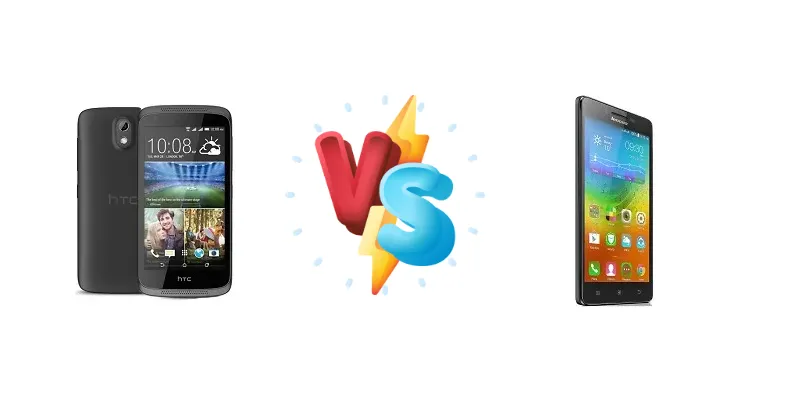
The HTC Desire 526G+ and Lenovo A6000 Plus represent a bygone era of ultra-affordable Android smartphones. Both devices aimed to deliver essential smartphone functionality at a minimal cost, but they took different approaches to achieving this. The Desire 526G+ boasts an octa-core processor, while the A6000 Plus relies on Qualcomm’s Snapdragon 410. This comparison dissects these key differences to determine which phone offers the best value today.
🏆 Quick Verdict
For the average user prioritizing efficiency and a smoother, more consistent experience, the Lenovo A6000 Plus emerges as the better choice. While the HTC Desire 526G+’s octa-core CPU sounds impressive on paper, the Snapdragon 410’s optimized architecture and 28nm process deliver superior real-world performance and battery life in this price bracket.
| Network |
|---|
| 2G bands | GSM 850 / 900 / 1800 / 1900 - SIM 1 & SIM 2 | GSM 900 / 1800 / 1900 - SIM 1 & SIM 2 |
| 3G bands | HSDPA 900 / 2100 | HSDPA 2100 |
| 4G bands | - | 1, 3, 7, 20, 40 - Data only, no voice |
| Speed | HSPA 21.1/5.76 Mbps | HSPA, LTE Cat4 150/50 Mbps |
| Technology | GSM / HSPA | GSM / HSPA / LTE |
| Launch |
|---|
| Announced | 2015, January. Released 2015, January | 2015, April. Released 2015, April |
| Status | Discontinued | Discontinued |
| Body |
|---|
| Dimensions | 139.8 x 69.8 x 9.9 mm (5.50 x 2.75 x 0.39 in) | 141 x 70 x 8.2 mm (5.55 x 2.76 x 0.32 in) |
| SIM | Dual SIM (Micro-SIM, dual stand-by) | Dual SIM (Micro-SIM, dual stand-by) |
| Weight | 154 g (5.43 oz) | 128 g (4.52 oz) |
| Display |
|---|
| Resolution | 540 x 960 pixels, 16:9 ratio (~234 ppi density) | 720 x 1280 pixels, 16:9 ratio (~294 ppi density) |
| Size | 4.7 inches, 60.9 cm2 (~62.4% screen-to-body ratio) | 5.0 inches, 68.9 cm2 (~69.8% screen-to-body ratio) |
| Type | IPS LCD, | IPS LCD |
| Platform |
|---|
| CPU | Octa-core 1.7 GHz - 526G+ modelQuad-core 1.3 GHz - 526G model | Quad-core 1.2 GHz Cortex-A53 |
| Chipset | - | Qualcomm MSM8916 Snapdragon 410 (28 nm) |
| GPU | - | Adreno 306 |
| OS | Android 4.4.2 (KitKat) | Android 4.4.4 (KitKat), upgradable to 5.2 (Lollipop) |
| Memory |
|---|
| Card slot | microSDHC (dedicated slot) | microSDHC (dedicated slot) |
| Internal | 8GB 1GB RAM, 16GB 1GB RAM | 16GB 2GB RAM |
| | - | eMMC 4.5 |
| Main Camera |
|---|
| Features | LED flash | LED flash |
| Single | 8 MP, f/2.2, AF | 8 MP, f/2.2, AF |
| Video | 1080p@30fps | 720p@30fps |
| Selfie camera |
|---|
| Single | 2 MP | 2 MP |
| Video | 720p | - |
| Sound |
|---|
| 3.5mm jack | - | Yes |
| 35mm jack | Yes | Yes |
| Loudspeaker | Yes | Yes, with stereo speakers |
| Comms |
|---|
| Bluetooth | 4.0, A2DP, aptX | 4.0, A2DP |
| NFC | No | No |
| Positioning | GPS | GPS |
| Radio | FM radio | FM radio |
| USB | microUSB 2.0 | microUSB 2.0 |
| WLAN | Wi-Fi 802.11 b/g/n, hotspot | Wi-Fi 802.11 b/g/n, hotspot |
| Features |
|---|
| Sensors | Accelerometer, proximity | Accelerometer, proximity |
| Battery |
|---|
| Stand-by | Up to 622 h (3G) | Up to 264 h (2G) / Up to 264 h (3G) |
| Talk time | Up to 15 h (3G) | Up to 22 h (2G) / Up to 13 h (3G) |
| Type | Li-Ion 2000 mAh, removable | Li-Po 2300 mAh, removable |
| Misc |
|---|
| Colors | Glacier blue, Stealth black, Lacquer black, Fervor red - 526G+Glacier blue, Stealth black - 526G | Black, White, Yellow, Red |
| Models | Desire 526GPLUS dual, Desire 526G dual sim, Desire_526G_dual_sim, D526h | - |
| Price | About 160 EUR | About 110 EUR |
HTC Desire 526G+ dual sim
- Potentially higher peak performance in multi-threaded tasks.
- Octa-core CPU may appeal to some users.
- Dual SIM functionality.
- Likely suffers from thermal throttling under sustained load.
- Less power-efficient CPU.
- Potentially shorter battery life.
Lenovo A6000 Plus
- More power-efficient Snapdragon 410 chipset.
- Better sustained performance due to optimized architecture.
- Longer battery life.
- Qualcomm’s display optimization.
- Fewer CPU cores compared to the HTC Desire 526G+.
- Lower peak performance in specific multi-threaded scenarios.
- Basic camera capabilities.
Display Comparison
Neither device is known for its display prowess. Specific display specs (resolution, panel type) are unavailable, but given the price point, both likely feature 720p LCD panels. The focus here isn't on visual fidelity. The A6000 Plus benefits from Qualcomm’s display optimization within the Snapdragon 410, potentially leading to slightly better color calibration and power efficiency. Bezels are expected to be substantial on both devices, reflecting the design trends of the time.
Camera Comparison
Camera performance on both devices is expected to be basic. Details regarding sensor size and aperture are unavailable. However, given the market segment, both likely feature low-resolution primary sensors. The focus should not be on image quality, but rather on basic functionality. Image processing will likely be minimal on both, resulting in images that are acceptable in good lighting conditions but struggle in low light. The absence of Optical Image Stabilization (OIS) on either device further limits low-light capabilities.
Performance
The core difference lies in the CPU architecture. The HTC Desire 526G+ features an octa-core processor clocked at 1.7 GHz, but the specific architecture isn't specified (likely ARM Cortex-A53). The Lenovo A6000 Plus utilizes the Qualcomm MSM8916 Snapdragon 410, a quad-core 1.2 GHz Cortex-A53 chipset built on a 28nm process. Despite having fewer cores, the Snapdragon 410’s optimized architecture and smaller manufacturing node (28nm vs. potentially larger for the HTC) provide a significant advantage in power efficiency and sustained performance. The Snapdragon’s Adreno 306 GPU also offers a more consistent gaming experience than the GPU found in the 526G+. The 526G+’s octa-core setup may show a temporary burst in multi-threaded applications, but will likely throttle under sustained load.
Battery Life
Battery capacity details are missing for both devices. However, the Snapdragon 410’s superior power efficiency gives the Lenovo A6000 Plus a clear advantage in battery life. The 28nm process node allows the Snapdragon 410 to consume less power at a given workload compared to the HTC’s octa-core processor, which likely uses a larger process node. While charging wattage is unknown for both, the A6000 Plus’s more efficient chipset will translate to longer usage times between charges.
Buying Guide
Buy the HTC Desire 526G+ dual sim if you absolutely need the potential for peak performance in multi-threaded tasks, and are willing to accept potential thermal throttling and reduced battery life. Buy the Lenovo A6000 Plus if you prioritize a stable, efficient user experience, longer battery life, and a more refined software experience, even if it means sacrificing raw CPU clock speed.
Frequently Asked Questions
❓ Will the HTC Desire 526G+ handle demanding games like PUBG Mobile?
While the octa-core processor might suggest gaming capability, the GPU and potential for thermal throttling will likely result in a subpar experience. Expect low frame rates and frequent stuttering, even on low settings. The Lenovo A6000 Plus, with its Adreno 306 GPU, will offer a more stable, albeit still basic, gaming experience.
❓ Is the dual SIM functionality on the HTC Desire 526G+ reliable for frequent SIM swapping?
The dual SIM functionality on the HTC Desire 526G+ is generally reliable for basic dual SIM usage. However, frequent SIM swapping may introduce minor software glitches. The Lenovo A6000 Plus also offers dual SIM support with similar reliability.
❓ Does the Snapdragon 410 in the Lenovo A6000 Plus support 4G LTE connectivity?
Yes, the Qualcomm Snapdragon 410 does support 4G LTE connectivity, allowing for faster data speeds where available. This is a significant advantage over older devices that only support 3G networks.