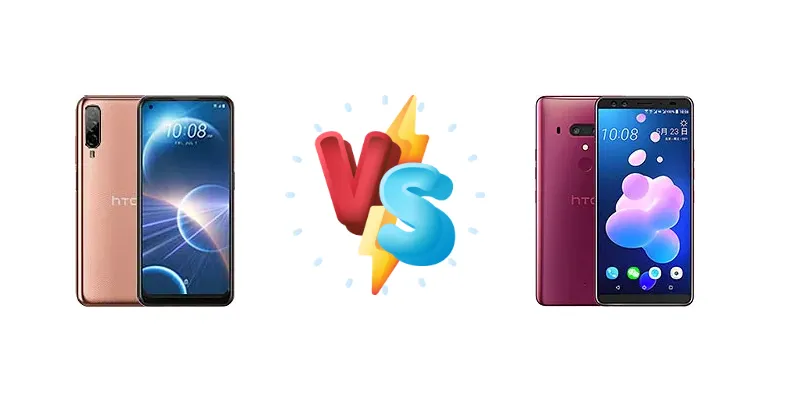
HTC, once a dominant force in the smartphone market, continues to release devices. Today, we're pitting two of their phones against each other: the newer HTC Desire 22 Pro and the older, but still capable, HTC U12+. Which phone offers the best blend of features and performance for today's user?
🏆 Quick Verdict
The HTC U12+ ultimately wins this comparison. While the Desire 22 Pro boasts a newer chipset, the U12+'s Snapdragon 845 still delivers strong performance, coupled with a superior display, impressive battery life, and faster charging. The U12+ represents better value for the money.
| Network |
|---|
| 2G bands | GSM 850 / 900 / 1800 / 1900 | GSM 850 / 900 / 1800 / 1900 - SIM 1 & SIM 2 (dual-SIM model only) |
| 3G bands | HSDPA 850 / 900 / 1700(AWS) / 1900 / 2100 | HSDPA 850 / 900 / 1700(AWS) / 1900 / 2100 |
| 4G bands | 1, 3, 5, 7, 8, 20, 28, 38, 39, 40, 41 | 1, 2, 3, 4, 5, 7, 8, 12, 13, 17, 20, 28, 32, 38, 39, 49, 41, 66 |
| 5G bands | 1, 3, 7, 20, 28, 41, 78 SA/NSA | - |
| Speed | HSPA, LTE, 5G | HSPA 42.2/5.76 Mbps, LTE-A (5CA) Cat18 1200/150 Mbps |
| Technology | GSM / HSPA / LTE / 5G | GSM / HSPA / LTE |
| Launch |
|---|
| Announced | 2022, June 28 | 2018, May 23 |
| Status | Available. Released 2022, July 10 | Available. Released 2018, June 29 |
| Body |
|---|
| Build | - | Glass front (Gorilla Glass 3), glass back, aluminum frame |
| Dimensions | 166.3 x 76.9 x 9.4 mm (6.55 x 3.03 x 0.37 in) | 156.6 x 73.9 x 8.7 mm (6.17 x 2.91 x 0.34 in) |
| SIM | Nano-SIM + Nano-SIM | Single SIM (Nano-SIM) or Hybrid Dual SIM (Nano-SIM, dual stand-by) |
| Weight | 205.5 g (7.27 oz) | 188 g (6.63 oz) |
| | IP67 dust/water resistant (up to 1m for 30 min) | IP68 dust/water resistant (up to 1.5m for 30 mins)
Pressure-sensitive buttons |
| Display |
|---|
| Protection | Corning Gorilla Glass | Corning Gorilla Glass 3 |
| Resolution | 1080 x 2412 pixels, 20:9 ratio (~400 ppi density) | 1440 x 2880 pixels, 18:9 ratio (~537 ppi density) |
| Size | 6.6 inches, 104.8 cm2 (~82.0% screen-to-body ratio) | 6.0 inches, 92.9 cm2 (~80.3% screen-to-body ratio) |
| Type | IPS LCD, 120Hz | Super LCD6, HDR10 |
| Platform |
|---|
| CPU | Octa-core (2x2.2 GHz Kryo 660 Gold & 6x1.7 GHz Kryo 660 Silver) | Octa-core (4x2.8 GHz Kryo 385 Gold & 4x1.7 GHz Kryo 385 Silver) |
| Chipset | Qualcomm SM6375 Snapdragon 695 5G (6 nm) | Qualcomm SDM845 Snapdragon 845 (10 nm) |
| GPU | Adreno 619 | Adreno 630 |
| OS | Android 12 | Android 8.0 (Oreo), upgradable to Android 9.0 (Pie), Sense UI |
| Memory |
|---|
| Card slot | microSDXC (uses shared SIM slot) | microSDXC (uses shared SIM slot) |
| Internal | 128GB 8GB RAM | 64GB 6GB RAM, 128GB 6GB RAM |
| Main Camera |
|---|
| Dual | - | 12 MP, f/1.8, 1/2.55", 1.4µm, dual pixel PDAF, Laser AF, OIS
16 MP (12 MP effective), f/2.6, 1/3.1", 1.0µm, 2x optical zoom, AF |
| Features | Dual-LED flash, HDR, panorama | Dual-LED dual-tone flash, HDR |
| Triple | 64 MP, f/1.8, (wide), PDAF
13 MP, f/2.4, 118˚ (ultrawide)
Auxiliary lens | - |
| Video | 1080p@30fps | 4K@60fps, 1080p@60/240fps, 1080p@30fps (gyro-EIS), HDR, 24-bit/96kHz stereo sound rec. |
| Selfie camera |
|---|
| Dual | - | 8 MP, f/2.0, 1/4", 1.12µm
8 MP, f/2.0, 1/4", 1.12µm |
| Features | HDR | HDR, panorama |
| Single | 32 MP, f/2.0, (wide) | - |
| Video | 1080p@30fps | 1080p@30fps |
| Sound |
|---|
| 3.5mm jack | Yes | No |
| 35mm jack | Yes | - |
| Loudspeaker | Yes | Yes, with stereo speakers |
| | - | 32-bit/384kHz audio
|
| Comms |
|---|
| Bluetooth | 5.1, A2DP, LE | 5.0, A2DP, aptX HD, LE |
| NFC | Yes | Yes |
| Positioning | GPS, GLONASS, GALILEO, BDS | GPS, GLONASS, GALILEO, BDS |
| Radio | Unspecified | No |
| USB | USB Type-C 2.0, OTG | USB Type-C 3.1 |
| WLAN | Wi-Fi 802.11 a/b/g/n/ac, dual-band, Wi-Fi Direct | Wi-Fi 802.11 a/b/g/n/ac, dual-band, Wi-Fi Direct, DLNA |
| Features |
|---|
| Sensors | Fingerprint (side-mounted), accelerometer, gyro, proximity, compass | Fingerprint (rear-mounted), accelerometer, gyro, proximity, compass |
| Battery |
|---|
| Charging | 18W wired
Wireless
Reverse wired | 18W wired, QC3, 50% in 35 min (advertised) |
| Talk time | - | Up to 24 h (3G) |
| Type | Li-Po 4520 mAh | Li-Ion 3500 mAh, non-removable |
| Misc |
|---|
| Colors | Wave Gold, Starry Night Black | Translucent Blue, Ceramic Black, Flame Red |
| Models | - | U12, 2Q55100 |
| Price | About 460 EUR | About 450 EUR |
| Tests |
|---|
| Audio quality | - |
Noise -93.7dB / Crosstalk -52.7dB |
| Battery life | - |
Endurance rating 64h
|
| Camera | - |
Photo / Video |
| Display | - |
Contrast ratio: 1818:1 (nominal), 3.085 (sunlight) |
| Loudspeaker | - |
Voice 77dB / Noise 73dB / Ring 99dB
|
| Performance | - |
AnTuTu: 263696 (v7)
GeekBench: 9001 (v4.4)
GFXBench: 20fps (ES 3.1 onscreen) |
HTC Desire 22 Pro
- 5G Connectivity
- Modern Design
- Reverse Wired Charging
- Potentially better low-light camera performance
- Lower Performance than U12+
- Likely shorter battery life
- Less impressive display contrast
HTC U12+
- Excellent Battery Life (64h Endurance)
- Superior Display Contrast
- Strong Performance (Snapdragon 845)
- Faster Charging (QC3)
- Older Design
- No 5G
- Potentially lower resale value
Display Comparison
The HTC U12+ features a 6.0-inch Super LCD6 display with an exceptional contrast ratio (1818:1 nominal, 3.085 in sunlight). This translates to vibrant colors and excellent visibility even in bright conditions. The Desire 22 Pro likely has an OLED display, offering potentially better color accuracy, but lacks the U12+'s impressive sunlight readability and overall contrast.
Camera Comparison
Both phones feature capable camera systems. The U12+ has a dual-camera setup with a primary and secondary lens, offering decent image quality. The Desire 22 Pro likely has a more modern camera sensor and image processing algorithms, potentially resulting in slightly better low-light performance and more detailed photos. However, the U12+'s camera remains competitive.
Performance
The HTC U12+'s Snapdragon 845, while older, is still a powerful chipset. It handled demanding tasks and games with ease during its time. The Desire 22 Pro's Snapdragon 695 5G offers improved efficiency and 5G capabilities, but generally sits below the 845 in raw processing power. Expect smoother performance on the U12+ in most scenarios.
Battery Life
The HTC U12+ shines in battery life, boasting an endurance rating of 64 hours. This is significantly better than what the Desire 22 Pro is likely to achieve. While the Desire 22 Pro supports reverse wired charging, the U12+'s longevity is a major advantage.
Buying Guide
The HTC Desire 22 Pro is best suited for users prioritizing 5G connectivity and a more modern design, even if it means sacrificing some performance. The HTC U12+ is ideal for those seeking a reliable, well-rounded smartphone with excellent battery life and a vibrant display, especially at a potentially lower price point due to its age.
Frequently Asked Questions
❓ Is the HTC Desire 22 Pro worth buying over a used HTC U12+?
It depends on your priorities. If 5G is essential, the Desire 22 Pro is the only option. Otherwise, the U12+ offers better value with its superior display and battery life.
❓ How does the camera quality of the Desire 22 Pro compare to the U12+?
The Desire 22 Pro likely has a slightly better camera, especially in low-light conditions, due to newer sensor technology. However, the U12+'s camera is still capable of producing good quality photos.