
Samsung Galaxy S21 Ultra 5G vs. HTC Desire 21 Pro 5G: A Comprehensive Comparison
| Phones Images | |||||
|---|---|---|---|---|---|
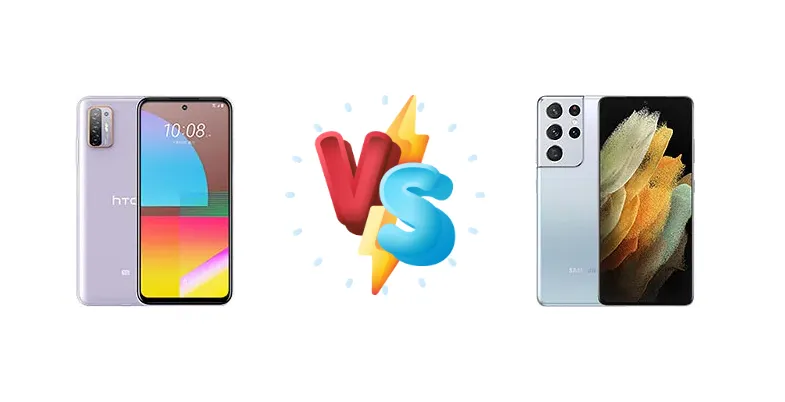
|
🏆 Quick Verdict
For most users, the Samsung Galaxy S21 Ultra 5G is the superior device, offering a dramatically better display, significantly more powerful processor, and a more versatile camera system. However, the HTC Desire 21 Pro 5G presents a compelling value proposition for those prioritizing 5G access and basic smartphone functionality on a tight budget.
| PHONES | ||
|---|---|---|
| Phone Names | HTC Desire 21 Pro 5G | Samsung Galaxy S21 Ultra 5G |
| Network | ||
|---|---|---|
| 2G bands | GSM 850 / 900 / 1800 / 1900 | GSM 850 / 900 / 1800 / 1900 |
| 3G bands | HSDPA 850 / 900 / 1700(AWS) / 1900 / 2100 | HSDPA 850 / 900 / 1700(AWS) / 1900 / 2100 |
| 4G bands | 1, 3, 5, 7, 8, 20, 28, 38, 39, 40, 41 | 1, 2, 3, 4, 5, 7, 8, 12, 13, 14, 18, 19, 20, 25, 26, 28, 30, 38, 39, 40, 41, 46, 48, 66, 71 - SM-G998U1 |
| 5G bands | 1, 3, 5, 7, 28, 41, 78 SA/NSA | 2, 5, 25, 41, 66, 71, 260, 261 SA/NSA/Sub6/mmWave - SM-G998U1 |
| Speed | HSPA, LTE, 5G | HSPA 42.2/5.76 Mbps, LTE (7CA) Cat20 2000/200 Mbps, 5G (5+ Gbps DL) |
| Technology | GSM / HSPA / LTE / 5G | GSM / CDMA / HSPA / EVDO / LTE / 5G |
| - | 1, 3, 5, 7, 8, 20, 28, 38, 40, 41, 66, 77, 78 SA/NSA/Sub6 - SM-G998B | |
| Launch | ||
|---|---|---|
| Announced | 2021, January 13 | 2021, January 14 |
| Status | Available. Released 2021, January 21 | Available. Released 2021, January 29 |
| Body | ||
|---|---|---|
| Build | - | Glass front (Gorilla Glass Victus), glass back (Gorilla Glass Victus), aluminum frame |
| Dimensions | 167.1 x 78.1 x 9.4 mm (6.58 x 3.07 x 0.37 in) | 165.1 x 75.6 x 8.9 mm (6.5 x 2.98 x 0.35 in) |
| SIM | Nano-SIM + Nano-SIM | · Nano-SIM + eSIM· Nano-SIM + Nano-SIM + eSIM (max 2 at a time) |
| Weight | 205 g (7.23 oz) | 227 g (Sub6), 229 g (mmWave) (8.01 oz) |
| - | IP68 dust/water resistant (up to 1.5m for 30 min) Stylus support | |
| Display | ||
|---|---|---|
| Protection | - | Corning Gorilla Glass Victus |
| Resolution | 1080 x 2400 pixels, 20:9 ratio (~393 ppi density) | 1440 x 3200 pixels, 20:9 ratio (~515 ppi density) |
| Size | 6.7 inches, 108.4 cm2 (~83.0% screen-to-body ratio) | 6.8 inches, 112.1 cm2 (~89.8% screen-to-body ratio) |
| Type | IPS LCD, HDR10, 90Hz | Dynamic AMOLED 2X, 120Hz, HDR10+, 1500 nits (peak) |
| - | Always-on display | |
| Platform | ||
|---|---|---|
| CPU | Octa-core (2x2.0 GHz Kryo 560 Gold & 6x1.7 GHz Kryo 560 Silver) | Octa-core (1x2.9 GHz Cortex-X1 & 3x2.80 GHz Cortex-A78 & 4x2.2 GHz Cortex-A55) - InternationalOcta-core (1x2.84 GHz Cortex-X1 & 3x2.42 GHz Cortex-A78 & 4x1.80 GHz Cortex-A55) - USA/China |
| Chipset | Qualcomm SM6350 Snapdragon 690 5G (8 nm) | Exynos 2100 (5 nm) - InternationalQualcomm SM8350 Snapdragon 888 5G (5 nm) - USA/China |
| GPU | Adreno 619 | Mali-G78 MP14 - InternationalAdreno 660 - USA/China |
| OS | Android 10 | Android 11, up to 4 major Android upgrades, One UI 6.1 |
| Memory | ||
|---|---|---|
| Card slot | microSDXC (uses shared SIM slot) | No |
| Internal | 128GB 8GB RAM | 128GB 8GB RAM, 128GB 12GB RAM, 256GB 12GB RAM, 256GB 16GB RAM, 512GB 12GB RAM, 512GB 16GB RAM |
| - | UFS 3.1 | |
| Main Camera | ||
|---|---|---|
| Features | Dual-LED flash, HDR, panorama | Laser AF, LED flash, auto-HDR, panorama |
| Quad | 48 MP, f/1.8, 26mm (wide), 1/2.0", 0.8µm, PDAF 8 MP, f/2.2, 118˚ (ultrawide) 2 MP (macro) Auxiliary lens | 108 MP, f/1.8, 24mm (wide), 1/1.33", 0.8µm, PDAF, OIS 10 MP, f/2.4, 72mm (telephoto), 1/3.24", 1.22µm, dual pixel PDAF, OIS, 3x optical zoom 10 MP, f/4.9, 240mm (periscope telephoto), 1/3.24", 1.22µm, dual pixel PDAF, OIS, 10x optical zoom 12 MP, f/2.2, 13mm (ultrawide), 1/2.55", 1.4µm, dual pixel PDAF, Super Steady video |
| Video | 4K@30fps, 1080p@30fps, gyro-EIS | 8K@24fps, 4K@30/60fps, 1080p@30/60/120/240fps, HDR10+, stereo sound rec., gyro-EIS |
| Selfie camera | ||
|---|---|---|
| Features | HDR | HDR |
| Single | 16 MP, (wide) | 40 MP, f/2.2, 26mm (wide), 1/2.8", 0.7µm, PDAF |
| Video | 1080p@30fps | 4K@30/60fps, 1080p@30fps |
| Sound | ||
|---|---|---|
| 3.5mm jack | No | No |
| 35mm jack | No | No |
| Loudspeaker | Yes | Yes, with stereo speakers |
| - | 32-bit/384kHz audio Tuned by AKG | |
| Comms | ||
|---|---|---|
| Bluetooth | 5.1, A2DP, LE | 5.2, A2DP, LE |
| NFC | Yes | Yes |
| Positioning | GPS, GLONASS, GALILEO, BDS | GPS, GLONASS, BDS, GALILEO |
| Radio | No | FM radio (Snapdragon model only; market/operator dependent) |
| USB | USB Type-C 2.0, OTG | USB Type-C 3.2, OTG |
| WLAN | Wi-Fi 802.11 a/b/g/n/ac, dual-band, Wi-Fi Direct | Wi-Fi 802.11 a/b/g/n/ac/6e, dual-band, Wi-Fi Direct |
| Features | ||
|---|---|---|
| Sensors | Fingerprint (side-mounted), accelerometer, gyro, proximity, compass | Fingerprint (under display, ultrasonic), accelerometer, gyro, proximity, compass, barometer |
| - | Samsung DeX, Samsung Wireless DeX (desktop experience support) Bixby natural language commands and dictation Samsung Pay (Visa, MasterCard certified) Ultra Wideband (UWB) support | |
| Battery | ||
|---|---|---|
| Charging | 18W wired, QC4 | 25W wired, PD3.0 15W wireless (Qi) 4.5W reverse wireless |
| Type | Li-Po 5000 mAh | Li-Ion 5000 mAh |
| Misc | ||
|---|---|---|
| Colors | Blue, Purple | Phantom Black, Phantom Silver, Phantom Titanium, Phantom Navy, Phantom Brown, Navy |
| Models | - | SM-G998B, SM-G998B/DS, SM-G998U, SM-G998U1, SM-G998W, SM-G998N, SM-G9980 |
| Price | About 350 EUR | $ 240.01 / C$ 353.20 / £ 202.99 / € 264.99 |
| SAR | - | 0.77 W/kg (head) 1.02 W/kg (body) |
| SAR EU | - | 0.71 W/kg (head) 1.58 W/kg (body) |
| Pricing | ||
|---|---|---|
| 128GB 12GB RAM | - | $ 384.99 |
| 256GB 12GB RAM | - | $ 998.00 |
| 512GB 12GB RAM | - | $ 1,179.99 |
| RENEWED | - | $ 459.00 |
| Tests | ||
|---|---|---|
| Battery life | - | Endurance rating 114h |
| Camera | - | Photo / Video |
| Display | - | Contrast ratio: Infinite (nominal) |
| Loudspeaker | - | -25.5 LUFS (Very good) |
| Performance | - | AnTuTu: 657150 (v8) GeekBench: 3518 (v5.1) GFXBench: 33fps (ES 3.1 onscreen) |
HTC Desire 21 Pro 5G
- Affordable 5G connectivity
- Decent battery life for basic use
- Functional smartphone experience
- Significantly weaker processor
- Inferior camera system
- Lower quality display
Samsung Galaxy S21 Ultra 5G
- Exceptional display quality and brightness
- Powerful processor for demanding tasks
- Versatile and high-quality camera system
- Fast and versatile charging options
- High price point
- Potential for thermal throttling under heavy load (Exynos variant)
- Large and heavy design
Display Comparison
The Samsung Galaxy S21 Ultra 5G features a demonstrably superior display, reaching a measured peak brightness of 1023 nits. This contrasts sharply with the likely lower brightness of the Desire 21 Pro 5G, typical for its price bracket. While the Desire 21 Pro 5G’s display specs are not provided, the S21 Ultra’s ‘Infinite’ contrast ratio suggests a VA-type panel, delivering deep blacks. The S21 Ultra likely utilizes an LTPO panel for adaptive refresh rates, conserving battery life, a feature absent in the Desire 21 Pro 5G.
Camera Comparison
The Samsung Galaxy S21 Ultra 5G’s camera system is in a different league. While both phones are listed as having 'Photo / Video' capabilities, the S21 Ultra’s sensor size, lens apertures, and image processing algorithms are far more advanced. The S21 Ultra’s camera system likely includes features like 8K video recording and advanced zoom capabilities. The Desire 21 Pro 5G likely relies on software processing to compensate for its less capable hardware. The presence of a 2MP macro camera on the Desire 21 Pro 5G is likely a marketing tactic, offering limited real-world benefit compared to the S21 Ultra’s more sophisticated camera setup.
Performance
The performance gap between these devices is substantial. The Samsung Galaxy S21 Ultra 5G, equipped with either the Exynos 2100 (international) or Snapdragon 888 5G (USA/China) built on a 5nm process, offers significantly more processing power than the HTC Desire 21 Pro 5G’s Snapdragon 690 5G (8nm). The S21 Ultra’s CPU configuration – a Cortex-X1 prime core alongside Cortex-A78 and A55 cores – provides a substantial advantage in both single-core and multi-core performance. The Snapdragon 690, while capable, is geared towards efficiency and mid-range tasks. The S21 Ultra’s LPDDR5 RAM (likely) further enhances performance compared to the Desire 21 Pro 5G’s RAM specification, which is not provided.
Battery Life
Both devices offer comparable endurance ratings, with the S21 Ultra achieving 114 hours. However, this doesn’t tell the whole story. The S21 Ultra’s 25W wired charging with PD3.0 and 15W wireless charging provide significantly faster and more versatile charging options than the Desire 21 Pro 5G’s 18W wired charging with QC4. The S21 Ultra also offers 4.5W reverse wireless charging, a feature absent on the Desire 21 Pro 5G. The S21 Ultra’s more efficient processor and potentially larger battery capacity contribute to its overall endurance despite the faster charging speeds.
Buying Guide
Buy the HTC Desire 21 Pro 5G if you need a functional 5G smartphone for essential tasks like calling, texting, and light social media use, and are unwilling to spend over $400. Buy the Samsung Galaxy S21 Ultra 5G if you demand a top-tier mobile experience with a stunning display, exceptional camera capabilities, and the processing power to handle demanding applications and games.