
HTC Desire 21 Pro 5G vs Motorola Edge+ 5G UW (2022): A Tale of Two Snapdragons
| Phones Images | |||||
|---|---|---|---|---|---|
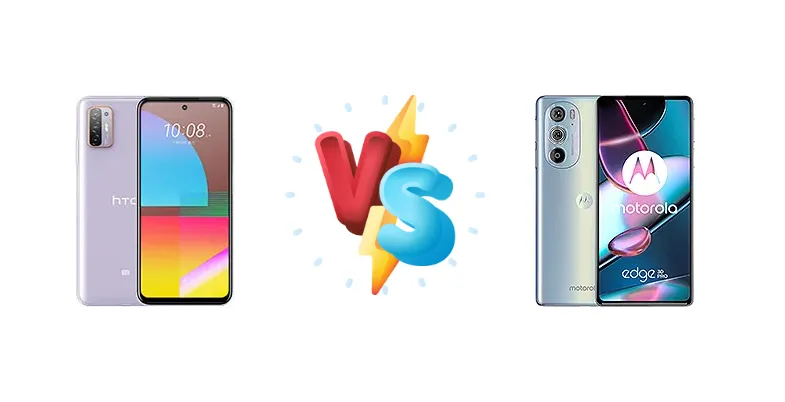
|
🏆 Quick Verdict
For the average user prioritizing raw performance and fast charging, the Motorola Edge+ 5G UW (2022) is the clear winner. Its Snapdragon 8 Gen 1 delivers a significantly smoother experience, especially in demanding tasks. However, the HTC Desire 21 Pro 5G offers a compelling value proposition for those on a tighter budget who don't need bleeding-edge speed.
| PHONES | ||
|---|---|---|
| Phone Names | HTC Desire 21 Pro 5G | Motorola Edge+ 5G UW (2022) |
| Network | ||
|---|---|---|
| 2G bands | GSM 850 / 900 / 1800 / 1900 | GSM 850 / 900 / 1800 / 1900 - SIM 1 & SIM 2 (Dual SIM model only) |
| 3G bands | HSDPA 850 / 900 / 1700(AWS) / 1900 / 2100 | HSDPA 850 / 900 / 1700(AWS) / 1900 / 2100 |
| 4G bands | 1, 3, 5, 7, 8, 20, 28, 38, 39, 40, 41 | 1, 2, 3, 4, 5, 7, 8, 12, 13, 14, 17, 20, 25, 26, 28, 29, 30, 38, 39, 40, 41, 46, 48, 66, 71 |
| 5G bands | 1, 3, 5, 7, 28, 41, 78 SA/NSA | 2, 5, 7, 12, 25, 26, 29, 30, 41, 48, 66, 71, 77, 78, 260, 261 SA/NSA/Sub6/mmWave - Verizon, USA |
| Speed | HSPA, LTE, 5G | HSPA 42.2/5.76 Mbps, LTE-A (CA) Cat20 2000/150 Mbps, 5G |
| Technology | GSM / HSPA / LTE / 5G | GSM / HSPA / LTE / 5G |
| Launch | ||
|---|---|---|
| Announced | 2021, January 13 | 2022, January 24 |
| Status | Available. Released 2021, January 21 | Available. Released 2022, March 24 |
| Body | ||
|---|---|---|
| Build | - | Glass front (Gorilla Glass 3), glass back (Gorilla Glass 5), plastic frame |
| Dimensions | 167.1 x 78.1 x 9.4 mm (6.58 x 3.07 x 0.37 in) | 163.1 x 76 x 8.8 mm (6.42 x 2.99 x 0.35 in) |
| SIM | Nano-SIM + Nano-SIM | Single SIM (Nano-SIM) or Dual SIM (Nano-SIM, dual stand-by) |
| Weight | 205 g (7.23 oz) | 196 g (6.91 oz) |
| - | Water-repellent design | |
| Display | ||
|---|---|---|
| Protection | - | Corning Gorilla Glass 3 |
| Resolution | 1080 x 2400 pixels, 20:9 ratio (~393 ppi density) | 1080 x 2400 pixels, 20:9 ratio (~393 ppi density) |
| Size | 6.7 inches, 108.4 cm2 (~83.0% screen-to-body ratio) | 6.7 inches, 108.4 cm2 (~87.4% screen-to-body ratio) |
| Type | IPS LCD, HDR10, 90Hz | OLED, 1B colors, 144Hz, HDR10+ |
| - | Always-on display | |
| Platform | ||
|---|---|---|
| CPU | Octa-core (2x2.0 GHz Kryo 560 Gold & 6x1.7 GHz Kryo 560 Silver) | Octa-core (1x3.00 GHz Cortex-X2 & 3x2.50 GHz Cortex-A710 & 4x1.80 GHz Cortex-A510) |
| Chipset | Qualcomm SM6350 Snapdragon 690 5G (8 nm) | Qualcomm SM8450 Snapdragon 8 Gen 1 (4 nm) |
| GPU | Adreno 619 | Adreno 730 |
| OS | Android 10 | Android 12, planned upgrade to Android 13 |
| Memory | ||
|---|---|---|
| Card slot | microSDXC (uses shared SIM slot) | No |
| Internal | 128GB 8GB RAM | 128GB 8GB RAM, 256GB 8GB RAM, 256GB 12GB RAM, 512GB 8GB RAM, 512GB 12GB RAM |
| - | UFS 3.1 | |
| Main Camera | ||
|---|---|---|
| Features | Dual-LED flash, HDR, panorama | Dual-LED dual-tone flash, HDR, panorama |
| Quad | 48 MP, f/1.8, 26mm (wide), 1/2.0", 0.8µm, PDAF 8 MP, f/2.2, 118˚ (ultrawide) 2 MP (macro) Auxiliary lens | - |
| Triple | - | 50 MP, f/1.8, (wide), 1/1.55", 1.0µm, multi-directional PDAF, OIS 50 MP, f/2.2, 114˚ (ultrawide), 1/2.76", 0.64µm, AF 2 MP, f/2.4, (depth) |
| Video | 4K@30fps, 1080p@30fps, gyro-EIS | 8K@24/30fps, 4K@30/60fps, 1080p@30/60/120/240/960fps, 10-bit HDR10+, gyro-EIS |
| Selfie camera | ||
|---|---|---|
| Features | HDR | HDR |
| Single | 16 MP, (wide) | 60 MP, f/2.2, (wide), 1/2.8", 0.61µm |
| Video | 1080p@30fps | 4K@30fps, 1080p@30/120fps |
| Sound | ||
|---|---|---|
| 3.5mm jack | No | No |
| 35mm jack | No | - |
| Loudspeaker | Yes | Yes, with stereo speakers |
| - | 24-bit/192kHz audio | |
| Comms | ||
|---|---|---|
| Bluetooth | 5.1, A2DP, LE | 5.2, A2DP, LE |
| NFC | Yes | Yes |
| Positioning | GPS, GLONASS, GALILEO, BDS | GPS (L1+L5), GLONASS, BDS, GALILEO |
| Radio | No | No |
| USB | USB Type-C 2.0, OTG | USB Type-C 3.1, DisplayPort 1.4 |
| WLAN | Wi-Fi 802.11 a/b/g/n/ac, dual-band, Wi-Fi Direct | Wi-Fi 802.11 a/b/g/n/ac/6e, dual-band, Wi-Fi Direct |
| Features | ||
|---|---|---|
| Sensors | Fingerprint (side-mounted), accelerometer, gyro, proximity, compass | Fingerprint (side-mounted), accelerometer, gyro, proximity, compass, barometer |
| - | Ready For support | |
| Battery | ||
|---|---|---|
| Charging | 18W wired, QC4 | 68W wired, 50% in 15 min, 100% in 35 min (advertised) 15W wireless 5W reverse wireless |
| Type | Li-Po 5000 mAh | Li-Po 4800 mAh, non-removable |
| Misc | ||
|---|---|---|
| Colors | Blue, Purple | Cosmos Blue, Stardust White |
| Price | About 350 EUR | About 850 EUR |
HTC Desire 21 Pro 5G
- Significantly more affordable
- 5G connectivity at a lower price point
- Acceptable performance for basic tasks
- Substantially slower performance than the Edge+
- Slow 18W charging
- Likely inferior camera quality
Motorola Edge+ 5G UW (2022)
- Flagship-level performance with Snapdragon 8 Gen 1
- Ultra-fast 68W wired charging
- Wireless and reverse wireless charging
- Considerably more expensive
- Snapdragon 8 Gen 1 can generate heat under load
- May be overkill for basic smartphone users
Display Comparison
While specific display specs like resolution and refresh rate aren't provided for the Desire 21 Pro 5G, it's likely a 1080p LCD panel typical of its price range. The Edge+ 5G UW (2022) is expected to have a higher quality OLED display. The key differentiator here is likely color accuracy and peak brightness, where the Edge+ will excel. The Snapdragon 8 Gen 1's ISP also supports more advanced display processing, potentially leading to better HDR performance on the Motorola device.
Camera Comparison
Without detailed camera specs, a direct comparison is difficult. However, the Motorola Edge+ 5G UW (2022), being a flagship, likely features a larger main sensor with optical image stabilization (OIS) and more sophisticated image processing algorithms powered by the Snapdragon 8 Gen 1's ISP. This will result in better low-light performance, dynamic range, and overall image quality. The Desire 21 Pro 5G will likely offer a serviceable camera for casual photography, but won't compete with the Edge+ in terms of detail and clarity.
Performance
The performance gap between the Snapdragon 690 and the Snapdragon 8 Gen 1 is substantial. The 8 Gen 1, built on a 4nm process, features a Cortex-X2 prime core clocked at 3.00 GHz, alongside Cortex-A710 and A510 cores, offering significantly higher single-core and multi-core performance than the 690's Kryo 560 cores. This translates to faster app loading times, smoother multitasking, and a far superior gaming experience on the Motorola Edge+. The 4nm node also contributes to better thermal efficiency, though the 8 Gen 1 is known to generate heat under sustained load. The Desire 21 Pro 5G will handle everyday tasks adequately, but will struggle with demanding applications.
Battery Life
The Motorola Edge+ 5G UW (2022) boasts a significant advantage in charging speed with its 68W wired charging, capable of reaching 100% in approximately 35 minutes. The HTC Desire 21 Pro 5G's 18W charging is considerably slower. While battery capacity isn't specified for either device, the faster charging of the Motorola device mitigates any potential disadvantage from a smaller battery size. The Edge+ also includes 15W wireless and 5W reverse wireless charging, features absent on the Desire 21 Pro 5G.
Buying Guide
Buy the HTC Desire 21 Pro 5G if you need a functional 5G smartphone for basic tasks like browsing, social media, and light gaming, and prioritize affordability above all else. Buy the Motorola Edge+ 5G UW (2022) if you demand the fastest possible performance for gaming, video editing, or multitasking, and are willing to pay a premium for it, along with the benefits of significantly faster charging speeds.