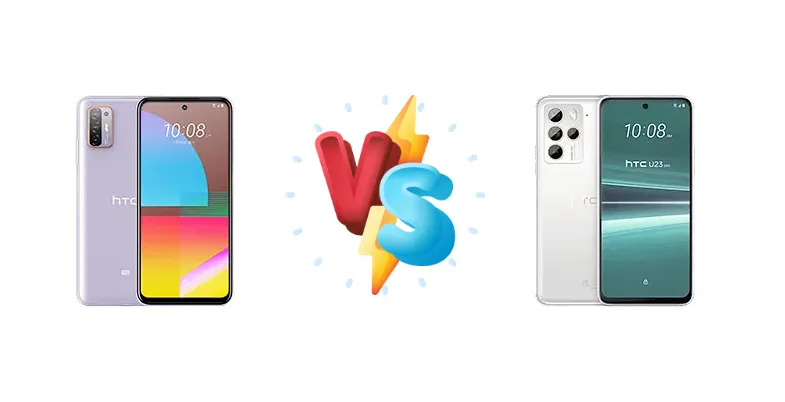
HTC has released both the Desire 21 Pro 5G and the U23 Pro, catering to different segments of the smartphone market. The Desire 21 Pro 5G represents a more budget-conscious approach, while the U23 Pro aims for a more balanced experience with a newer chipset and enhanced features. This comparison dissects the key differences to help you determine which device best suits your needs.
🏆 Quick Verdict
For the average user, the HTC U23 Pro is the clear winner. Its Snapdragon 7 Gen 1 chipset delivers significantly improved performance and efficiency compared to the Desire 21 Pro 5G’s Snapdragon 690. While the Desire 21 Pro 5G offers a lower entry price, the U23 Pro’s superior processing power, faster charging, and brighter display justify the price difference.
| Network |
|---|
| 2G bands | GSM 850 / 900 / 1800 / 1900 | GSM 850 / 900 / 1800 / 1900 |
| 3G bands | HSDPA 850 / 900 / 1700(AWS) / 1900 / 2100 | HSDPA 850 / 900 / 1700(AWS) / 1900 / 2100 |
| 4G bands | 1, 3, 5, 7, 8, 20, 28, 38, 39, 40, 41 | 1, 3, 5, 7, 8, 12, 17, 20, 28, 38, 39, 40, 41 |
| 5G bands | 1, 3, 5, 7, 28, 41, 78 SA/NSA | 1, 3, 7, 20, 28, 41, 78 SA/NSA |
| Speed | HSPA, LTE, 5G | HSPA, LTE, 5G |
| Technology | GSM / HSPA / LTE / 5G | GSM / HSPA / LTE / 5G |
| Launch |
|---|
| Announced | 2021, January 13 | 2023, May 18 |
| Status | Available. Released 2021, January 21 | Available. Released 2023, May 18 |
| Body |
|---|
| Build | - | Glass front (Gorilla Glass Victus), plastic frame, plastic back |
| Dimensions | 167.1 x 78.1 x 9.4 mm (6.58 x 3.07 x 0.37 in) | 166.6 x 77.1 x 8.9 mm (6.56 x 3.04 x 0.35 in) |
| SIM | Nano-SIM + Nano-SIM | Nano-SIM + Nano-SIM |
| Weight | 205 g (7.23 oz) | 205 g (7.23 oz) |
| | - | IP67 dust/water resistant (up to 1m for 30 min) |
| Display |
|---|
| Protection | - | Corning Gorilla Glass Victus |
| Resolution | 1080 x 2400 pixels, 20:9 ratio (~393 ppi density) | 1080 x 2400 pixels, 20:9 ratio (~393 ppi density) |
| Size | 6.7 inches, 108.4 cm2 (~83.0% screen-to-body ratio) | 6.7 inches, 108.4 cm2 (~84.4% screen-to-body ratio) |
| Type | IPS LCD, HDR10, 90Hz | OLED, 120Hz |
| Platform |
|---|
| CPU | Octa-core (2x2.0 GHz Kryo 560 Gold & 6x1.7 GHz Kryo 560 Silver) | Octa-core (1x2.4 GHz Cortex-A710 & 3x2.36 GHz Cortex-A710 & 4x1.8 GHz Cortex-A510) |
| Chipset | Qualcomm SM6350 Snapdragon 690 5G (8 nm) | Qualcomm SM7450-AB Snapdragon 7 Gen 1 (4 nm) |
| GPU | Adreno 619 | Adreno 644 |
| OS | Android 10 | Android 13 |
| Memory |
|---|
| Card slot | microSDXC (uses shared SIM slot) | microSDXC |
| Internal | 128GB 8GB RAM | 256GB 8GB RAM, 256GB 12GB RAM |
| Main Camera |
|---|
| Features | Dual-LED flash, HDR, panorama | Dual-LED flash, HDR, panorama |
| Quad | 48 MP, f/1.8, 26mm (wide), 1/2.0", 0.8µm, PDAF
8 MP, f/2.2, 118˚ (ultrawide)
2 MP (macro)
Auxiliary lens | 108 MP, f/1.7, (wide), 1/1.67", 0.64μm, PDAF, OIS
8 MP, f/2.4, 120˚ (ultrawide), 1/4.0", 1.12µm
5 MP (macro)
Auxiliary lens |
| Video | 4K@30fps, 1080p@30fps, gyro-EIS | 4K@30fps, 1080p@30fps, gyro-EIS |
| Selfie camera |
|---|
| Features | HDR | HDR |
| Single | 16 MP, (wide) | 32 MP, f/2.5, (wide), 1/3.2", 0.7µm |
| Video | 1080p@30fps | 1080p@30fps |
| Sound |
|---|
| 3.5mm jack | No | Yes |
| 35mm jack | No | Yes |
| Loudspeaker | Yes | Yes |
| Comms |
|---|
| Bluetooth | 5.1, A2DP, LE | 5.2, A2DP, LE |
| NFC | Yes | Yes |
| Positioning | GPS, GLONASS, GALILEO, BDS | GPS, GLONASS, GALILEO, BDS |
| Radio | No | No |
| USB | USB Type-C 2.0, OTG | USB Type-C 3.0 |
| WLAN | Wi-Fi 802.11 a/b/g/n/ac, dual-band, Wi-Fi Direct | Wi-Fi 802.11 a/b/g/n/ac/6, dual-band |
| Features |
|---|
| Sensors | Fingerprint (side-mounted), accelerometer, gyro, proximity, compass | Fingerprint (side-mounted), accelerometer, gyro, proximity, compass |
| Battery |
|---|
| Charging | 18W wired, QC4 | 30W wired
15W wireless
5W reverse wireless
Reverse wired |
| Type | Li-Po 5000 mAh | Li-Ion 4600 mAh |
| Misc |
|---|
| Colors | Blue, Purple | Snow White, Coffee Black |
| Models | - | 2QC9200, 2QC9100, 2QCB100 |
| Price | About 350 EUR | About 220 EUR |
HTC Desire 21 Pro 5G
- More affordable price point
- Supports 5G connectivity
- Quick Charge 4.0 support
- Older Snapdragon 690 chipset
- Slower 18W charging
- Likely lower camera performance
HTC U23 Pro
- Significantly faster Snapdragon 7 Gen 1
- Brighter display (727 nits)
- 30W wired, 15W wireless, and 5W reverse wireless charging
- Higher price tag
- Camera specs are not fully detailed
- May not be available in all markets
Display Comparison
The HTC U23 Pro boasts a significantly brighter display, reaching a measured 727 nits, compared to an unspecified brightness for the Desire 21 Pro 5G. This higher peak brightness translates to better visibility outdoors under direct sunlight. While both likely utilize LCD panels given the price points, the U23 Pro’s brightness advantage is a key differentiator. We can assume the Desire 21 Pro 5G's display is adequate for indoor use, but will struggle in bright environments. Bezels are likely similar on both devices, reflecting their mid-range positioning.
Camera Comparison
The context data only mentions 'Photo / Video' for the U23 Pro, lacking specific sensor details. However, given the U23 Pro’s positioning, we can expect a more capable camera system than the Desire 21 Pro 5G. The Desire 21 Pro 5G’s camera performance is likely adequate for casual photography, but will struggle in low-light conditions. The U23 Pro, with a potentially larger sensor and improved image processing, should deliver better dynamic range and detail. The absence of information on OIS for either device suggests limited stabilization capabilities.
Performance
The core difference lies in the chipsets. The HTC U23 Pro’s Snapdragon 7 Gen 1 (4nm) is a substantial upgrade over the Desire 21 Pro 5G’s Snapdragon 690 (8nm). The 7 Gen 1 features a more modern CPU architecture – a 1x Cortex-A710 prime core alongside 3x Cortex-A710 performance cores and 4x Cortex-A510 efficiency cores – versus the 690’s 2x Kryo 560 Gold and 6x Kryo 560 Silver. This translates to a noticeable performance boost in demanding applications and multitasking. The 4nm process node of the 7 Gen 1 also provides better thermal efficiency, reducing the likelihood of throttling during extended gaming sessions. The U23 Pro will handle graphically intensive games and apps with greater ease.
Battery Life
The HTC U23 Pro offers a more versatile charging experience with 30W wired charging, 15W wireless charging, and even 5W reverse wireless charging. The Desire 21 Pro 5G is limited to 18W wired charging with Quick Charge 4.0. While the U23 Pro’s battery capacity isn’t specified, its endurance rating of 83 hours suggests excellent battery life. The faster charging speeds on the U23 Pro will significantly reduce downtime, and the addition of wireless charging adds convenience. The reverse wired charging is a niche feature, but useful for topping up accessories.
Buying Guide
Buy the HTC Desire 21 Pro 5G if you prioritize affordability and basic 5G connectivity for everyday tasks like browsing and social media. You'll accept compromises in performance and camera quality. Buy the HTC U23 Pro if you value a smoother user experience, better gaming capabilities, faster charging speeds (including wireless), and a brighter, more vibrant display, even if it means spending more upfront.
Frequently Asked Questions
❓ Does the Snapdragon 7 Gen 1 in the U23 Pro get noticeably warmer than the Snapdragon 690 during prolonged gaming sessions?
While the Snapdragon 7 Gen 1 is more powerful, its 4nm process node is significantly more efficient than the 690’s 8nm node. This means the U23 Pro is likely to generate less heat under load and experience less thermal throttling, resulting in more sustained performance during gaming.
❓ Is the 15W wireless charging on the U23 Pro fast enough for daily use, or is it still significantly slower than wired charging?
15W wireless charging is slower than the U23 Pro’s 30W wired charging, but it’s still a convenient option for topping up the battery overnight or during work hours. Expect a full charge from 0% to 100% to take around 2-3 hours wirelessly, compared to approximately 1 hour with the wired charger.
❓ Given the lack of detailed camera specs for the U23 Pro, should I expect a dramatic improvement over the Desire 21 Pro 5G?
While specific sensor details are missing, the U23 Pro’s newer chipset includes a more advanced image signal processor (ISP). This, combined with potential improvements in sensor size and lens quality, should result in noticeably better image quality, particularly in challenging lighting conditions. Expect improved dynamic range, detail, and noise reduction.