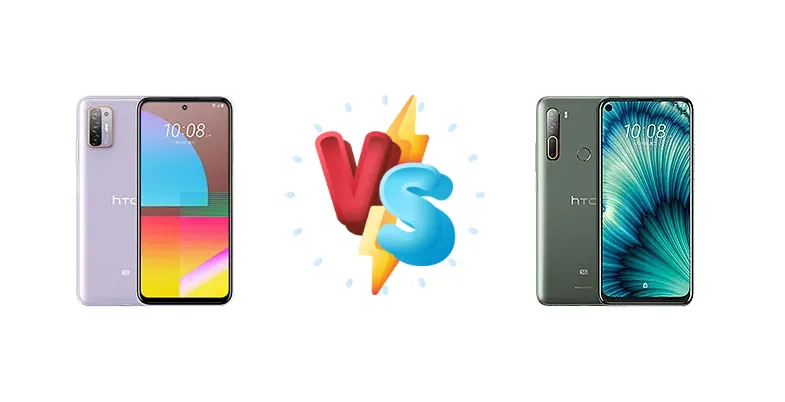
Both the HTC Desire 21 Pro 5G and the HTC U20 5G represent HTC's attempts to remain competitive in the mid-range 5G smartphone market. While both offer 5G connectivity and similar pricing, they diverge significantly in their core processing power, stemming from the different Snapdragon chipsets employed. This comparison will dissect those differences, helping you determine which device best suits your needs.
🏆 Quick Verdict
For the average user prioritizing consistent performance and a smoother experience, the HTC U20 5G emerges as the better choice. Its Snapdragon 765G chipset, built on a smaller 7nm process, delivers a noticeable performance uplift over the Desire 21 Pro 5G’s Snapdragon 690, making it more capable for demanding tasks and future-proofing.
| Network |
|---|
| 2G bands | GSM 850 / 900 / 1800 / 1900 | GSM 850 / 900 / 1800 / 1900 |
| 3G bands | HSDPA 850 / 900 / 1700(AWS) / 1900 / 2100 | HSDPA 850 / 900 / 1900 / 2100 |
| 4G bands | 1, 3, 5, 7, 8, 20, 28, 38, 39, 40, 41 | 1, 2, 3, 5, 7, 8, 20, 28, 38, 39, 40, 41 |
| 5G bands | 1, 3, 5, 7, 28, 41, 78 SA/NSA | 1, 3, 28, 41, 78 SA/NSA |
| Speed | HSPA, LTE, 5G | HSPA, LTE, 5G 2.56/0.9 Gbps |
| Technology | GSM / HSPA / LTE / 5G | GSM / HSPA / LTE / 5G |
| Launch |
|---|
| Announced | 2021, January 13 | 2020, June 16. Released 2020, October 01 |
| Status | Available. Released 2021, January 21 | Discontinued |
| Body |
|---|
| Dimensions | 167.1 x 78.1 x 9.4 mm (6.58 x 3.07 x 0.37 in) | 171.2 x 78.1 x 9.4 mm (6.74 x 3.07 x 0.37 in) |
| SIM | Nano-SIM + Nano-SIM | Nano-SIM + Nano-SIM |
| Weight | 205 g (7.23 oz) | 215.5 g (7.62 oz) |
| Display |
|---|
| Protection | - | Asahi Dragontrail Glass |
| Resolution | 1080 x 2400 pixels, 20:9 ratio (~393 ppi density) | 1080 x 2400 pixels, 20:9 ratio (~387 ppi density) |
| Size | 6.7 inches, 108.4 cm2 (~83.0% screen-to-body ratio) | 6.8 inches, 111.6 cm2 (~83.5% screen-to-body ratio) |
| Type | IPS LCD, HDR10, 90Hz | IPS LCD |
| Platform |
|---|
| CPU | Octa-core (2x2.0 GHz Kryo 560 Gold & 6x1.7 GHz Kryo 560 Silver) | Octa-core (1x2.4 GHz Kryo 475 Prime & 1x2.2 GHz Kryo 475 Gold & 6x1.8 GHz Kryo 475 Silver) |
| Chipset | Qualcomm SM6350 Snapdragon 690 5G (8 nm) | Qualcomm SM7250 Snapdragon 765G 5G (7 nm) |
| GPU | Adreno 619 | Adreno 620 |
| OS | Android 10 | Android 10 |
| Memory |
|---|
| Card slot | microSDXC (uses shared SIM slot) | microSDXC |
| Internal | 128GB 8GB RAM | 256GB 6GB RAM, 256GB 8GB RAM |
| Main Camera |
|---|
| Features | Dual-LED flash, HDR, panorama | Dual-LED flash, HDR, panorama |
| Quad | 48 MP, f/1.8, 26mm (wide), 1/2.0", 0.8µm, PDAF
8 MP, f/2.2, 118˚ (ultrawide)
2 MP (macro)
Auxiliary lens | 48 MP, f/1.8, 26mm (wide), 1/2.0", 0.8µm, PDAF
8 MP, f/2.2, 118˚ (ultrawide), 1/4.0", 1.12µm
2 MP (macro)
Auxiliary lens |
| Single | - | 8 MP, AF |
| Video | 4K@30fps, 1080p@30fps, gyro-EIS | 4K@30fps, 1080p@30fps, gyro-EIS |
| Selfie camera |
|---|
| Features | HDR | HDR |
| Single | 16 MP, (wide) | 32 MP, f/2.0, (wide), 1/2.8", 0.8µm |
| Video | 1080p@30fps | 1080p@30fps |
| Sound |
|---|
| 3.5mm jack | No | No |
| 35mm jack | No | No |
| Loudspeaker | Yes | Yes |
| Comms |
|---|
| Bluetooth | 5.1, A2DP, LE | 5.0, A2DP, LE |
| NFC | Yes | Yes |
| Positioning | GPS, GLONASS, GALILEO, BDS | GPS, GLONASS, GALILEO, BDS |
| Radio | No | No |
| USB | USB Type-C 2.0, OTG | USB Type-C 2.0 |
| WLAN | Wi-Fi 802.11 a/b/g/n/ac, dual-band, Wi-Fi Direct | Wi-Fi 802.11 a/b/g/n/ac, dual-band, Wi-Fi Direct |
| Features |
|---|
| Sensors | Fingerprint (side-mounted), accelerometer, gyro, proximity, compass | Fingerprint (rear-mounted), accelerometer, gyro, proximity, compass, SAR |
| Battery |
|---|
| Charging | 18W wired, QC4 | 18W wired, QC4 |
| Stand-by | - | Up to 200 h |
| Talk time | - | Up to 8 h 20 min |
| Type | Li-Po 5000 mAh | Li-Po 5000 mAh |
| Misc |
|---|
| Colors | Blue, Purple | Green, White |
| Price | About 350 EUR | - |
| SAR EU | - | 0.44 W/kg (head) |
HTC Desire 21 Pro 5G
- Potentially lower price point
- 5G connectivity
- QC4 fast charging
- Less powerful Snapdragon 690 chipset
- 8nm process less efficient
- Likely slower app loading and multitasking
HTC U20 5G
- More powerful Snapdragon 765G chipset
- 7nm process for better efficiency
- Smoother performance and multitasking
- Potentially better camera image processing
- May be slightly more expensive
- Similar charging speed to Desire 21 Pro 5G
Display Comparison
Unfortunately, detailed display specifications are unavailable. However, given the market positioning, both likely utilize LCD panels. The key difference lies in the processing power driving them. The U20 5G’s more capable chipset can potentially handle more complex image processing for improved color accuracy and dynamic range, even on a similar panel. Bezels are likely comparable, reflecting the mid-range nature of both devices.
Camera Comparison
Without detailed camera specs, it’s difficult to make a definitive judgment. However, the U20 5G’s more powerful processor allows for more sophisticated image signal processing (ISP) capabilities. This means better noise reduction, dynamic range, and overall image quality, even if both phones share similar sensor resolutions. The 765G’s ISP can also handle more complex computational photography features. The presence of OIS (Optical Image Stabilization) would be a significant advantage, but this information is unavailable for either device.
Performance
The core distinction between these phones is the chipset. The HTC U20 5G boasts the Qualcomm Snapdragon 765G (7nm), featuring a Kryo 475 Prime core clocked at 2.4GHz, a Kryo 475 Gold core at 2.2GHz, and six Kryo 475 Silver cores at 1.8GHz. This contrasts with the Desire 21 Pro 5G’s Snapdragon 690 (8nm), with its 2x2.0 GHz Kryo 560 Gold and 6x1.7 GHz Kryo 560 Silver configuration. The 7nm process of the 765G is more efficient, leading to better thermal management and sustained performance. The higher clock speeds and the inclusion of a 'Prime' core in the 765G translate to faster app launches, smoother multitasking, and improved gaming performance. While both support 5G, the 765G’s more robust modem offers potentially faster and more stable connections.
Battery Life
Both phones feature 18W wired charging with Quick Charge 4 (QC4) support. Battery capacity is not specified, but given the similar form factors and target market, they are likely in the 4000-5000 mAh range. The Snapdragon 765G’s 7nm process offers better power efficiency, meaning the U20 5G is likely to achieve slightly longer battery life despite potentially similar capacity. The 18W charging speed will result in approximately 1.5-2 hours for a full charge on both devices.
Buying Guide
Buy the HTC Desire 21 Pro 5G if you need a functional 5G phone for basic tasks like calling, texting, and light social media use, and are on a very tight budget. Buy the HTC U20 5G if you prefer a more responsive user experience, enjoy occasional mobile gaming, and value the benefits of a more powerful processor for multitasking and app loading speeds.
Frequently Asked Questions
❓ Will the HTC U20 5G handle demanding games like PUBG Mobile smoothly?
The Snapdragon 765G in the U20 5G is capable of running PUBG Mobile at medium to high settings with reasonable frame rates. While it won't deliver a flagship-level gaming experience, it provides a significantly smoother experience than the Snapdragon 690 in the Desire 21 Pro 5G, which may struggle with consistent performance during intense gameplay.
❓ Does the Snapdragon 690 in the Desire 21 Pro 5G suffer from significant throttling under sustained load?
The Snapdragon 690, being built on an 8nm process, is more prone to thermal throttling than the 7nm Snapdragon 765G. This means that during prolonged gaming sessions or heavy multitasking, the Desire 21 Pro 5G’s performance may decrease as the processor heats up, leading to noticeable lag and slowdowns.
❓ Is the 5G connectivity on both phones compatible with all 5G networks?
Both phones support 5G, but compatibility can vary depending on your carrier and region. The Snapdragon 765G generally offers broader 5G band support than the 690, potentially providing better connectivity in more locations. Check with your carrier to ensure compatibility before purchasing.