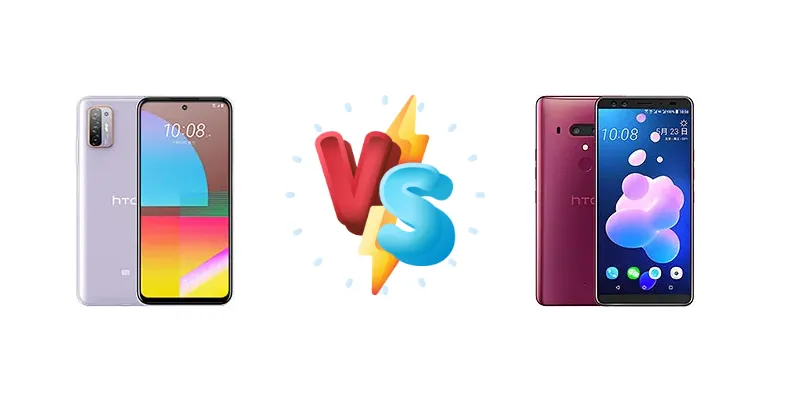
The HTC Desire 21 Pro 5G and the HTC U12+ represent different eras of HTC’s smartphone strategy. The U12+ was a flagship aiming for the top tier, while the Desire 21 Pro 5G targets the mid-range with 5G connectivity. This comparison dissects their key differences to determine which device best suits your needs, especially considering the U12+'s age and potential price drops.
🏆 Quick Verdict
For most users, the HTC U12+ offers a superior experience thanks to its significantly more powerful Snapdragon 845 chipset and excellent display. However, the Desire 21 Pro 5G is the clear choice for those prioritizing 5G connectivity on a budget, accepting a performance trade-off.
| Network |
|---|
| 2G bands | GSM 850 / 900 / 1800 / 1900 | GSM 850 / 900 / 1800 / 1900 - SIM 1 & SIM 2 (dual-SIM model only) |
| 3G bands | HSDPA 850 / 900 / 1700(AWS) / 1900 / 2100 | HSDPA 850 / 900 / 1700(AWS) / 1900 / 2100 |
| 4G bands | 1, 3, 5, 7, 8, 20, 28, 38, 39, 40, 41 | 1, 2, 3, 4, 5, 7, 8, 12, 13, 17, 20, 28, 32, 38, 39, 49, 41, 66 |
| 5G bands | 1, 3, 5, 7, 28, 41, 78 SA/NSA | - |
| Speed | HSPA, LTE, 5G | HSPA 42.2/5.76 Mbps, LTE-A (5CA) Cat18 1200/150 Mbps |
| Technology | GSM / HSPA / LTE / 5G | GSM / HSPA / LTE |
| Launch |
|---|
| Announced | 2021, January 13 | 2018, May 23 |
| Status | Available. Released 2021, January 21 | Available. Released 2018, June 29 |
| Body |
|---|
| Build | - | Glass front (Gorilla Glass 3), glass back, aluminum frame |
| Dimensions | 167.1 x 78.1 x 9.4 mm (6.58 x 3.07 x 0.37 in) | 156.6 x 73.9 x 8.7 mm (6.17 x 2.91 x 0.34 in) |
| SIM | Nano-SIM + Nano-SIM | Single SIM (Nano-SIM) or Hybrid Dual SIM (Nano-SIM, dual stand-by) |
| Weight | 205 g (7.23 oz) | 188 g (6.63 oz) |
| | - | IP68 dust/water resistant (up to 1.5m for 30 mins)
Pressure-sensitive buttons |
| Display |
|---|
| Protection | - | Corning Gorilla Glass 3 |
| Resolution | 1080 x 2400 pixels, 20:9 ratio (~393 ppi density) | 1440 x 2880 pixels, 18:9 ratio (~537 ppi density) |
| Size | 6.7 inches, 108.4 cm2 (~83.0% screen-to-body ratio) | 6.0 inches, 92.9 cm2 (~80.3% screen-to-body ratio) |
| Type | IPS LCD, HDR10, 90Hz | Super LCD6, HDR10 |
| Platform |
|---|
| CPU | Octa-core (2x2.0 GHz Kryo 560 Gold & 6x1.7 GHz Kryo 560 Silver) | Octa-core (4x2.8 GHz Kryo 385 Gold & 4x1.7 GHz Kryo 385 Silver) |
| Chipset | Qualcomm SM6350 Snapdragon 690 5G (8 nm) | Qualcomm SDM845 Snapdragon 845 (10 nm) |
| GPU | Adreno 619 | Adreno 630 |
| OS | Android 10 | Android 8.0 (Oreo), upgradable to Android 9.0 (Pie), Sense UI |
| Memory |
|---|
| Card slot | microSDXC (uses shared SIM slot) | microSDXC (uses shared SIM slot) |
| Internal | 128GB 8GB RAM | 64GB 6GB RAM, 128GB 6GB RAM |
| Main Camera |
|---|
| Dual | - | 12 MP, f/1.8, 1/2.55", 1.4µm, dual pixel PDAF, Laser AF, OIS
16 MP (12 MP effective), f/2.6, 1/3.1", 1.0µm, 2x optical zoom, AF |
| Features | Dual-LED flash, HDR, panorama | Dual-LED dual-tone flash, HDR |
| Quad | 48 MP, f/1.8, 26mm (wide), 1/2.0", 0.8µm, PDAF
8 MP, f/2.2, 118˚ (ultrawide)
2 MP (macro)
Auxiliary lens | - |
| Video | 4K@30fps, 1080p@30fps, gyro-EIS | 4K@60fps, 1080p@60/240fps, 1080p@30fps (gyro-EIS), HDR, 24-bit/96kHz stereo sound rec. |
| Selfie camera |
|---|
| Dual | - | 8 MP, f/2.0, 1/4", 1.12µm
8 MP, f/2.0, 1/4", 1.12µm |
| Features | HDR | HDR, panorama |
| Single | 16 MP, (wide) | - |
| Video | 1080p@30fps | 1080p@30fps |
| Sound |
|---|
| 3.5mm jack | No | No |
| 35mm jack | No | - |
| Loudspeaker | Yes | Yes, with stereo speakers |
| | - | 32-bit/384kHz audio
|
| Comms |
|---|
| Bluetooth | 5.1, A2DP, LE | 5.0, A2DP, aptX HD, LE |
| NFC | Yes | Yes |
| Positioning | GPS, GLONASS, GALILEO, BDS | GPS, GLONASS, GALILEO, BDS |
| Radio | No | No |
| USB | USB Type-C 2.0, OTG | USB Type-C 3.1 |
| WLAN | Wi-Fi 802.11 a/b/g/n/ac, dual-band, Wi-Fi Direct | Wi-Fi 802.11 a/b/g/n/ac, dual-band, Wi-Fi Direct, DLNA |
| Features |
|---|
| Sensors | Fingerprint (side-mounted), accelerometer, gyro, proximity, compass | Fingerprint (rear-mounted), accelerometer, gyro, proximity, compass |
| Battery |
|---|
| Charging | 18W wired, QC4 | 18W wired, QC3, 50% in 35 min (advertised) |
| Talk time | - | Up to 24 h (3G) |
| Type | Li-Po 5000 mAh | Li-Ion 3500 mAh, non-removable |
| Misc |
|---|
| Colors | Blue, Purple | Translucent Blue, Ceramic Black, Flame Red |
| Models | - | U12, 2Q55100 |
| Price | About 350 EUR | About 450 EUR |
| Tests |
|---|
| Audio quality | - |
Noise -93.7dB / Crosstalk -52.7dB |
| Battery life | - |
Endurance rating 64h
|
| Camera | - |
Photo / Video |
| Display | - |
Contrast ratio: 1818:1 (nominal), 3.085 (sunlight) |
| Loudspeaker | - |
Voice 77dB / Noise 73dB / Ring 99dB
|
| Performance | - |
AnTuTu: 263696 (v7)
GeekBench: 9001 (v4.4)
GFXBench: 20fps (ES 3.1 onscreen) |
HTC Desire 21 Pro 5G
- Affordable 5G connectivity
- Modern chipset architecture (Snapdragon 690)
- QC4 fast charging support
- Significantly lower performance than the U12+
- Display specifications are unknown and likely inferior
- Camera performance likely lags behind the U12+
HTC U12+
- Powerful Snapdragon 845 processor
- Excellent display contrast ratio
- Potentially superior camera system
- Lacks 5G connectivity
- Older chipset and software support
- Battery may show age-related degradation
Display Comparison
The HTC U12+ boasts a superior display experience, though specific details beyond contrast ratios (1818:1 nominal, 3.085 in sunlight) are missing. These ratios suggest excellent visibility even in bright conditions. The Desire 21 Pro 5G’s display specifications are not provided, implying a standard LCD panel likely lacking the U12+'s contrast and potentially color accuracy. The U12+'s higher contrast ratio translates to richer blacks and a more vibrant image, benefiting media consumption and gaming.
Camera Comparison
Detailed camera specifications are limited for both devices. However, the U12+ likely benefits from a more sophisticated image signal processor (ISP) within the Snapdragon 845, enabling better dynamic range and noise reduction. The Desire 21 Pro 5G’s camera performance will be adequate for casual photography, but it won’t match the U12+'s potential for detail and low-light performance. Without sensor size information, it’s difficult to make a definitive statement, but the U12+’s flagship status suggests a higher-quality camera system overall.
Performance
The core difference lies in the chipsets. The HTC U12+ utilizes the Snapdragon 845 (10nm), featuring four Kryo 385 Gold cores clocked at 2.8 GHz and four Kryo 385 Silver cores at 1.7 GHz. This is a significant leap over the Desire 21 Pro 5G’s Snapdragon 690 5G (8nm) with its 2x2.0 GHz Kryo 560 Gold and 6x1.7 GHz Kryo 560 Silver configuration. The 845’s higher clock speeds and more powerful architecture deliver substantially better CPU and GPU performance. While the 690 offers 5G, it’s a mid-range chip designed for efficiency, not raw speed. The 10nm process of the 845 also contributes to better thermal management under sustained load, reducing throttling compared to the 8nm 690.
Battery Life
The HTC U12+ has an endurance rating of 64 hours, indicating solid battery life. Both phones support 18W Quick Charge, but the U12+ advertises 50% charge in 35 minutes with QC3, while the Desire 21 Pro 5G uses QC4. While both offer similar charging speeds, the U12+'s larger battery capacity (specific mAh not provided) combined with the Snapdragon 845’s efficiency likely translates to longer real-world usage despite the older chipset. The Desire 21 Pro 5G’s battery life will be sufficient for a day of moderate use, but heavy users may need to top up before the end of the day.
Buying Guide
Buy the HTC Desire 21 Pro 5G if you need affordable 5G access and are willing to compromise on raw processing power. It’s ideal for everyday tasks, streaming, and light gaming. Buy the HTC U12+ if you prioritize a smoother, faster experience for demanding applications, gaming, and photography, and can find it at a compelling price despite its age and lack of 5G.
Frequently Asked Questions
❓ Is the Snapdragon 690 in the Desire 21 Pro 5G capable of running demanding games like PUBG or Call of Duty?
While the Snapdragon 690 can run these games, you'll likely need to lower the graphics settings to achieve a smooth frame rate. The Snapdragon 845 in the U12+ will provide a significantly better gaming experience with higher settings and more consistent performance.
❓ How does the lack of 5G on the U12+ affect its usability in 2024?
If you live in an area with widespread 5G coverage and frequently use data-intensive applications, the lack of 5G on the U12+ will be noticeable. However, for most users, the benefits of 5G may not outweigh the U12+'s superior performance and display quality, especially if 5G coverage is limited.
❓ Does the HTC U12+ still receive software updates?
Software update support for the HTC U12+ is likely limited or non-existent at this point. This means you may miss out on the latest security patches and features. The Desire 21 Pro 5G, being newer, may have a longer support lifespan, but HTC's software update track record is generally not as strong as other manufacturers.