
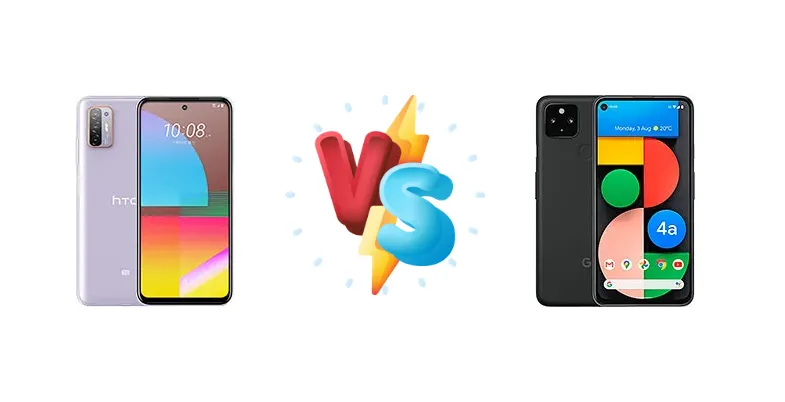
HTC Desire 21 Pro 5G vs Google Pixel 4a 5G: Which 5G Phone Delivers More?
| Phones Images | |||||
|---|---|---|---|---|---|
|
🏆 Quick Verdict
For the average user, the Google Pixel 4a 5G is the superior choice. While both phones offer 5G, the Pixel 4a 5G’s more powerful Snapdragon 765G chipset, coupled with Google’s software optimizations, delivers a noticeably smoother and more responsive experience. The camera also significantly outperforms the Desire 21 Pro 5G.
| PHONES | ||
|---|---|---|
| Phone Names | HTC Desire 21 Pro 5G | Google Pixel 4a 5G |
| Network | ||
|---|---|---|
| 2G bands | GSM 850 / 900 / 1800 / 1900 | GSM 850 / 900 / 1800 / 1900 |
| 3G bands | HSDPA 850 / 900 / 1700(AWS) / 1900 / 2100 | HSDPA 850 / 900 / 1700(AWS) / 1900 / 2100 |
| 4G bands | 1, 3, 5, 7, 8, 20, 28, 38, 39, 40, 41 | 1, 2, 3, 4, 5, 7, 8, 12, 13, 14, 17, 18, 19, 20, 25, 26, 28, 29, 30, 32, 38, 39, 40, 41, 42, 46, 48, 66, 71 |
| 5G bands | 1, 3, 5, 7, 28, 41, 78 SA/NSA | 1, 2, 3, 5, 7, 8, 12, 28, 41, 66, 71, 77, 78 Sub6, mmWave (market dependant) |
| Speed | HSPA, LTE, 5G | HSPA, LTE, 5G |
| Technology | GSM / HSPA / LTE / 5G | GSM / HSPA / LTE / 5G |
| Launch | ||
|---|---|---|
| Announced | 2021, January 13 | 2020, September 30 |
| Status | Available. Released 2021, January 21 | Available. Released 2020, November 05 |
| Body | ||
|---|---|---|
| Build | - | Glass front (Gorilla Glass 3), plastic back, plastic frame |
| Dimensions | 167.1 x 78.1 x 9.4 mm (6.58 x 3.07 x 0.37 in) | 153.9 x 74 x 8.2 mm (Sub-6) or 8.5 mm (Sub-6 and mmWave) |
| SIM | Nano-SIM + Nano-SIM | Nano-SIM + eSIM |
| Weight | 205 g (7.23 oz) | 168 g (5G Sub-6); 171 g ( 5G Sub-6 and mmWave) (5.93 oz) |
| Display | ||
|---|---|---|
| Protection | - | Corning Gorilla Glass 3 |
| Resolution | 1080 x 2400 pixels, 20:9 ratio (~393 ppi density) | 1080 x 2340 pixels, 19.5:9 ratio (~413 ppi density) |
| Size | 6.7 inches, 108.4 cm2 (~83.0% screen-to-body ratio) | 6.2 inches, 95.7 cm2 (~84.1% screen-to-body ratio) |
| Type | IPS LCD, HDR10, 90Hz | OLED, HDR |
| - | Always-on display | |
| Platform | ||
|---|---|---|
| CPU | Octa-core (2x2.0 GHz Kryo 560 Gold & 6x1.7 GHz Kryo 560 Silver) | Octa-core (1x2.4 GHz Kryo 475 Prime & 1x2.2 GHz Kryo 475 Gold & 6x1.8 GHz Kryo 475 Silver) |
| Chipset | Qualcomm SM6350 Snapdragon 690 5G (8 nm) | Qualcomm SM7250 Snapdragon 765G 5G (7 nm) |
| GPU | Adreno 619 | Adreno 620 |
| OS | Android 10 | Android 11, upgradable to Android 14 |
| Memory | ||
|---|---|---|
| Card slot | microSDXC (uses shared SIM slot) | No |
| Internal | 128GB 8GB RAM | 128GB 6GB RAM |
| - | UFS 2.1 | |
| Main Camera | ||
|---|---|---|
| Dual | - | 12.2 MP, f/1.7, 27mm (wide), 1/2.55", 1.4µm, dual pixel PDAF, OIS 16 MP, f/2.2, 107˚ (ultrawide), 1.0µm |
| Features | Dual-LED flash, HDR, panorama | LED flash, Pixel Shift, Auto-HDR, panorama |
| Quad | 48 MP, f/1.8, 26mm (wide), 1/2.0", 0.8µm, PDAF 8 MP, f/2.2, 118˚ (ultrawide) 2 MP (macro) Auxiliary lens | - |
| Video | 4K@30fps, 1080p@30fps, gyro-EIS | 4K@30/60fps, 1080p@30/60/120/240fps; gyro-EIS |
| Selfie camera | ||
|---|---|---|
| Features | HDR | HDR |
| Single | 16 MP, (wide) | 8 MP, f/2.0, 24mm (wide), 1/4.0", 1.12µm |
| Video | 1080p@30fps | 1080p@30fps |
| Sound | ||
|---|---|---|
| 3.5mm jack | No | Yes |
| 35mm jack | No | Yes |
| Loudspeaker | Yes | Yes, with stereo speakers |
| Comms | ||
|---|---|---|
| Bluetooth | 5.1, A2DP, LE | 5.0, A2DP, LE, aptX HD |
| NFC | Yes | Yes |
| Positioning | GPS, GLONASS, GALILEO, BDS | GPS, GLONASS, GALILEO, QZSS, BDS |
| Radio | No | No |
| USB | USB Type-C 2.0, OTG | USB Type-C 3.1 |
| WLAN | Wi-Fi 802.11 a/b/g/n/ac, dual-band, Wi-Fi Direct | Wi-Fi 802.11 a/b/g/n/ac, dual-band, Wi-Fi Direct |
| Features | ||
|---|---|---|
| Sensors | Fingerprint (side-mounted), accelerometer, gyro, proximity, compass | Fingerprint (rear-mounted), accelerometer, gyro, proximity, compass, barometer |
| Battery | ||
|---|---|---|
| Charging | 18W wired, QC4 | 18W wired, PD2.0 |
| Type | Li-Po 5000 mAh | Li-Po 3885 mAh |
| Misc | ||
|---|---|---|
| Colors | Blue, Purple | Just Black, Clearly White |
| Models | - | GD1YQ, G025I, G025E, G025H, G6QU3 |
| Price | About 350 EUR | About 140 EUR |
HTC Desire 21 Pro 5G
- Potentially larger battery capacity
- Wider availability in some regions
- Supports Quick Charge 4.0
- Less powerful Snapdragon 690 chipset
- Inferior camera performance
- Less frequent software updates
Google Pixel 4a 5G
- More powerful Snapdragon 765G chipset
- Superior camera quality and software
- Guaranteed software updates from Google
- Potentially smaller battery capacity
- May be less readily available in some markets
- Supports Power Delivery 2.0 only
Display Comparison
Neither HTC nor Google provided detailed display specs beyond resolution. However, the Desire 21 Pro 5G’s larger size suggests a lower pixel density compared to the Pixel 4a 5G’s 6.2-inch display. Both likely utilize LCD panels, common in this price bracket. The absence of high refresh rates on either device indicates a focus on battery life over visual fluidity. The Pixel 4a 5G’s smaller size may offer a slightly more comfortable one-handed experience.
Camera Comparison
Google’s computational photography prowess gives the Pixel 4a 5G a substantial advantage. While both phones likely feature similar sensor resolutions for their main cameras (details not provided), the Pixel’s image processing algorithms excel in dynamic range, noise reduction, and detail preservation. The Pixel 4a 5G’s software features like Night Sight and Portrait Mode are industry-leading. The Desire 21 Pro 5G likely relies more on hardware, and without Google’s software magic, will struggle to compete in challenging lighting conditions. Ignoring the typical 2MP macro/depth sensors found on both, the main sensor and image processing are the key differentiators.
Performance
The core difference lies in the chipsets. The Google Pixel 4a 5G’s Snapdragon 765G, fabricated on a 7nm process, demonstrably outperforms the HTC Desire 21 Pro 5G’s Snapdragon 690 (8nm). The 765G’s Kryo 475 Prime core, clocked at 2.4 GHz, provides a significant single-core performance boost, crucial for app launch speeds and general responsiveness. The 765G also features a more capable Adreno 620 GPU, translating to better gaming performance. While both support 5G, the 765G’s modem is generally considered more efficient. The Desire 21 Pro 5G’s 6GB of RAM is comparable to the Pixel 4a 5G, but the chipset bottleneck limits its potential.
Battery Life
Both devices feature 18W wired charging, supporting QC4 (HTC) and PD2.0 (Google). While battery capacity isn’t specified, the larger size of the Desire 21 Pro 5G *suggests* a potentially larger battery. However, the Snapdragon 765G’s 7nm process is more power-efficient than the Snapdragon 690’s 8nm node. This efficiency, combined with Google’s software optimizations, could result in comparable or even better real-world battery life on the Pixel 4a 5G despite a potentially smaller battery capacity. The charging speeds are identical, so 0-100% times will likely be similar.
Buying Guide
Buy the HTC Desire 21 Pro 5G if you prioritize a larger screen and are heavily invested in the HTC ecosystem, or if it's significantly cheaper in your region. Buy the Google Pixel 4a 5G if you value a superior camera experience, smoother performance, timely software updates, and Google’s clean Android interface. The Pixel 4a 5G is the better all-rounder for most users.